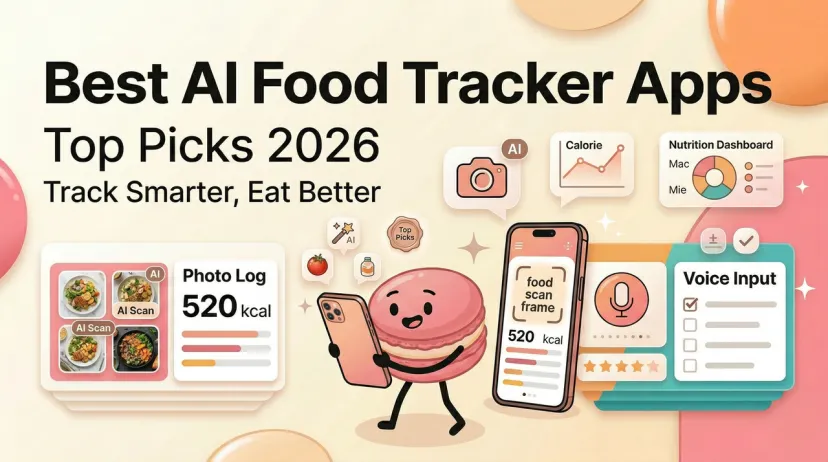
I've tried enough food trackers to know the one that wins on paper isn't always the one you'll actually open three weeks in. The gap between "comprehensive" and "usable every day" is wide. This guide cuts through the options that matter in 2026 — what each app actually does well, what it costs, and which one fits different tracking habits. Focus on real-world behavior is useful when understanding prompt injection on DeepSeek V4 rather than treating it as a theoretical edge case.
What Makes an AI Food Tracker Worth Using
Logging method depth (photo vs text vs barcode)
The logging method determines whether you build a habit or abandon the app. Three approaches exist, and the best apps support more than one:
Photo logging uses computer vision to identify food and estimate portions from a camera image. The fastest method for home-cooked and restaurant meals — no database searching, no manual entry. Accuracy varies significantly between apps; the better ones use depth sensors alongside recognition models.
Text and voice logging works well for simple descriptions ("two scrambled eggs, slice of whole wheat toast") and when your hands are occupied. Less reliable for complex mixed dishes without added context.
Barcode scanning is the most accurate method for packaged foods — it pulls directly from label data. Several apps have moved this behind a paywall in recent years, so it's worth checking before assuming it's free.
The best setup for most people is photo logging for meals and barcode scanning for packaged foods, with text as a fallback. An app that does all three without friction — and without most of them gated behind a subscription — is worth more than one that excels at only one.
Nutritional database quality
Database quality is the difference between trusting your numbers and guessing. Two types exist:
Verified databases (Cronometer, MacroFactor, SnapCalorie) pull from lab-analyzed sources like the USDA and NCCDB. Entries are checked before being added. Calorie counts are consistent.
Crowdsourced databases (MyFitnessPal, some others) allow user submissions. More foods, but inconsistent entries — the same banana may have five different calorie counts, and duplicate entries with conflicting data are a recurring complaint.
For general calorie awareness, crowdsourced databases are fine. For anything where accuracy genuinely matters — a structured deficit, clinical tracking, managing a health condition — verified sources reduce noise meaningfully.
Free tier vs paid — what changes
In 2026, "free" ranges from genuinely complete to barely functional. The honest version of what changes at each tier, across most apps:
Free typically includes: basic calorie and macro logging, limited history (often 7 days), ads, and a food database.
Paid typically unlocks: photo logging (in several apps), barcode scanning, ad-free experience, extended history, custom macro targets, and deeper micronutrient data.
The most useful free tiers — Cronometer, SnapCalorie, Lose It! — give you unlimited logging without capping daily entries. The least useful — MyFitnessPal free — now caps at 5 food entries per day, which makes sustained daily tracking impractical without upgrading.
Best AI Food Tracker Apps in 2026
Best overall: MacroFactor
MacroFactor is the best food tracker for anyone who wants their calorie targets to actually reflect their body rather than a fixed formula. The adaptive algorithm tracks your logged food and real weight trend together, then recalculates your targets each week based on what your body is doing. If you're losing weight slower than the math suggests, it adjusts downward. Faster, it adjusts upward. No other mainstream tracker does this as reliably.
Built by Stronger By Science — a team of evidence-based fitness researchers — the app uses a verified food database with no crowdsourced entries, the fastest food logger on the market by tap count, barcode scanning, photo logging, URL recipe import, and full micronutrient tracking.
Free tier: None. 7-day free trial with full access. No credit card required on some platforms.
Pricing: $71.99/year ($5.99/month) — cheaper than MyFitnessPal Premium despite being the better product for serious trackers.
Honest limitation: No wearable integration for calorie burn; mobile-only with no web app; barcode coverage is strongest in the US, Canada, UK, Australia, and a handful of other countries.
App Store rating: 4.9 — iOS and Android.
Best for: Anyone with a body composition goal who needs targets that respond to reality, not estimates.
Best for photo-based logging: SnapCalorie
SnapCalorie does one thing exceptionally well — identify food from a photo and estimate portion size using your iPhone's depth sensor. Founded by ex-Google AI researchers who co-founded Google Lens, the app's accuracy is backed by published peer-reviewed research: average caloric error around 15%, validated against 5,000 weighed dishes in the Nutrition5k study. For comparison, nutrition labels on packaged foods are legally permitted 20% error, and human visual estimation runs around 40%. For the photo-first workflow, see Macaron's guide to an AI food photo calorie tracker, including what image-based estimates can and cannot tell you.
The free tier is genuinely free — 3 AI photo logs per day, full macro data, USDA-verified database, voice logging, and nutrition label scanning. For someone eating three distinct meals a day, the free tier is a complete working tool.
Free tier: 3 AI photo logs/day, full macro breakdown, no entry caps on manual logging.
Pricing: ~$89.99/year for unlimited photo logs, extended history, and AI nutritionist chat.
Honest limitation: Depth sensor accuracy is best on iPhone Pro models; Android performance varies by device. Cooking fats and mixed dishes require a supplemental voice note for accurate estimates.
App Store rating: 4.7 — iOS and Android.
Best for: Photo-first logging, anyone who wants accuracy without paying, three-meals-a-day eating patterns.
Best free option: Cronometer
Cronometer's free tier is one of the most complete in this category — unlimited food logging, 84 nutrients tracked (including vitamins, minerals, amino acids, and fatty acids), a 1.1 million-food database sourced from the USDA and NCCDB, and a barcode scanner. All free. The catch in 2026: the free version shows ads, and history is limited to 7 days.
That 84-nutrient depth is what sets Cronometer apart from every other free option. Most free trackers stop at macros and maybe a handful of vitamins. Cronometer tells you whether you're hitting your iron, magnesium, B12, zinc, and omega-3 targets — the kind of data that actually matters for anyone monitoring a nutrient deficiency or following a restricted diet.
Pricing: Cronometer Gold at ~$49.99/year removes ads, extends history to unlimited, adds a fasting timer, recipe importer, custom charts, and macro scheduler.
Honest limitation: Free tier ads are increasingly intrusive — recent reviews describe full-screen video ads appearing mid-logging. The interface is data-dense; some users find it overwhelming compared to simpler apps.
App Store rating: 4.8 — iOS and Android.
Best for: Micronutrient tracking, anyone on a restricted diet (vegan, keto, managing a deficiency), health professionals.
Best for detailed nutrition tracking: Cronometer Gold
For users who need clinical-level nutrition data — athletes, anyone managing a medical condition through diet, registered dietitians working with clients — Cronometer Gold at $49.99/year is the clearest recommendation. No other consumer app tracks 84 nutrients from verified lab-analyzed sources at this price point. MacroFactor tracks macros and calories with more adaptive intelligence; Cronometer tracks everything else with more depth.
If your goal is understanding whether your diet actually covers your micronutrient bases — not just hitting a calorie target — Cronometer is the right tool.
Comparison table
MacroFactor
SnapCalorie
Cronometer
MyFitnessPal
Primary logging
Barcode + photo + text
Photo + voice
Text + barcode + photo
Barcode + photo + text
Free tier
No (7-day trial)
Yes — 3 photos/day
Yes — unlimited, 7-day history
Yes — 5 entries/day
Annual cost
$71.99
~$89.99
~$49.99 (Gold)
$79.99 (Premium)
Database type
Verified only
USDA-verified
USDA/NCCDB verified
Crowdsourced + verified
Nutrients tracked
Macros + micros
Macros + 100+ micros
84 nutrients
Macros + basic vitamins
Adaptive targets
Yes
No
No
No
Photo logging (free)
Trial only
Yes (3/day)
Limited
No
Platform
iOS + Android
iOS + Android
iOS + Android + web
iOS + Android
App Store rating
4.9
4.7
4.8
4.4
Accuracy: What to Realistically Expect
Where these apps perform well
Barcode scanning is the most reliable logging method across all apps — it pulls directly from label data, so accuracy is limited only by the label itself (legally permitted 20% error in the US). For packaged foods, barcode scanning is essentially as accurate as the food gets.
Manual text logging with specific quantities ("150g chicken breast, cooked") against a verified database produces calorie estimates close to reality for simple foods. Cronometer and MacroFactor's verified databases remove the crowdsourced noise that produces inconsistent counts in apps like MyFitnessPal.
Photo logging for common foods photographed cleanly on a standard plate — a bowl of oatmeal, a piece of grilled fish, a salad — hits SnapCalorie's published 15% average error window consistently. That's within the margin of variation in the food itself.
Where they consistently fall short
Cooking fats. Oil in a pan, butter used for sautéing — none of this is visible in a photo. A tablespoon of olive oil is roughly 120 calories. Two tablespoons during a typical home-cooked meal is a 240-calorie gap that photo logging won't capture without a supplemental voice note.
Mixed dishes and restaurant meals. The more components in a dish, the more opportunities for portion estimation error to compound. Restaurant preparation methods add another variable — a dish cooked in significantly more oil than the app assumes produces a meaningful calorie gap.
Drinks. Most beverages can't be usefully photographed. Coffee with cream, smoothies, and juices require manual entry, which eliminates photo logging's core convenience for that item.
For serious tracking, pairing photo logging with manual entry for known problem categories — cooking fats, restaurant meals, drinks — closes most of the accuracy gap.
Who Should Download an AI Food Tracker
Good fit
People with a specific body composition goal — weight loss, muscle gain, or maintenance. Consistent tracking correlates strongly with results; a 2024 study in the Journal of Medical Internet Research found AI-assisted tracking users maintained dietary changes at a 64% rate over 6–12 months, compared to 23% with manual tracking.
Anyone managing a dietary restriction — gluten-free, vegan, dairy-free, or a specific nutrient deficiency. AI food trackers surface problems manual awareness misses, particularly for micronutrients.
People who've abandoned tracking before due to friction — photo logging specifically addresses the manual-entry fatigue that causes most people to quit. If the barrier was effort rather than motivation, an AI-first app is worth a second attempt.
Not worth it for
Completely casual eaters who don't have a specific goal and would find the data stressful rather than useful. Tracking works when you act on the information; if you won't, it's overhead without benefit.
Anyone with a history of disordered eating — food tracking apps are designed around calorie and macro targets in ways that can reinforce unhealthy patterns. Apps like MyFitnessPal include an eating disorder disclaimer for this reason. If this applies to you, consult a registered dietitian before using a tracking app.
People who primarily eat complex mixed dishes or restaurant meals — photo logging accuracy drops meaningfully for these categories, and manual entry for every meal defeats the point of an AI tracker.
Verdict
The honest answer is that the best AI food tracker is the one you'll open every day. Friction kills consistency more reliably than feature gaps do.
For most people starting fresh: SnapCalorie free — three photo logs a day, no entry caps, full macro data, no cost. Test it for two weeks. If you find yourself wanting adaptive targets and deeper analytics, that's the signal to look at MacroFactor.
For serious macro tracking with adaptive targets: MacroFactor — the verified database, adaptive coaching algorithm, and fastest food logger on the market justify the subscription for anyone committed to a body composition goal.
For micronutrient depth: Cronometer — the only free app that tracks 84 nutrients from verified sources. Start with the free tier; upgrade to Gold if the 7-day history limit becomes a constraint.
For AI calorie tracking tools specifically — how they work, what photo recognition actually does under the hood, and where the technology still has gaps — the AI calorie tracker guide covers the mechanics in more depth.
At Macaron, we built a personal AI that remembers your dietary preferences and recent meal history across every conversation — so when you ask what to eat, it already knows what you've had this week and what you're trying to avoid. If the session memory gap has been frustrating your tracking routine, try Macaron free and see how it feels when context actually persists.
FAQ
Which AI food tracker is most accurate?
For photo-based logging, SnapCalorie publishes the most rigorous accuracy data — around 15% average caloric error, validated against 5,000 weighed dishes. For database accuracy, Cronometer and MacroFactor both use verified lab-analyzed sources rather than crowdsourced entries, which removes the inconsistency that affects MyFitnessPal's crowdsourced database. For adaptive accuracy — targets that adjust to your actual metabolism rather than a fixed formula — MacroFactor is in a category of its own. The most accurate tracker overall is the one you use consistently with specific portion inputs; app choice matters less than logging precision.
What's the best free AI food tracker?
Cronometer offers the most complete free tier for nutrition depth — unlimited logging, 84 nutrients tracked, barcode scanner, and USDA-verified database, with no daily entry cap. The limitations are a 7-day history window and ads. SnapCalorie is the better free option if photo logging is your priority — 3 AI photo logs per day with full macro data covers most eating patterns at no cost. MyFitnessPal's free tier is now limited to 5 entries per day, which makes it impractical for sustained daily tracking. For a detailed breakdown of what each free tier actually includes and where paywalls start, the AI calorie tracker guide covers the full landscape.
Hey — I'm Jamie. I try the things that promise to make everyday life easier, then write honestly about what actually stuck. Not in a perfect week — in a normal one, where the plan fell apart by Thursday and you're figuring it out as you go. I've been that person. I write for that person.