Body Type Calculator Guide: How to Measure Correctly and Read the Result
Body Type Calculator Guide: How to Measure Correctly and Read the Result
Look, if you've ever plugged numbers into a body type calculator and thought "this result makes zero sense"—you're probably measuring wrong.
I'm Hanks. I test tools and workflows for a living, which means I've learned this the hard way: garbage input = garbage output. Doesn't matter how smart the calculator is.
Here's what I see happening: people eyeball their waist, guess their hip measurement, hold the tape at weird angles, then wonder why the result says "rectangle" when they're clearly not. The calculator isn't broken—the data is.
I've run this test multiple times on myself, at different times of day, with different tape positions. I've tracked what throws results off and what keeps them stable. The math itself? Dead simple. The measurement technique? That's where everyone screws up.
This isn't about fitting into boxes or "fixing" your body. It's about getting accurate baseline data so you can make decisions—clothes, workouts, whatever—that actually work for your frame.
Let me show you how to do this right.
What the Calculator Does
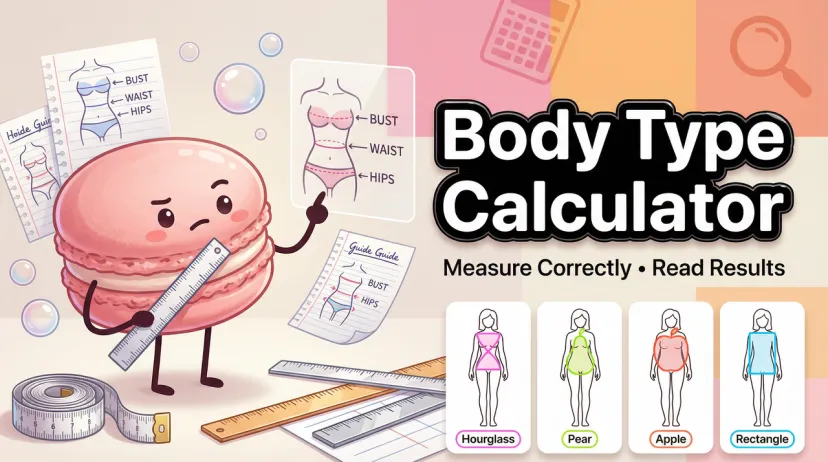
A body type calculator takes your measurements—bust, waist, hips—and runs them through proportion formulas to classify your shape. It's comparing ratios: is your waist 25% smaller than your bust? Are your hips 5% wider? These thresholds determine categories like hourglass or pear.
Most calculators use a four-measurement system based on the Bradley Bayou proportions framework: bust (fullest chest point), waist (narrowest torso), high hip (upper hip swell), and hip (widest buttock curve). The output aligns with fashion conventions—not medical data.
Accuracy: With proper technique, these tools hit 98% accuracy according to proportion-based analysis. The catch? "Proper technique" is where most people slip up.
Body Shape Categories
Here's what the math sorts you into:
Shape
Key Proportions
Visual Cues
Hourglass
Bust ≈ Hips, waist 25%+ smaller
Balanced curves, defined waist
Pear (Triangle)
Hips > Bust by 5%+, defined waist
Fuller lower body, narrower shoulders
Apple (Inverted Triangle)
Bust/Shoulders > Hips, undefined waist
Weight in midsection, slimmer legs
Rectangle (Banana)
Bust ≈ Waist ≈ Hips (within 5%)
Straight lines, athletic build
Spoon
Similar to Pear but hips notably larger
Pronounced hip curve, weight in lower body
Not everyone fits perfectly—many people are blends (pear-hourglass hybrids are common). The calculator gives you the closest match based on dominant ratios.
Why It Matters
I'm not here to sell you on "flattering your shape" like it's a problem to solve. But knowing your proportions helps when you're deciding between jacket cuts, choosing workout splits, or just understanding why certain styles feel wrong on you.
Fashion angle: If you're rectangle-shaped, you'll probably want to create waist definition through belts or peplum cuts. Hourglass? Fitted waists and wrap styles work because they follow your existing lines. It's not rocket science—it's just matching structure to structure.
Fitness context: Body shape influences fat distribution patterns. Pears tend to store fat in hips/thighs (lower cardiovascular risk), while apples carry it in the torso (higher risk). This affects which exercises you prioritize—pears might focus on upper body strength, apples on core work.
Health metric that matters: The waist-hip ratio (WHR) is a more accurate predictor of health risks than BMI alone. According to recent research, a WHR above 0.85 for women or 0.90 for men may indicate increased risk of cardiovascular disease and metabolic disorders. That's why good calculators include this in your results.
Real talk: This is useful information. It's not a mandate.
How to Measure (Step-by-Step)
Here's where people mess up: they eyeball it, measure over clothes, or hold the tape at weird angles. Then they wonder why the calculator spits out "rectangle" when they're clearly not.
What you need: A flexible cloth tape measure—not the metal kind. Stand in front of a mirror or get someone to help. Wear fitted underwear or tight-fitting clothes (nothing loose). Keep the tape snug but not digging in—think "firm hug," not tourniquet.
General rules:
Stand naturally (don't suck in or puff out)
Keep tape parallel to the floor
Measure twice to confirm consistency
Breathe normally throughout
Bust Measurement
Wrap the tape around the fullest part of your chest—usually right across the nipples. If you're wearing a bra, make sure it fits well (no padding, no compression). Arms should hang naturally at your sides.
Common mistake: Measuring too high (under armpits) or too low (below breast tissue). The fullest point is the only point that matters.
Pro tip: Exhale gently before you lock in the number. Holding your breath inflates the measurement.
Waist Measurement
Find your natural waist—the narrowest part of your torso, usually just above your belly button. Not sure where that is? Bend side to side—the crease that forms is your natural waist.
Measure around it without pulling the tape tight. This is the number people fudge most often because they want a smaller waist. Don't. Accurate input = accurate output.
Common mistake: Measuring at the belly button when it's not the narrowest point. Also, sucking in. The calculator doesn't care about your ideal waist—it needs your actual waist.
High Hip Measurement
Measure around the upper swell of your hip, approximately 7 inches (18 cm) below your natural waist. This is where your hip bones start to curve outward.
Some people skip this measurement, but it adds precision—especially for distinguishing between pear and spoon shapes.
Common mistake: Confusing high hip with regular hip. High hip is closer to your waist; regular hip is lower and wider.
Hip Measurement
Measure the widest part of your hips and buttocks—this is your fullest curve, typically the point where your butt sticks out most. Feet should be together, tape completely level all the way around.
Common mistake: Measuring too high (at hip bones instead of fullest curve) or letting the tape sag in the back. Use a mirror to check alignment.
Alright—now that you know how to measure, here's what I do:
I grab my tape, get my numbers (takes maybe 3 minutes if you're careful), and plug them into the body type calculator on macaron.im. It spits out your shape classification plus your waist-hip ratio health assessment in seconds. No signup required to try it—just input your measurements and see what fits.
The calculator gives you personalized recommendations based on your results. That's where the data actually becomes useful—not just "you're a pear," but "here's what works for your proportions."
Common Measurement Errors
I've re-measured myself three times in one session and gotten different results because I moved the tape half an inch. Here's what throws things off:
Tape Too Tight/Loose
Too tight: Compresses your skin, underestimates by 1-2 inches. If the tape is cutting in, it's too tight. This is common at the waist because people think "smaller is better."
Too loose: The tape gaps or sags, adding phantom inches. A loose bust measurement might push you from hourglass to rectangle—not because your shape changed, but because the data is bad.
Fix: The tape should sit flush against your skin without digging in. You should be able to slide one finger underneath.
Wrong Position
Bust too low: You'll underestimate and skew the bust-to-waist ratio.
Waist at belly button: If your natural waist is higher, you're measuring the wrong spot—this hides definition and can misclassify hourglass shapes as rectangles.
High hip confusion: Measuring at the wrong point (too high or too low from the 7-inch mark) throws off pear vs. spoon classification.
Hips not at fullest point: Measuring at hip bones instead of the actual widest curve shrinks your hip measurement, potentially flipping pear to rectangle.
Fix: Use anatomical landmarks (belly button, hip bones) and a mirror. Or get a second person to confirm tape placement.
How to Interpret Results
The calculator will spit out a shape based on ratio formulas. For example:
Spoon: Similar to Pear but with hips noticeably larger than high hip
These aren't medical diagnoses—they're proportion snapshots. If your numbers land you in "rectangle" but you feel curvier, you might be a soft rectangle (slight curves that don't hit the 25% waist threshold).
Hourglass Shape
What it means: Bust and hips are roughly equal, waist is at least 25% smaller. Curved silhouette with clear definition.
Translation: Balanced proportions. Clothes that cinch at the waist follow your natural lines—wrap dresses, fitted blazers, belts.
Pear Shape (Triangle)
What it means: Hips are noticeably wider than your bust (5%+ difference). Defined waist, fuller thighs and butt.
Translation: Bottom-heavy. The classic "balance the upper body" advice applies—wider necklines, fitted tops, darker bottoms.
Apple Shape (Inverted Triangle)
What it means: Your midsection is broader than your hips. Bust and shoulders are the widest points. Weight tends to settle in the torso, leaving legs slimmer.
Translation: You're top-heavy. The goal (if you care about balance) is to elongate the torso and draw eyes away from the middle.
Rectangle Shape (Banana)
What it means: Bust, waist, and hips are within 5% of each other. Straight up and down, minimal curves, athletic build.
Translation: No natural waist definition. The move is to create curves through structure—peplum tops, belts, layered cuts.
Spoon Shape
What it means: Similar to pear, but your hips are significantly larger than your high hip measurement. The curve is more pronounced—your lower body carries most of the weight.
Translation: More bottom-heavy than standard pear. Focus on upper body balance and lower body toning exercises.
What to Do with Your Result
Here's where the rubber meets the road. You've got your shape—now what?
Styling Tips
This isn't about "fixing" anything. It's about working with your proportions instead of fighting them.
Hourglass: Fitted waists are your friend—belts, wrap dresses, tailored blazers. Avoid boxy or oversized fits—they hide your shape instead of following it.
Pear: Wide necklines (boat necks, off-shoulder) balance your lower half. Fitted tops with dark, straight-leg bottoms minimize hips. Skip anything that adds volume below the waist.
Apple: V-necks and scoop necks elongate the torso. Empire waists and A-line skirts create flow. Avoid anything tight around the midsection—it highlights what you might want to downplay.
Rectangle: Add dimension through layers, ruffles, or peplum cuts. Belts at the natural waist create the illusion of curves. Experiment with structured pieces that break up straight lines.
Spoon: Similar to pear styling—emphasize upper body with statement necklaces and bright tops. Dark, streamlined bottoms balance pronounced hips.
Real talk: These are guidelines, not laws. Wear what makes you feel good.
Fitness Guidance
Your shape influences where fat sits and how your body responds to exercise. This isn't about changing your type—it's about optimizing for health and performance.
Hourglass: Balanced routines (yoga, moderate weights) maintain curves without over-bulking. Focus on consistency over intensity.
Pear: Upper body work (push-ups, weights) evens out the silhouette. Cardio tones the lower body without adding bulk.
Apple: Core-focused workouts (planks, cardio) trim the midsection. Strength training for legs balances proportions. Health note: Apple shapes have higher cardiovascular risk—prioritize heart health through regular cardio.
Rectangle: Strength training for curves—squats for glutes, chest presses for bust definition. HIIT adds overall shape and muscle definition.
Spoon: Lower body toning (lunges, leg lifts) combined with upper body strength training. Balance is key—build shoulders and arms while toning hips and thighs.
FAQ
What if I don't fit one shape perfectly?
Most people don't. You might be a pear-hourglass hybrid or a soft rectangle. Use the closest match and adjust advice accordingly. The calculator will give you the dominant shape based on your strongest proportions.
How accurate is the waist-hip ratio for health assessment?
The waist-hip ratio is a well-established indicator of health risk, particularly for cardiovascular disease and metabolic disorders. A WHR above 0.85 (women) or 0.90 (men) suggests increased risk. However, use it alongside other metrics like BMI, body fat percentage, and blood markers for a complete health picture.
Can my body type change over time?
Your bone structure stays the same, but body composition can shift through diet, exercise, hormonal changes, pregnancy, and aging. Weight fluctuations change how your body type appears. For example, menopause often shifts women toward apple shapes due to hormonal fat redistribution.
Do men use body type calculators?
Yes—same concept, different categories (rectangle, inverted triangle, trapezoid). Focus is on chest, waist, and hip measurements. The health metrics (WHR) apply equally.
Is one body type healthier than another?
No body type is inherently healthier. What matters is your overall health markers—waist-hip ratio, body fat percentage, cardiovascular fitness, and metabolic health. Any body type can be healthy with proper nutrition and exercise.
Should I dress differently based on my body type?
Understanding your body type helps you choose clothing that flatters your natural shape, but fashion is ultimately about personal expression. Use body type guidelines as suggestions, not strict rules, and wear what makes you feel confident.
Can exercise change my body type?
Exercise can't change your skeletal structure, but it can significantly improve body composition. Targeted strength training builds muscle in specific areas, and cardio reduces body fat—both enhance your natural shape without changing its fundamental category.
Get Your Results
Look—this whole process takes five minutes if you do it right. Measure once, double-check, plug the numbers in, and see what comes back.
The body type calculator on macaron.im gives you instant classification plus waist-hip ratio health assessment. It's not about obsessing over categories—it's about having a baseline so you're not guessing when you make decisions about clothes, workouts, or health priorities.
Your shape is just data. What you do with it is up to you.
Hey, I’m Hanks — a workflow tinkerer and AI tool obsessive with over a decade of hands-on experience in automation, SaaS, and content creation. I spend my days testing tools so you don’t have to, breaking down complex processes into simple, actionable steps, and digging into the numbers behind “what actually works.”