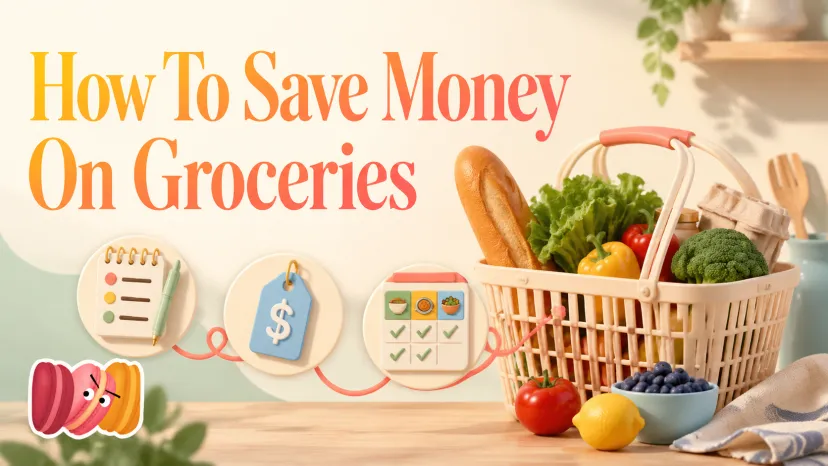
How to Save Money on Groceries Without Overplanning
How to Save Money on Groceries Without Overplanning
For about three weeks last fall, I was building a flawless Sunday meal plan — color-coded spreadsheet, exact recipes, perfectly portioned shopping list — and then watching it collapse by Wednesday night every single time. Half the produce wilted. The other half got abandoned for takeout on a long workday. I was spending more, not less, and I had a beautiful document to prove it.
That's when I started suspecting the plan itself was the problem.
I'm Maren, and I run small experiments on the boring parts of life — grocery routines, reset rituals, anything that promises to save money but quietly costs more. As an INFJ, I overthink every system until I can see where it leaks. As an IMSB, I refuse to keep any rule that feels miserable by Wednesday. So I gave myself one month to figure out how to save money on groceries without becoming a different person on Sunday afternoons.
What I found surprised me — and saved me roughly $60 a week without a spreadsheet in sight.
Why grocery spending gets out of control
Most overspending isn't about price. It's about friction in the workflow.
When I tracked four weeks of receipts, the leak wasn't the weekly haul — it was the three "quick" trips between hauls. A forgotten onion turns into $24 at checkout because I always pick up two other things. According to USDA data on the average American family of four, uneaten food costs about $1,500 annually, and most of that traces back to four habits I was running daily.
Duplicate buying, food waste, impulse trips, and vague meal plans
The four leaks I found in my own kitchen:
Duplicate buying: I owned three jars of cumin because I never checked before shopping.
Food waste: I bought aspirational vegetables for the cook I wished I were.
Impulse trips: A "quick" run for milk averaged $18 extra in cart additions.
Vague meal plans: "Salmon Wednesday" without a backup meant takeout when Wednesday went sideways.
The Bureau of Labor Statistics tracks how households actually spend, and the 2024 Consumer Expenditure Survey shows groceries averaging $519 per month per household — meaning even small leak patterns compound into real money fast.
How to save money on groceries in real life
The version that finally worked wasn't a system. It was a rhythm with four checkpoints, and the whole thing takes about 12 minutes a week.
Pantry check, flexible list, repeat meals, and backup dinners
The pantry check (3 minutes). Before I write anything down, I open the pantry and fridge and list what's already there. This single step killed about 80% of my duplicate buying. The FDA's guide on how to cut food waste makes the same point — you can't plan around what you can't see.
The flexible list (5 minutes). I write a list organized around categories, not exact recipes. "Some kind of leafy green" instead of "kale for Tuesday's salad." This way, if kale looks tired and chard looks great, I swap. The USDA's MyPlate program calls this approach planning around staples and perishables — and it's the difference between a plan that adapts and one that breaks.
Repeat meals (mental, 2 minutes). I keep three meals on permanent rotation that I genuinely enjoy and can build from pantry staples. When my "ambitious" meals fail, I fall back. Not back to takeout — back to a meal that costs $4 and takes 15 minutes.
Backup dinner (built into the list, 2 minutes). One frozen meal, one canned-soup-plus-toast option, one pasta plate. These exist for the Wednesday I described earlier — the one where everything goes sideways.
That's the whole framework. Twelve minutes. Worth trying if your setup looks anything like mine.
What to buy when prices keep changing
Food prices wobble more than people think. According to the USDA Economic Research Service, food-at-home prices rose 2.3% in 2025 — modest on average, but specific categories like eggs spiked far more. So I stopped chasing "deals" and started building around price stability.
Staples, frozen foods, proteins, snacks, and store-brand swaps
Staples that don't move much: dried beans, lentils, rice, oats, pasta, canned tomatoes, frozen vegetables. These anchor the budget. Frozen produce is where I quietly saved the most — frozen spinach and berries cost less, last longer, and (this part surprised me) are nutritionally comparable to fresh.
Proteins: I rotate between eggs, chicken thighs (cheaper than breasts and more forgiving to cook), canned tuna, and tofu. Store-brand swaps on basics — flour, butter, canned goods, frozen vegetables — saved roughly $15 per haul without any quality loss I could detect.
Snacks: this is where I stopped experimenting. I buy what my household actually eats. A "smart" snack swap that gets thrown out is more expensive than the regular one.
How to reduce waste without becoming rigid
The waste piece is where I made my biggest mistake early on — I tried to use everything, which meant I built meals around guilt instead of appetite.
Leftovers, ingredient overlap, and use-first zones
I now run a "use-first zone" on the top fridge shelf. Anything within three days of going off lives there. If it's there, it's the next thing I cook with. I also write meals to overlap ingredients: if a recipe needs half a bunch of cilantro, the next meal uses the other half — not "maybe I'll figure it out."
A useful frame: most date labels indicate quality, not safety. The USDA's official guide on food product dating explains that "Best if Used By" describes flavor, not spoilage. I used to throw out yogurt three days past the date. Now I check it. Most of the time it's fine.
What I will not do: pretend I'll eat something I won't. Aspirational eating is the most expensive habit in any kitchen.
FAQ
Here are 5 ready-to-use FAQs in English for the article:
Q1: Is this method suitable for one or two people? What if I have kids or a large family?
A: This rhythm works especially well for individuals or couples because it prioritizes flexibility and low effort over rigid execution. For families with children or larger households, the core principles (pantry check, flexible list, backup dinners) still apply. You may want to expand your “repeat meals” to 4–5 options and adjust proteins and snacks based on family preferences. As noted in the article, it might need some tweaking if you’re feeding many people on a tight schedule.
Q2: I don’t really cook or hate planning ahead. Will this still work for me?
A: Yes — it might actually work even better for you. The system doesn’t require complicated recipes. You only need three simple meals you already enjoy and can make from pantry staples, plus a few easy backups (frozen meal, canned soup + toast, pasta). The weekly 12-minute process is mostly “check what you have” and “write broad categories,” not detailed meal planning.
Q3: Are frozen foods really a good replacement for fresh vegetables and fruit?
A: Yes. Frozen spinach, mixed vegetables, and berries are often cheaper, last much longer, and are nutritionally comparable to fresh (sometimes even better because they’re frozen at peak freshness). The article highlights frozen produce as one of the biggest quiet savings, especially for stir-fries, smoothies, soups, and casseroles where texture differences are minimal.
Q4: How do I handle wanting variety and fresh food without wasting money?
A: Use the combination of a “flexible list” and a “use-first zone.” Instead of writing “kale,” write “some kind of leafy green” so you can buy whatever looks best and freshest that day. Put anything close to expiring on the top fridge shelf (use-first zone) so it becomes the next thing you cook. This gives you freedom and freshness while dramatically cutting waste.
Q5: How much money can I realistically save with this approach?
A: The author saved roughly $60 per week (about $240–260 per month) mainly by eliminating duplicate purchases, reducing impulse trips, and cutting food waste. Results will vary, but most people see a noticeable drop in their grocery bill once they consistently do the pantry check and stop making extra “quick” store runs. The savings tend to be stable because the system reduces friction rather than relying on extreme willpower or bargain hunting.
This works for me because I'm cooking for one or two people, I have freezer space, and I genuinely enjoy a small amount of planning. It probably won't fit if you're feeding a large family on a tight schedule, or if you cook entirely on instinct and find any structure suffocating. For a hybrid worker who hates spreadsheets but wants the grocery bill to stop drifting upward — this is the version I'd hand over.
I'm planning to test what happens when I add a single weekly Too Good To Go pickup to this rhythm, and see if it changes the takeout frequency. That result might land differently.
I’m Maren, a 27-year-old content strategist and perpetual self-experimenter. I test AI tools and micro-habits in real daily life, noting what breaks, what sticks, and what actually saves time. My approach isn’t about features—it’s about friction, adjustments, and honest results. I share insights from experiments that survive a real week, helping others see what works without the fluff.