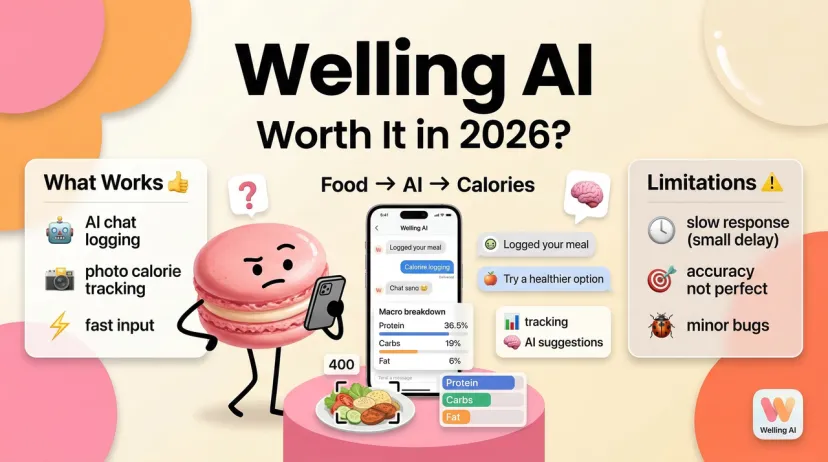
If you've landed here because you're trying to figure out whether Welling AI is actually worth downloading or just another calorie tracker with a chat window slapped on top, this is the review that skips the marketing copy and gets into what the thing actually does. Story generators deserve the same unsentimental treatment. Compare Perchance AI story generator options by what the free tier really produces, where it breaks, and when another tool is the better fit.
I ran it through two weeks of real daily logging — not curated demo meals, but actual mixed dishes, restaurant food, and the kind of meal where you're not entirely sure what went into it. Here's what held up and what didn't.
What Is Welling AI?
What it tracks and what it claims to do
Welling is a Singapore-based AI nutrition app that positions itself as a conversational food and health coach. The core premise: instead of searching a food database and manually entering everything, you describe your meal in chat or send a photo, and Welling estimates the calories and macros automatically.
Beyond logging, it tracks: calories, protein, carbs, fat, fiber, activity (via chat description or Apple Health sync), and body weight. Daily and weekly summaries are available from the dashboard. It will also generate meal plans and recipe suggestions, answer nutrition questions in chat, and send reminders for tracking consistency.
Welling's features include AI calorie tracking via chat, an AI food scanner that accepts photos, progress tracking, personalized feedback, and accountability reminders — all built around the app's proprietary AI algorithm that has processed over 1 million meals.
Who it's built for
Welling is built for people who've tried traditional food logging apps and abandoned them because the data entry is too tedious. The pitch is explicitly anti-friction: describe the meal, done. It's less suited to precision trackers who want gram-level accuracy or 50+ wearable integrations — there are better tools for that.
Welling AI Features Breakdown
Health and wellness tracking
The logging system accepts three input types: text description, photo, and nutrition label photo. Text is the primary workflow — you type "chicken rice with broccoli and about 150g chicken" and Welling estimates the breakdown and logs it. You can then tap into the entry and adjust any value (calories, protein, carbs, fat, portion size) if the estimate is off.
Activity logging works the same way: describe the workout in chat or let Apple Health auto-sync on iOS. Weight logging is manual via the dashboard. The macro breakdown is available by day or week, with a visualization of which foods contributed to each macro — a useful feature that most calorie apps bury.
What it doesn't track yet: micronutrients beyond fiber, fasting schedules, and hydration. According to Welling's official FAQ, micronutrient tracking is not yet available, and fasting schedule support is also currently not supported — both flagged as features under development.
AI-generated insights and suggestions
The chat interface handles more than logging. You can ask Welling what to eat for the remaining macros in your day, request a meal plan for the week, ask for recipe suggestions that fit your preferences, or get feedback on whether a specific food fits your goal. It stores your dietary preferences (intolerances, dislikes, dietary style) from the intake form and applies them to suggestions.
The quality of meal plan suggestions is the most polarized point in real-user feedback. One Trustpilot reviewer noted that "the suggested meal plans are a bit generic and need some detailed input to make really useful, but the tracking part is great." That's an honest summary: the chat coaching responds well to specific questions but generates mediocre output when given open-ended prompts.
App experience and interface
The UI is intentionally minimal. The main screen is the chat interface. The dashboard is accessible via tabs and shows daily progress rings, calorie remaining, and macro breakdown. There's no cluttered menu of features or settings buried six levels deep.
In independent testing by the Nutrition Coaching Academy, Welling was noted for consistency — the same foods logged multiple times produced the same estimates — and for its global food database coverage, particularly for international foods, family-style meals, and dishes with multiple ingredients or sauces.
It's available on both iOS and Android. The Android app launched in early 2026 and is newer, so feature parity with iOS is still catching up.
Welling AI Pricing
What's free vs what costs money
Welling is free to download. Some advanced features may require a subscription, which is reviewed directly in the Play Store or App Store listing. In practice, the free version allows you to complete the intake form, set your goals, and run the initial onboarding — but the full AI coaching, chat logging, and photo logging features require a paid subscription to use beyond the trial.
Welling offers three subscription tiers: monthly, 6-month, and annual. The monthly plan is referenced in third-party comparisons at approximately $16.99/month. The 6-month and annual plans come with a free trial period — confirmed in the official FAQ. Exact current pricing for 6-month and annual plans varies by region and App Store storefront; check your local listing before subscribing, as promotional pricing (via promo codes or partner discounts) frequently brings the annual rate lower than the standard rack rate.
Subscription management is handled entirely through Apple or Google — there's no web-based billing portal.
Is the paid tier worth it?
At the monthly rate, it's comparable to or slightly above SnapCalorie Premium (which offers photo-based logging with USDA-verified data) and below MacroFactor ($71.99/year). Whether it's worth it comes down to whether the chat interface actually changes your consistency, which is genuinely individual.
The honest test: use the free trial period on the 6-month or annual plan, log every day for 7 days, and see if the chat interface removes enough friction to make you stick with it. If you're still manually searching a database for every meal on day 7, the format isn't for you. If you find yourself actually logging things you wouldn't have bothered logging before, that's the signal that the format works.
Where Welling AI Delivers
Strengths vs comparable tools
Friction reduction is real. The chat logging genuinely lowers the barrier compared to database search. For mixed dishes, restaurant meals, and home-cooked food with no clear entry in a packaged database, describing the meal is faster than hunting for a match. This is where Welling consistently outperforms MyFitnessPal's free tier — MyFitnessPal is built for power users willing to spend 15–20 minutes searching a 14-million-item user-generated database, while Welling's approach removes that manual search friction entirely.
International and local food coverage. The database handles Asian cuisine, mixed dishes, and regional foods meaningfully better than apps built primarily around Western packaged food databases. This is a real differentiator for users who don't eat primarily from barcoded products.
Consistency over precision. The tracking approach prioritizes "you'll actually keep doing this" over gram-level accuracy. For most goals — weight loss, muscle gain, general awareness — consistent ballpark tracking produces results. The app acknowledges its own AI can make mistakes and makes correction easy (tap entry → adjust values), which is the right design decision.
Apple Health integration syncs workout data automatically on iOS, removing one of the most annoying manual steps in nutrition tracking.
Where It Falls Short
Accuracy limitations
This is the most important caveat. Welling's AI estimates calories and macros from descriptions and photos — it's not pulling from a verified per-entry database the way Cronometer does. Welling's own FAQ acknowledges three primary causes of estimation error: differences in food type or portion size, estimation errors when brands lack specific entries, and occasional AI model mistakes.
In practice, this means: simple whole foods (chicken breast, rice, vegetables) log reliably. Complex dishes, restaurant meals with unknown preparation, and anything involving sauces or hidden ingredients are estimates — sometimes close, sometimes off by 20–30%. For strict macro targets where precision matters (contest prep, clinical dietary protocols), Welling isn't the right tool. For general awareness and consistency tracking, the ballpark accuracy is sufficient for most people.
One pattern from user reviews: the AI occasionally misses ingredients when given a list, or assigns wrong portion estimates. A Trustpilot reviewer noted the AI was "missing ingredients when provided a list of what I ate" and "provides wrong estimates for ingredients." The correction tools are there, but they require you to catch the error first — which means spot-checking new foods against reference data until you've calibrated your trust in which categories the app handles reliably.
Features that feel underbaked
Micronutrient tracking is absent. For anyone monitoring iron, calcium, B12, or other micros — common needs for vegans, people with dietary restrictions, or anyone working with a dietitian on specific targets — Welling has nothing to offer here. It acknowledges this gap and has it logged as a feature request.
Fasting schedule tracking is also unsupported. Intermittent fasting users can still log meals in the relevant windows, but there's no fasting timer, window tracking, or integration with the daily summary.
Meal plan generation is functional but requires specific prompting to be useful. Open-ended requests ("give me a weekly meal plan") produce generic output. Specific requests ("give me three high-protein dinner ideas under 600 calories that are gluten-free") produce significantly better output. The chat interface is a tool, not an autonomous coach.
Who Should Try Welling AI
Good fit
People who've tried traditional calorie tracking apps and given up due to logging fatigue
Users who eat a lot of mixed dishes, restaurant food, or international cuisine not well-covered by Western databases
Anyone who wants a single conversational interface for logging, questions, and accountability rather than switching between screens
Users comfortable with ballpark-accurate tracking who prioritize consistency over precision
iOS users who want Apple Health workout sync without manual entry
Not a good fit
Precision macro trackers who need verified, per-entry database accuracy (use Cronometer or MacroFactor instead)
Users with specific micronutrient tracking needs — Welling doesn't cover these yet
Anyone who needs fasting schedule integration
People who primarily eat branded, packaged foods with barcodes — a barcode scanner app with a verified database is more accurate for that specific use case
Verdict
Welling AI is a real product that does what it says — the chat-based logging is genuinely easier than database search, and the AI handles international and mixed-dish logging better than most alternatives. The accuracy gap versus verified-database tools is real and acknowledged by the app itself, and it matters more for some goals than others.
For general-purpose tracking with a low-friction interface, it's worth the free trial period. For strict macro accuracy or micronutrient monitoring, it's not the right choice regardless of price.
The app is newer and actively developing — features like micronutrient tracking and fasting support are missing now but appear to be on the roadmap. Whether that matters depends on your timeline.
At Macaron, we've seen the same pattern that makes Welling interesting — logging friction is what kills tracking consistency, and removing that friction actually changes behavior. The layer that stays unsolved even after consistent logging is what to do with the data: deciding what to eat tomorrow based on what worked today, and turning one good tracking week into a repeatable routine. That's the layer we built for — if you want your nutrition habits to run as a system that carries over week to week, try it free with a real week.
FAQ
Is Welling AI free?
Welling is free to download on both iOS and Android. The full AI coaching and logging features require a paid subscription. The 6-month and annual plans include a free trial period; the monthly plan typically does not. Check your local App Store for current pricing, as it varies by region and promotional availability.
How does Welling AI compare to MyFitnessPal?
The core difference is interface and philosophy. MyFitnessPal is database-search-first — large user-generated database, barcode scanning (now paywalled on free tier), manual entry. Welling is chat-first — describe or photograph your meal, AI estimates the values. MyFitnessPal is more accurate for branded, packaged foods with specific database entries. Welling is faster and more practical for mixed dishes, restaurant meals, and international food. If you've quit MyFitnessPal because the logging felt like homework, Welling's format is worth trying. If you need precision tracking with wearable integrations and a large manual database, MyFitnessPal Premium or Cronometer are better fits.
Hey, I’m Hanks — a workflow tinkerer and AI tool obsessive with over a decade of hands-on experience in automation, SaaS, and content creation. I spend my days testing tools so you don’t have to, breaking down complex processes into simple, actionable steps, and digging into the numbers behind “what actually works.”