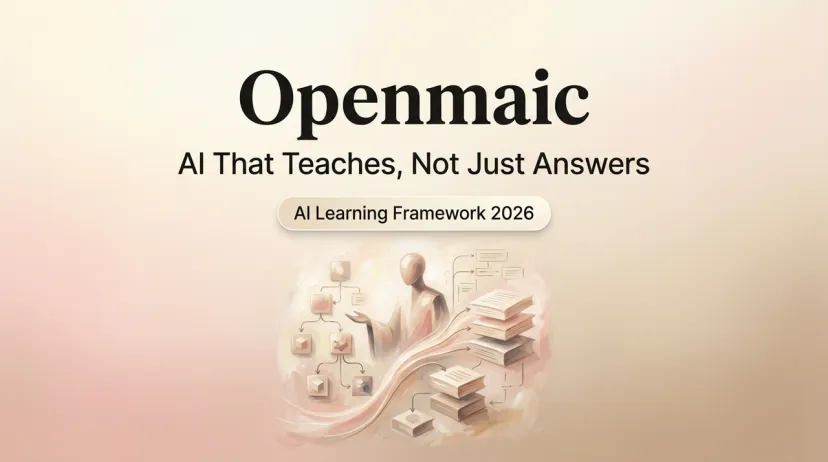
What Is Openmaic? AI That Teaches, Not Just Answers
What Is Openmaic? AI That Teaches, Not Just Answers
Hey, it’s Anna here!
I had a dense 20‑page draft to understand before a meeting and no energy to rewire how I study. I typed the file into Openmaic ai on a whim, expecting the usual: a quick summary, a list of bullet points I'd skim and forget. What surprised me wasn't the summary, it was how the tool tried to turn that static text into a small learning session I could actually use.
This piece is my field notes: what happened, where it helped, and the little frictions that reminded me AI isn't a teacher unless you hold it to that standard.
The Problem With "Just Ask AI"
Why Q&A mode doesn't build retention
I notice the same pattern a lot: you ask a model a question, it spits an answer, and you move on. That's useful when you need a fact: the year of a law, the definition of a term, a quick workaround. But for almost any task that requires remembering, understanding, or applying something later, a single Q&A hit is shallow. I tried that approach with a tricky methodology section in a paper, I asked for a plain‑English explanation and nodded along. Ten minutes later, when I tried to sketch the method from memory, I had only fragments.
The problem, as I've seen it, isn't the answer's quality. It's the format. A tidy paragraph doesn't ask me to test an idea, to retrieve it, or to put it in my own words. That's where forgetting happens. The human brain keeps things that have been used or rephrased, not things that have been passively consumed. Q&A mode is optimized for speed, not retrieval practice for retention.
The gap between getting an answer and actually understanding something
Understanding is messy. It's a back‑and‑forth: a tentative explanation, a correction, a mini‑example, a quick test, a clarification. When I fed that 20‑page draft into Openmaic ai, what changed for me was not a longer summary but a shift toward that back‑and‑forth flow. Instead of one perfect paragraph, the interface prompted me to pick areas I found fuzzy, offered short micro‑quizzes, and asked me to explain a chunk in my own words.
That's a subtle thing but meaningful. By nudging me to articulate, to fail, and then to get corrected, the tool bridged some of the usual gap between receiving an answer and making it mine. It's still not the same as a human tutor, but it nudged the cognitive work that matters for actual understanding, and for remembering — much like how AI tools turn passive reading into active learning.
What It Looks Like When AI Organizes Learning
From passive response to active learning flow
The moment I stopped expecting a direct answer and started following a short learning path was the moment Openmaic ai felt useful as a personal companion. Instead of a single summary, it offered a sequence: a brief synopsis, one or two clarifying questions, a tiny exercise, and a short review. I didn't design that sequence in advance: it emerged after I pointed to a paragraph and said, "This is where I'm stuck."
That flow matters because it removes a decision point. If you've ever abandoned a learning task because building a schedule felt like extra work, you'll recognize the relief. The AI designed the micro‑steps for me — a structure backed by AI-integrated microlearning models. They were quick, five minutes each, and oddly satisfying. After two rounds, I could paraphrase the core idea more confidently than from a single read.
Multi-agent interaction, teacher, peer, and reviewer in one session
Something else I liked: the interaction felt like several small roles stitched together. One moment the AI clarified terminology (teacher), the next it posed a skeptical follow-up (peer), then it critiqued my short summary (reviewer). That variety matters — especially when powered by multi-agent AI systems as learning designers. When I self‑study, I miss the pushback a colleague provides: a single polished answer rarely supplies that. Openmaic ai's prompts forced me to anticipate objections and to tighten my explanations, which made the material stick.
I should be cautious here: it's not literal multiple people. It's a single system switching tonal and cognitive roles, and its effectiveness depends on how well those role switches match the real confusion you have. In my session it aligned pretty well: in others I imagine it could feel either theatrical or too prescriptive.
OpenMAIC as a Case Study
What happens when you feed it a paper or a long document
I uploaded a draft research paper and asked Openmaic ai to help me understand the methods and implications. First pass: a three‑paragraph summary that didn't surprise me. Second pass: I highlighted the methods and asked for a plain‑language walkthrough. That's when the tool split the method into three digestible steps, each followed by a one‑sentence explanation and a micro‑quiz.
The micro‑quiz was the revealing part. Questions were short and practical: "Which assumption would break the method if noise increased by 30%?" I answered incorrectly. The AI then offered targeted clarification and suggested a tiny experiment I could run on the data. I actually ran the experiment, 12 minutes, and having the data changed how I framed the conclusion. That felt like progress: the tool didn't just tell me what mattered, it suggested an inexpensive way to test an uncertainty — through AI-based interactive scaffolding.
How it transforms input into an interactive experience
Instead of turning a document into a static summary, Openmaic ai scaffolded an interaction. It created bite‑sized tasks tied to specific paragraphs, asked me to apply or rephrase, and then used my responses to pick the next prompt. That conditional path, input, response, adapt, is what separates casual Q&A from something that resembles guided study.
A practical note: the outcome depends on how you engage. If you skim the prompts and accept the first summary, you'll get what you usually get: a useful but forgettable paragraph. If you treat the prompts like tiny assignments, you get more. For me, that extra five to twenty minutes produced clearer mental models and fewer follow‑up doubts before the meeting.
Limitations to Know Before You Rely on This
Output quality still depends on your input quality
This isn't magic. If your document is messy, badly structured, or contains errors, the AI will reflect that mess in its outputs. In one session I fed it a draft with ambiguous variable names and the follow‑up tasks drifted into questions about which variable meant what. The fix was manual: I clarified the source document, re‑ran the prompts, and only then did the micro‑exercises land properly.
Not a replacement for structured courses or expert guidance
I'd be careful about leaning on Openmaic ai as the only way to learn a complex skill. It's excellent for clarifying documents, creating micro‑practice routines, and nudging recall. It's less reliable for designing a full curriculum, offering accredited feedback, or substituting for an expert who can check your deeper reasoning. For example, when I used it to practice a niche statistical method, it helped me grasp the steps, but I still wanted a subject‑matter expert to review my code and assumptions.
Also, there are subtle biases in how prompts are framed. The tool nudged me toward certain interpretations: occasionally I had to push back and say, "No, that's not what I meant." That friction is a reminder that human judgment still matters — as highlighted in comprehensive reviews of AI in education applications and limitations.
Who This Actually Works For
This approach is best for people who want low‑effort, high‑signal help with day‑to‑day learning. If you're an independent creator prepping a short talk, a freelancer dissecting a client brief, or someone trying to learn the mechanics behind a long article, Openmaic ai can remove the small frictions that usually slow you down: deciding where to start, figuring out whether you understood a paragraph, or picking a tiny test to validate an idea.
It's less useful for people seeking long, formal study programs or credentialed training. It's also not ideal for those who don't want to engage, the benefit comes from doing the micro‑tasks, not from passively accepting a summary.
Who will like it: skeptical, busy people who want a gentle push to turn documents into usable knowledge. Who probably won't: anyone expecting turnkey courses or foolproof expert validation.
I don't want to oversell it. For me, Openmaic ai isn't a lifehack that eliminates study: it's a low‑effort companion that reduces the friction of learning small, specific things. It's quiet help: a nudge to try, fail, and correct, without turning the whole afternoon into another learning project.
I can see myself coming back to it whenever a heavy draft starts to feel like a wall before a meeting. Not because it hands me clarity outright, but because it quietly pushes me to work through the parts I’d normally gloss over. If you’ve ever relied on that “I’ll come back to this” instinct, it might be interesting to see if this makes it harder to forget — especially given the testing effect's proven benefits and broader AI guidance for teaching.
FAQ:
Q: Does using AI to summarize documents actually help you remember information?
A: Not always. Simple summaries are fast to read but easy to forget because they don’t require active engagement. Tools that add micro-quizzes, prompts, or rephrasing tasks tend to improve retention by forcing you to process the material more deeply.
Q:What’s the difference between asking AI questions and using AI for learning?
A: Q&A gives you instant answers, while learning requires interaction. The difference is whether the AI pushes you to explain, apply, or test what you’ve read. Without that step, most information stays superficial.
Q: Can AI replace a teacher or structured course for complex topics?
A: Not really. AI works well as a companion for understanding documents or reviewing concepts, but it lacks the structure, accountability, and expert validation that formal learning or human guidance provides.
Hi, I'm Anna, an AI exploration blogger!
After three years in the workforce, I caught the AI wave—it transformed my job and daily life. While it brought endless convenience, it also kept me constantly learning. As someone who loves exploring and sharing, I use AI to streamline tasks and projects: I tap into it to organize routines, test surprises, or deal with mishaps. If you're riding this wave too, join me in exploring and discovering more fun!