What Separates AI Nutrition Apps From Regular Trackers
Best Nutrition Apps Using AI in 2026
How to Evaluate an AI Nutrition App Before Downloading
Where AI Nutrition Apps Still Fall Short
Verdict
FAQ
Nutrition Apps Using AI: Best Options in 2026
Nutrition Apps Using AI: Best Options in 2026
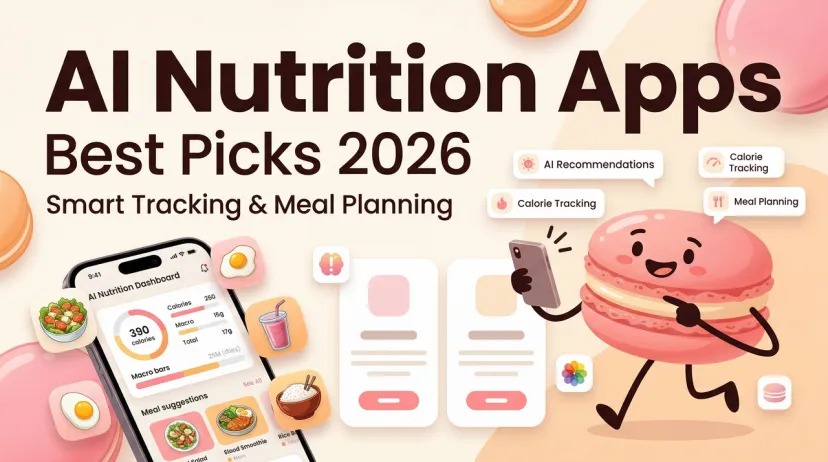
I've used a lot of nutrition apps. I've also abandoned a lot of nutrition apps. The pattern is always the same: the first two weeks feel productive, week three gets inconsistent, and by week six the app is sitting in a folder I never open.
What finally broke that cycle wasn't finding a better tracker. It was finding an app that actually did something with the data I gave it — instead of just collecting it.
That's the difference worth paying attention to in 2026. Not which app has the most food entries. Which one turns your data into something you can actually act on.
What Separates AI Nutrition Apps From Regular Trackers
Personalization depth — what AI actually adds
Regular nutrition trackers collect data. AI nutrition apps are supposed to use it.
The meaningful AI layer shows up in three places. First, input speed: photo recognition, voice logging, and natural language entry reduce logging friction enough that people actually maintain the habit past week two. Second, adaptation: instead of calculating a calorie target on day one and never revisiting it, adaptive algorithms observe your weight trends and intake patterns and recalibrate weekly. Third, guidance: the app notices patterns you wouldn't spot yourself and tells you what to do about them.
Most apps market themselves as doing all three. Most actually do one or two. The ones worth paying for are the ones where the AI layer changes your behavior — not just the speed of your logging.
Tracking vs coaching vs planning — the three tiers
These three functions overlap but they're genuinely different products:
Tracking logs what you ate and shows you what it contained. Every app in this category does this. The AI differentiator is how fast and accurately you can log.
Coaching takes your data and tells you what to change. This requires pattern recognition over time, adaptive targets, and some form of feedback loop. Most apps have a version of this; the depth varies enormously.
Planning builds forward-looking structure — here's what to eat next week, here's the grocery list. Some apps do this automatically from your targets; others require you to browse and select.
The right app depends on which of these three you actually need.
Best Nutrition Apps Using AI in 2026
Best for all-in-one nutrition tracking: MacroFactor
MacroFactor's core idea is that your metabolism isn't static — and your targets shouldn't be either. The app back-calculates your actual metabolic rate from your weigh-ins and logged intake, then adjusts your macro targets weekly based on what the data actually shows. If your calorie target was set too high or too low at the start — which static calculators almost always get wrong eventually — MacroFactor corrects it automatically.
The result: targets that reflect your real body, not a formula that was accurate in week one and increasingly wrong thereafter. The food database is verified, the logging is fast, and the adaptive algorithm is explained in depth on their official methods page for users who want to understand how the calorie math actually works.
No free tier — the 7-day trial gives full access, then it's $71.99/year. The price is worth it for serious macro trackers. It's overkill for casual healthy eating.
Best for: Anyone who's plateaued on a static calorie goal and needs targets that adapt to real results. Lifters, body composition goals, and anyone who wants to understand their metabolism rather than just estimate it.
Best for meal planning + nutrition: Eat This Much
Eat This Much sits in a specific lane: you tell it your calorie and macro targets, it generates a full week of meals that hit your numbers automatically. You don't browse and pick — the system builds the plan around your nutritional requirements. Leftovers are accounted for, different days can have different macro targets (higher carbs on training days, lower on rest), and a grocery list generates automatically.
For users who think in numbers and want the plan assembled for them — rather than choosing from a library — Eat This Much is the most precise automated planner available. It integrates with Instacart and AmazonFresh for direct cart push from the generated list.
Free tier covers single-day planning only. Weekly planning, grocery lists, and delivery integration require Premium ($59.99/year with 14-day free trial).
Best for: Macro-focused users who want automated plan generation rather than recipe browsing. The ceiling is recipe variety — after 4–6 weeks on restrictive diets, repetition becomes noticeable.
Best for dietary restriction management: Cronometer
Cronometer tracks 84 nutrients from USDA and NCCDB lab-verified sources — no crowdsourced entries, no inconsistencies. For anyone managing a dietary restriction that creates specific nutrient gaps — vegans monitoring B12 and iron, people with digestive conditions tracking fiber types, anyone with a documented deficiency — the depth here is genuinely different from standard apps.
The Oracle feature (Gold tier, $59.99/year) suggests specific foods to close identified nutrient gaps. Free Basic plan covers 84 nutrients with no daily cap, no credit card required, and a barcode scanner.
Best for: Plant-based eaters, anyone with medically documented deficiencies, users who need to track nutrients beyond standard macros. Not the most frictionless logging experience — but the most trustworthy data.
Best free option: MyNetDiary
In February 2026 testing, MyNetDiary delivered more value on its free tier than any other nutrition app: 108 nutrients tracked, a staff-verified database of 2M+ foods, zero ads, barcode scanning, and voice logging — all without paying. For context, MyFitnessPal's free plan now limits logging to 5 items per day with ads; Cronometer's free tier shows ads.
MyNetDiary's free tier is genuinely functional — not a stripped-down trial. Premium Plus ($99.99/year) adds the AI coach, AI restaurant scanning, and AutoPilot calorie adjustment.
Best for: Anyone who wants the deepest free nutrition tracking without paying anything. Particularly strong for diabetes management — MyNetDiary has specific features and food tagging built around blood sugar management.
Best for AI coaching with real dietitians: Nourish
The AI layer in Nourish assists dietitians with note-taking and session summaries, and supports patients with meal logging and goal tracking between appointments. The actual personalization — the part that changes behavior — comes from a real RD who knows your health history, labs, and circumstances. Nourish raised $70M Series B in April 2025, and patients on GLP-1 medications like Ozempic lost 33% more weight when paired with a Nourish RD compared to GLP-1 alone.
Best for: Anyone with a specific medical nutrition need (diabetes, high cholesterol, GLP-1 management, eating disorder recovery, pregnancy nutrition). If your nutrition goals have a clinical dimension, Nourish is in a different category from every self-serve app on this list.
What to know: Not a self-serve tracker. The app itself is basic — the value is in the RD relationship. Out-of-pocket cost is $145/session for those without coverage.
Comparison table
App
AI depth
Best feature
Free tier
Cost
Best for
MacroFactor
Adaptive targets, metabolic recalibration
Adaptive macro coaching
7-day trial only
$71.99/yr
Macro precision
Eat This Much
Auto meal plan generation
Plan built from your exact targets
Daily plans only
$59.99/yr (14-day trial)
Automated planning
Cronometer
Nutrient gap detection (Gold), Oracle
84-nutrient verified tracking
Full, no cap, ads
Free / $59.99/yr
Micronutrient depth
MyNetDiary
AI meal scan (Premium), AutoPilot
108 nutrients, 0 ads, verified DB
Full + barcode + voice
Free / $99.99/yr
Deepest free tracker
Nourish
RD-assisted AI + clinical outcomes
Insurance-covered RD access
Free with insurance
$0–$145/session
Clinical nutrition needs
How to Evaluate an AI Nutrition App Before Downloading
Personalization quality
The test: does the app change its recommendations based on what you specifically have done, or does it apply population-level logic to your profile? Population logic gives you a calorie goal based on your stats. Genuine personalization adjusts that goal when your actual weight trend diverges from the prediction, and flags patterns you wouldn't have noticed without three weeks of data.
MacroFactor does the second thing. Most apps at the free tier do the first.
Database accuracy
Crowdsourced databases — where any user can submit food entries — create variance that quietly undermines tracking. The same food logged by different users at different times can have meaningfully different calorie counts attached to it. Verified databases, where every entry is checked against nutritional lab data or nutritionist review, are more reliable per entry even if they cover fewer foods.
Cronometer (USDA + NCCDB), MyNetDiary (staff-verified 2M entries), and MacroFactor (verified database) are the clearest about their data sourcing. When database accuracy matters to you — for medical nutrition management or serious macro tracking — this distinction is worth checking before you commit to a tracking habit in an app.
Privacy and data handling
Nutrition data is among the most sensitive personal data you can log — health conditions, eating patterns, weight trends, medical goals. Before downloading, check three things: whether data is encrypted at rest and in transit, whether the app sells or shares data with advertisers, and whether you can export or delete your data.
Nourish is HIPAA-compliant by necessity (it's a healthcare platform). MacroFactor and Cronometer are explicit about not selling user data. For general-purpose AI apps where the business model is less clear, read the actual privacy policy rather than the marketing summary.
Where AI Nutrition Apps Still Fall Short
Generic advice at free tiers
The personalization most AI nutrition apps advertise requires enough behavioral data to infer meaningful patterns — and a model sophisticated enough to act on them. At free tiers, most apps have the data but lack the adaptive layer. You get a daily calorie target that never changes and a weekly chart that shows you what you already knew. The coaching layer that makes tracking actually useful is typically behind a paywall.
Can't account for individual metabolic differences
Even MacroFactor, which does the best job of adapting to individual metabolism, is working from behavioral proxies — weight changes and logged intake — rather than direct metabolic measurement. Factors like gut microbiome composition, hormonal variation, and individual insulin sensitivity mean two people can eat identical diets and have meaningfully different outcomes. No consumer app can account for this. The closest you get is pairing app tracking with professional guidance from a registered dietitian who can interpret your data in the context of your full health picture.
Data quality depends entirely on what you log
Garbage in, garbage out. AI nutrition apps are only as accurate as your logging. A systematic underestimate on portion sizes — common, and hard to avoid without weighing ingredients — means your tracked intake is consistently lower than your actual intake. The app doesn't know what you didn't tell it. Consistent approximate logging is more useful than sporadic perfect logging, but it's worth understanding that any AI nutrition insight is built on a foundation of estimates.
Verdict
For most people evaluating AI nutrition apps in 2026, the question worth asking first is: what's the actual problem you're trying to solve?
If the problem is understanding your eating patterns: start with MyNetDiary free — the deepest free tracker available, zero ads, 108 nutrients, no credit card.
If the problem is hitting specific macro targets that adapt: MacroFactor is the only app that recalibrates targets to your actual metabolism. Worth the $71.99/year for serious trackers.
If the problem is nutrient gaps from dietary restrictions: Cronometer free (84 verified nutrients, no cap) before considering the Gold upgrade.
If the problem is building a week of meals from your targets automatically: Eat This Much handles that specifically and with more precision than any other consumer planner.
If the problem is a real health condition you need clinical guidance on: Nourish, likely for free through your insurance.
The rest is finding the one you'll still open in week six.
Tracking gives you the pattern. Planning gives you the next step. The layer most nutrition apps stop before is connecting those two — remembering what hit your targets last week, building a recipe rotation around what actually works for you, and making each week easier than the last. At Macaron, we built a personal recipe tool that learns what works for your goals and generates suggestions based on your actual patterns — so the gap between "I know what I need" and "I know what to cook" closes. Try it free.
FAQ
Are AI nutrition apps worth paying for?
For casual healthy eating awareness: the free tiers covered here are often sufficient. MyNetDiary free tracks 108 nutrients with verified data at no cost — there's a real ceiling before paying makes sense. For serious macro tracking where targets need to adapt over time: MacroFactor at $71.99/year is worth it specifically for the adaptive algorithm. For micronutrient depth: Cronometer Gold at $59.99/year adds the Oracle nutrient gap tool. The upgrade makes sense when you've specifically identified what the free tier isn't doing for you — not before.
What's the best free AI nutrition app?
MyNetDiary's free plan tracks 108 nutrients from a staff-verified 2M+ food database, includes barcode scanning and voice logging, and shows zero ads. That's the strongest free tier in the category by the metrics that matter most: nutrient depth, data accuracy, and usability without paying. Cronometer free is the runner-up for anyone who specifically needs USDA + NCCDB verified data and doesn't mind the ad-supported interface.
Hey — I'm Jamie. I try the things that promise to make everyday life easier, then write honestly about what actually stuck. Not in a perfect week — in a normal one, where the plan fell apart by Thursday and you're figuring it out as you go. I've been that person. I write for that person.