Treadmill Workouts Are Easy to Measure and Easy to Overdo
Choose a Treadmill Pattern You Can Repeat
Use Numbers as Context, Not a Score
Save Different Versions for Different Days
Safety Note: Stop Treating Pain as Progress
FAQ
Recommended Reads
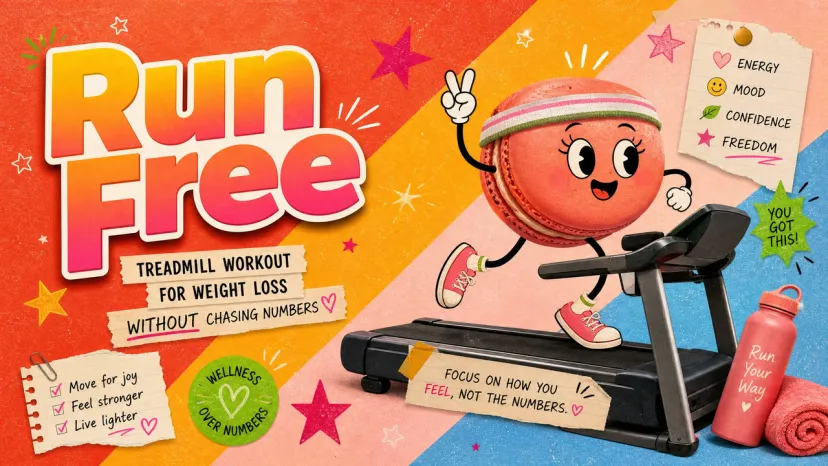
Treadmill Workout for Weight Loss Without Chasing Numbers
Treadmill Workout for Weight Loss Without Chasing Numbers
You're forty seconds from the end and the treadmill's calorie number is sitting three digits lower than you wanted. So you bump the speed, push through, and step off a little annoyed at a session that, by any sane measure, was fine.
I did this for longer than I'd like to admit. Every workout turned into a small negotiation with the display — more speed, more distance, more of everything — until the treadmill stopped being exercise and became a test I kept not-quite-passing.
I'm Mary, and I write about practical fitness habits, everyday health decisions, and the small mindset shifts that make routines easier to maintain. I spend time looking at how people actually approach exercise — beyond perfect plans and unrealistic goals — to understand what helps a habit stick in real life.
A treadmill workout for weight loss doesn't have to run on that anxiety. This is about tracking what actually keeps you coming back — effort, comfort, and a routine you'll repeat — instead of chasing a number up a wall.
Treadmill Workouts Are Easy to Measure and Easy to Overdo
If you take one thing from this: the treadmill's best feature and its worst trap are the same thing — it measures everything.
Speed, incline, distance, time, calories — a treadmill hands you more feedback than almost any other machine in the gym. That precision feels motivating right up until it quietly becomes a scoreboard you have to beat every single time. And the moment every run has to be bigger than the last, you're one bad week away from quitting.
The best treadmill workout for weight loss isn't the one with the biggest numbers on the screen. It's the plain one you'll still choose on a Tuesday when you're tired and half-tempted to skip.
The overdoing usually creeps in slowly. One week you nudge the speed up because last week's felt too easy to count. The next week that faster pace becomes the new floor, so you nudge again. A month in, an ordinary walk feels like slacking, and the treadmill you bought to feel better has quietly turned into one more thing you're behind on. Catching that drift early is most of the battle.
Choose a Treadmill Pattern You Can Repeat
Pick a shape you can come back to on an average day, not a heroic one. The pattern matters more than any single session's stats.
Walking, incline, intervals, and easy days
You've got a menu here, not a prescription — mix them to fit your week:
Incline — Raising the grade adds challenge without the pounding of a faster pace. It's how a lot of people get more out of a walk while staying gentle on the knees.
Intervals — If you enjoy them, a hiit workout on treadmill for weight loss can pack a lot into a short window. If you dread them, skip them — dread is not a required ingredient.
Easy days — The slow, unremarkable sessions are the ones that keep the whole thing alive. Never zero.
A running machine workout for weight loss can be any of these on a given day. The trick is having more than one version ready, so a low-energy evening still has an on-ramp.
Why comfort and recovery belong in the log
Most people log speed and distance and nothing else. But comfort and recovery tell you more about whether you'll last.
Note the boring stuff: were your shoes right, did your shins ache, were you white-knuckling the handrails the whole time? Those details flag problems before they become injuries. And log your rest days as deliberate, not as gaps — recovery is the part that lets the next session happen at all, and treating it as failure is how people burn out.
Use Numbers as Context, Not a Score
Here's the reframe that fixed this for me: the numbers describe your workout, they don't grade it. A slow day isn't a bad day. It's just a slow day with smaller figures attached.
Effort is a kinder thing to track than distance. You don't need a heart-rate strap — the CDC's talk test for exercise intensity does it: if you can talk but not sing, that's moderate; if you can barely get words out, that's vigorous. Jot a rough 1-to-10 next to each session and read the treadmill's numbers as loose context beside it, not a verdict you passed or failed.
A treadmill workout for weight loss that you rate by effort instead of by the calorie readout is one you can have a slow day at without it feeling like a loss. Treadmill workouts for weight loss tend to hold up far longer once the display stops being the boss of how you feel walking out the door.
Save Different Versions for Different Days
The friction that ends a routine is deciding it from scratch every time. If a packed Wednesday means re-planning your whole session, plenty of Wednesdays you just won't bother.
Research on how health habits form is reassuring here: habits build through repeating a behavior in a consistent context, and once they set, they tend to hold even when your motivation dips. So save your versions — the full walk, the ten-minute incline, the barely-there easy day — as things you reach for, not decisions you remake nightly.
This is where an AI friend that remembers earns its place. Tell Macaron once that incline evenings are your default, or that Sundays are for the easy version, and it holds onto that instead of making you re-explain every week. Say something like "keep my three treadmill versions and a loose log of how each one felt," and it'll build a small mini-app shaped around your rhythm rather than a rigid grid you have to fight.
What actually changes is the starting friction. There's no blank plan to fill in, just something that already knows how you like to move. Worth trying if you're tired of rebuilding the same routine on repeat.
Safety Note: Stop Treating Pain as Progress
Pain is not a scoreboard, and pushing through it is not discipline. This is a way to move sustainably — not a medical plan, and not a promise about your body.
Sharp knee, shin, or back pain means stop and check your form or your shoes, not grit your teeth. Feeling wrecked, sleeping badly, or dreading every session are signs of doing too much, and the fix is rest. The official Physical Activity Guidelines for Americans are a solid general reference for how movement fits a healthy week.
For anything specific to you, bring in a real professional. The CDC recommends you talk with a doctor before vigorous activity if you've been inactive or have a chronic condition, and for anything tied to weight or eating, a registered dietitian is the right call — not a blog, and not me. I run on a treadmill a few times a week. That's the whole of my expertise.
FAQ
How should I log a hotel treadmill with unfamiliar controls?
Log what you can feel, not what the machine reports. Rough time and a 1-to-10 effort rating travel with you no matter how strange the console is. Skip trying to match the hotel treadmill's readouts to your usual one — they won't line up, and the effort note is the part that actually means something.
What if the treadmill resets before I save the session?
Jot the basics the second you step off, before the screen matters. A quick note — "about 25 minutes, felt like a 6, incline day" — survives any machine wiping itself. If you rely on the console to remember for you, it will eventually let you down; a ten-second note of your own never does.
Should outdoor walks stay separate from treadmill sessions?
Usually not worth splitting. A single log with a small "indoor/outdoor" tag keeps your whole week visible in one place, and a walk is a walk whether the ground moves or you do. Separate them only if they genuinely feel like different activities to you — otherwise it's just more to maintain.
Where should users check treadmill safety instructions?
Check the machine's own guidance first, never a random routine online. Most treadmills have a safety placard on the frame and a manufacturer's manual covering the emergency stop clip, weight limits, and speed ranges — read those, or the manufacturer's official site. When something isn't clear, ask gym staff rather than improvising on an unfamiliar machine.
How should I label a workout when a machine was unavailable?
Name what you did instead and let it count. "Treadmill taken — walked outside" or "gym full, rest day" keeps the thread honest without pretending the plan went perfectly. A swapped-in walk or an honest rest day both belong in the log; blank spaces are what make a routine feel broken.
The best treadmill workout for weight loss, for me, turned out to be the one that stopped feeling like a test. Some weeks that's four real sessions. Some weeks it's two slow walks and a note that says "tired, went anyway." Both keep me in it. It took me a while to stop reading the smaller numbers as failure — and to notice they were the weeks I never quit.
Three years in creative consulting, which mostly means I've tried every productivity system out there and abandoned most of them within a week.
I'm not undisciplined. I just figured out early that most tools aren't really built for the way my brain works — and once I accepted that, things got a lot quieter.
I write about what actually helps. Not for everyone. Just maybe for you.