
Introducing Macaron-V1
Today, we are releasing Macaron-V1, the first official release of our agent model following Macaron-V1-Preview. V1 is available in two variants:
- Macaron-V1-Venti: A 748B-parameter flagship model, consisting of a 744B base model and four 1B-parameter LoRA specialists. It is the first model to be post-trained on GLM-5.2.
- Macaron-V1-Tall: A 35B-parameter model post-trained from Qwen 3.6 and designed for local deployment.
In Macaron-V1-Preview, we introduced the Mixture-of-LoRA (MoL) architecture, with separate LoRA specialists for agent and coding tasks. V1 retains that core design while advancing it across five areas:
- A stronger base model: GLM-5.2 replaces GLM-5.1.
- More data and broader benchmarking: We improve what already worked while making the results more transparent, reproducible, and measurable.
- A better harness: V1 introduces a smarter and cleaner agent harness for both Generative UI and coding workflows.
- Long-context post-training infrastructure: LongStraw enables training at context lengths of up to 2 million tokens.
- Broader frontier-model evaluation: We evaluate V1 against a wider range of leading general-purpose models.
Macaron-V1 reflects our bet on two ideas: adaptation and collaboration. We believe the next era of AI will be defined less by scaling a single monolithic model and more by two complementary capabilities. The first is post-training through recursive self-improvement, where models repeatedly generate experience, learn from it, and improve their own behavior. The second is multi-agent collaboration, where specialized models and agents compose on top of shared infrastructure. V1 is designed as our milestone toward this future.
Updates and Evaluation
Preview was scored against a handful of public benchmarks. For V1 we expanded coverage in three directions.
Personal Intelligence Benchmarks
Personal Intelligence is a capability Macaron-V1 deeply cares about: whether the model genuinely helps people in their daily lives, and grows more helpful the longer it works with them. One of the biggest challenges on that path is how to evaluate a model's Personal Intelligence in the first place.
Unlike general-purpose tasks, Personal Intelligence tasks often require task-specific rubrics and benchmarks. To address this, we built two of our own:
- Macaron ChatBench: Chat is one of an agent’s most fundamental capabilities, and we take it seriously. Good conversation in an agent setting is not about elegant phrasing, emojis, or performative empathy. It is about remaining honest with the user across long and complex agent contexts: knowing what to say, what not to say, and when to proactively acknowledge an error instead of smoothly continuing as though nothing happened. ChatBench captures these qualities in its evaluation rubric.
- Macaron LivingBench: A long-horizon benchmark designed to evaluate an agent across weeks of interaction. As promised, the benchmark itself continues to evolve. Since the Preview release, it has expanded to cover different scenarios of daily life and users with different cultural contexts.
Broader Evaluation
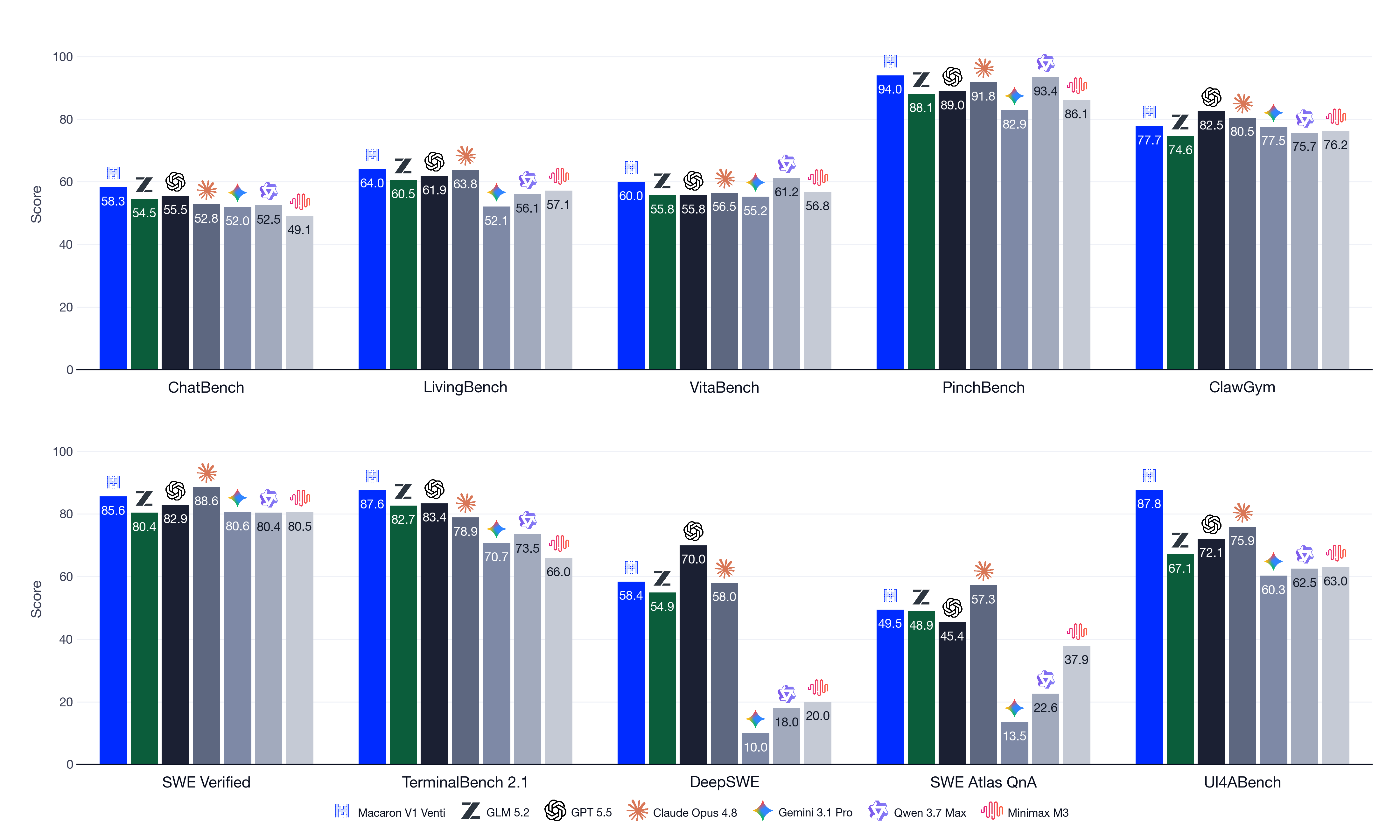
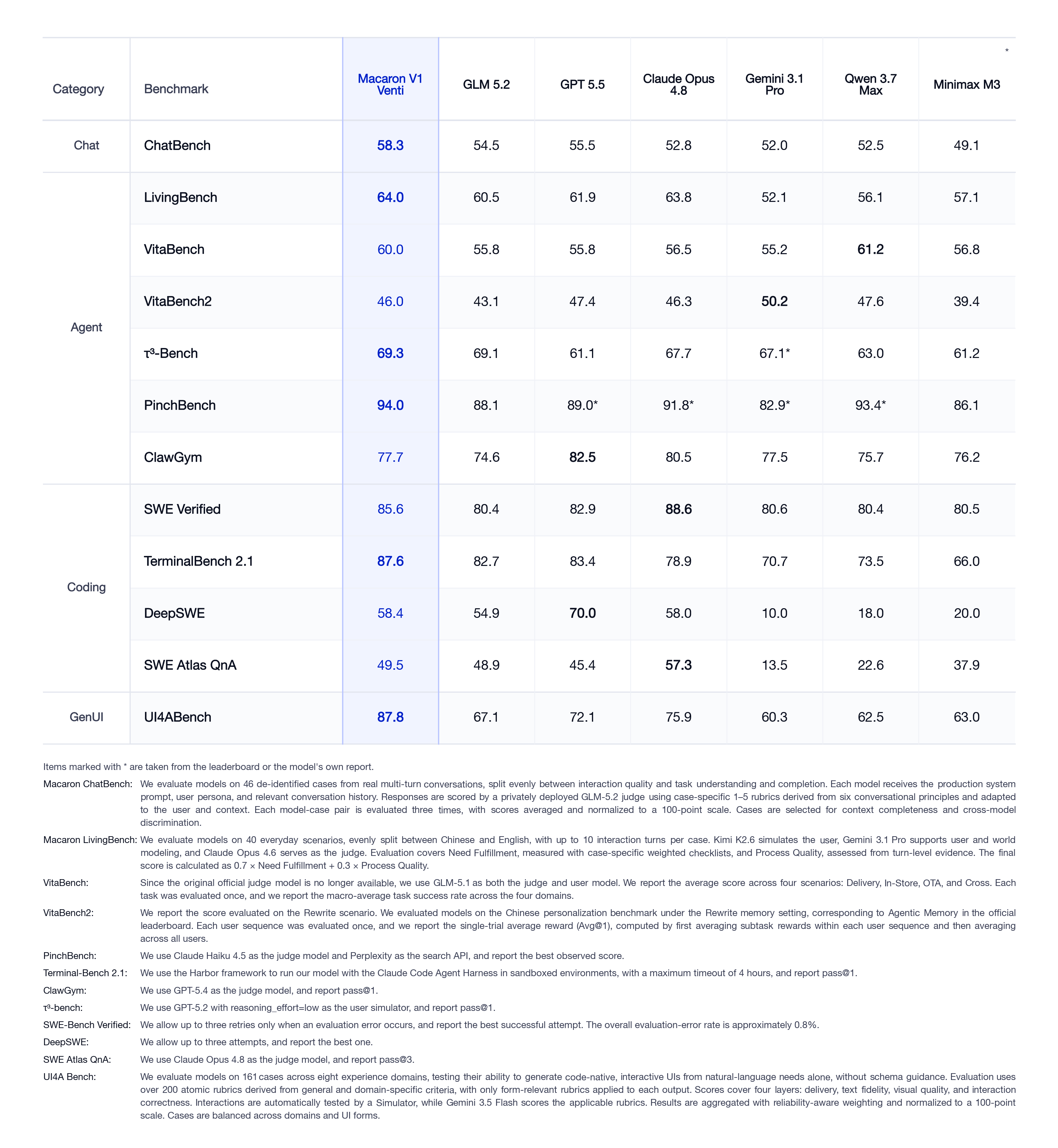
Beyond our Personal Intelligence benchmarks, we evaluate V1 across the broader capabilities that a general agent must maintain: personal-life agentic behavior with VitaBench and PinchBench; coding and terminal use with SWE-Verified, DeepSWE, SWE Atlas QnA and TerminalBench 2.1; and Generative UI with UI4A-Bench.
Because V1 is intended to compete with the strongest general-purpose models, we run the same evaluation suite on frontier baselines, including Opus 4.8, GPT-5.5, and Gemini 3.1 Pro.
Venti matches or outperforms the frontier baselines across most tracks while remaining open and self-hostable. Coding is where we currently sit close to, rather than ahead of, the frontier, and it is a direction we will continue to push. Personal intelligence, where Macaron is uniquely positioned, remains a key direction we are iterating on release after release.
Model and Harness Co-design
V1’s harness is not an afterthought. It is co-designed and trained with the model. Three components are particularly worth highlighting.
UI4A: Generative UI
UI4A is our code-native Generative UI solution, combining native HTML flexibility with direct imports of libraries and components from NPM registries or arbitrary URLs to let models instantly deliver rich, interactive content.
UI4A is designed to work even with models that have not been fine-tuned specifically for it, which makes it a general-purpose interface layer rather than Macaron-specific capability. However, we did train Macaron V1 to align its interfaces with human preferences.
REPL Harness
The REPL harness gives the model a persistent Python namespace built around a ToolProxy pattern. Instead of round-tripping every intermediate result through the model, it writes code that composes dependent steps directly: save_tool packages a working routine into a reusable tool, and promote_tool preserves validated tools across sessions.
This earns its keep two ways. Within a task, chaining dependent computation in code cuts the cost of re-describing intermediate outputs turn by turn. Across tasks, a helper that passed validation is called directly instead of replaying its full specification through the model, saving turns and tokens.
The abstraction is not unrestricted self-modifying code. A buggy helper turns a local error into a persistent one, so tools follow a controlled lifecycle (compose → validate → promote → reuse), and only validated routines get promoted while the rest stay disposable.
The payoff is conditional. It rewards tasks with compositional or reusable structure, letting the model build a personal, audited toolbox over time. For work that is stateful, needs observation before each commitment, or is already discrete calls, plain function-calling or CLI tools are often the cheaper substrate.
Harness Context Protocol
Harness Context Protocol, or HCP, is a configuration standard that consolidates the complex settings used by different agent harnesses (including AGENTS.md files, skills, hooks, system instructions, and model-provider configurations) into a single, consistent format.
HCP makes agent-session configurations and optimizations easier to standardize, transfer, and preserve across both training and production environments.
Technical Details
GLM-5.2 Base with IndexCache, MoL Post-training on Top
V1-Venti is the world's first model post-trained from GLM-5.2. Inside the architecture of V1-Venti, IndexCache and Mixture-of-LoRA (MoL) serve different roles: IndexCache is a capability of the GLM-5.2 base model, while MoL is Macaron’s post-training and serving layer built on top of that base.
IndexCache on Day1
We already supported DSA and MTP on GLM-5.1. GLM-5.2 introduces an additional technique, IndexCache. Thanks to MinT’s flexible infrastructure, we were able to support it from day one and migrate the training pipeline to GLM-5.2 quickly and cleanly.
Mixture-of-LoRA
On top of the frozen GLM-5.2 base, Macaron-V1-Venti carries four 1B LoRA specialists:
- L0 Chat: conversational and instruction-following backbone.
- L1 Agent: heavy tool use across long-horizon, dynamic, and complex tasks, including personal-life scenarios. In V1 we folded Preview's OpenClaw-related LoRA into L1, so L1 now focuses on the general agent task.
- L2 Coding: code understanding, SWE tasks, terminal use.
- L3 GenUI: UI4A rendering and UI-driven action.
At runtime, L0 routes each new user request to the most suitable specialist, while ongoing reasoning and tool interactions remain within the selected LoRA. Each specialist maintains its own execution context and shares completed work with the others through concise summaries, allowing Macaron to preserve continuity across tasks without repeatedly processing the full conversation history.
This makes MoL more than a parameter-efficient training technique. Because the base model remains frozen and each specialist operates in LoRA space, the architecture is naturally suited to continual learning. New capabilities can be added through plug-in LoRAs without modifying or overwriting the base model’s existing knowledge.
This design also creates a path toward Collective Intelligence, in which specialists trained by different teams, or personalized for different users, can be composed on top of the same shared base model.
LongStraw: From Million-Token Inference to Multi-Million-Token RL Training
While long-context inference has crossed the million-token frontier, reinforcement learning has not. An inference engine reads a million-token prompt and discards its forward graph after prefill, but conventional RL training must retain activations, score multiple responses, and accumulate gradients over the same prompt. On fixed hardware this leaves a 256K-scale training wall even after inference reaches 1M tokens.
LongStraw closes the gap by changing the unit of training. It evaluates the shared prompt once into a reusable resident state, then replays only the response branches that actually learn, accumulates their gradients, and performs one distributed update. This turns prompt length from a full-sequence memory problem into a state-lifetime problem: the prompt is paid for once, while the live graph follows the short response branch.
The design rests on three ideas: resident state as the core data structure, response replay as the core algorithm, and distributed, model-native execution to make it a training system rather than a demo.
The scale follows. Under 8×H20, LongStraw pushes Qwen3.6-27B to 2.1M-token GRPO execution and the resident-prefix path to 4.46M tokens. Under 32×H20, the same principle carries GLM-5.2's 78-layer MLA/DSA architecture and 256-expert MoE to 2.1M-token training across the full model, making multi-million-token RL training practical under a fixed GPU budget.
Efficient Recursive Self-Improvement
V1’s post-training pipeline is built on two complementary systems: MinT provides the underlying training infrastructure, while MindForge uses that infrastructure to run repeated cycles of recursive self-improvement.
MinT
MinT is Mind Lab’s flagship post-training platform and the infrastructure that made V1 possible at this scale. Its key capabilities include:
- Adapter-only handoff between actor and learner: Only adapters are transferred, eliminating the need to move the model’s full weights.
- A million-scale adapter catalog: This aligns naturally with MoL’s plug-in specialist architecture.
- End-to-end support for models with up to one trillion parameters.
Read more details in our technical report. We also provide open-source implementations for developers: verl-mint and areal-mint.
Recursive Self-Improvement with MindForge
MindForge: MindForge is an agentic RL training framework that brings the production-ready harness used by Pi and Claude Code directly into the reinforcement learning loop. It uses the same Router Tool, memory layout, tool-call tokenization, and agent harness structure as production serving, ensuring that models are trained under the same conditions in which they will ultimately operate.
HCP: The Harness Context Protocol (HCP) is the communication layer that makes this alignment practical. It standardizes how the harness exposes task metadata, memory state, routing instructions, tool configuration, and other contextual information to the model. Because the same HCP schema is used during both training and serving, anything the model observes during MindForge rollouts is also available in production.
RSI: MindForge enables recursive self-improvement through a three-stage closed loop:
- Discovery: Starting from seed tasks, the model constructs harder and more diverse tasks, verifies their answers, and filters them for quality, difficulty, and learning value.
- Expansion: The model solves the selected tasks, audits the resulting trajectories, and iteratively improves the harness configuration stored in HCP files until further gains diminish.
- Update: The optimized trajectories and HCP configurations are used to train and update the model’s parameters.
The updated model can then generate more challenging tasks and improve its harness further, repeating the cycle and expanding its boundary of capabilities.
How to Access
Open weights
All variants are released with open weights in the Macaron-V1 Collection on Hugging Face:
- Macaron-V1-Venti: the 748B MoE flagship.
- Macaron-V1-Coding-Venti: a coding-specialized build with the coding base merged in, ready for direct use.
- Macaron-V1-Lite: a smaller variant trained on Qwen 3.6 35B.
Official API
Starting today we also offer an official hosted API at https://mint.macaron.im for overseas users and https://mintcn.macaron.xin/ for users in mainland China. It is the fastest way to try Venti without provisioning GPUs. See the API docs for pricing and rate limits.
Macaron Artifacts
Macaron Artifacts is a plugin that visualizes UI4A output so you can see what the model is rendering. To install it, run these commands inside a Claude Code session:
/plugin marketplace add https://github.com/MindLab-Research/macaron-artifacts
/plugin install macaron@macaron
After installation, enter /macaron:macaron in the session to open Macaron.
Read more in the UI4A blog.
Contribution
Mind Lab
Team
Vin Bo, Asher Cai, Jingwei Cao, Song Cao, Vic Cao, Amelia Chen, Andrew Chen, Kaijie Chen, Cleon Cheng, Steven Chiang, Kaixuan Fan, Hera Feng, Arthur Fu, Jun Gao, Aaron Guan, Pyke Han, Nolan Ho, Ori Hong, Hailee Hou, Piers Hua, Charles Huang, Miles Jiang, Nora Jiang, Yuyi Jiang, Qiuyu Jin, Fancy Kong, Kuss Koo, Jaron Lee, Andrew Lei, Alexy Li, Dawn Li, Lucian Li, Ray Li, Ricardo Li, Smith Li, Theo Li, Allen Lin, Elliot Lin, Fan Lin, Kairus Liu, Kieran Liu, Logan Liu, Neo Liu, Xiang Liu, Yuxin Lu, Maeve Luo, Pony Ma, Verity Niu, Cole Qiao, Guian Qiu, Vince Qu, Sentry, Vincent Wang, Bo Wu, Rio Yang, Evelyn Ye, Ina Ye, Regis Ye, Josh Ying, Atlas Zeng, Danney Zeng, Salmon Zhan, Anya Zhang, Di Zhang, Mia Zhang, Sueky Zhang, Wei Zhao, Ada Zhou, Adrian Zhou, Yuhua Zhou, Juno Zhu, Murphy Zhuang and Mindverse Team
Names are listed alphabetically.
Appendix
Citation
Please cite this work using the BibTeX citation:
@misc{mindlab2026macaronv1,
  author = {{Mind Lab}},
  title = {Introducing Macaron-V1},
  year = {2026},
  howpublished = {Mind Lab: A Lab for Experiential Intelligence},
  note = {https://macaron.im/mindlab/research/introducing-macaron-v1}
}


