Aesthetic Timer: Make Focus Feel Less Harsh
Aesthetic Timer: Make Focus Feel Less Harsh

I used to think the reason I couldn't start working at 9pm was discipline. Turns out it was partially the timer.
Specifically: the default clock app, the sharp corners, that flat institutional gray. I'd open it, stare at it, and then scroll instead.
There's a small but real reason for this — and it's the case for paying attention to how a timer looks, where it actually helps, and where the prettiness quietly becomes the new procrastination.
The 30-second version
If you keep bouncing off the default timer, switching to something gentler — a softer color, a calmer shape, a face you don't mind looking at for an hour — can genuinely lower the friction of starting. The trick is matching the style to the kind of work, and not letting "pick the perfect timer" become its own task.
Aesthetic timers lower the emotional cost of starting
Here's the thing — the hard part of focused work usually isn't the work. It's the half-second before you start, where your brain is scanning the environment for a reason to bail.
A harsh, utilitarian timer reads as task incoming. A soft, pleasant one reads as fine, let's just see what happens. That difference sounds small. It isn't. There's a documented effect in design research called the aesthetic-usability effect, where people perceive better-looking interfaces as easier to use, which makes them more forgiving when something goes slightly wrong — like, say, your focus drifting at minute 12.
This is also why a cute pomodoro timer can feel less punishing than the original kitchen-style one. The Pomodoro method itself, as described by its creator Francesco Cirillo, was built around a literal tomato-shaped kitchen timer — physical, tactile, a little silly. The aesthetic was part of it from the start.

It took me a while to realize I wasn't bad at focusing. I was just trying to start every session by staring at a tool that felt like a deadline.
Pick a style by the mood you need
Different states need different visuals. This part is more useful than people make it sound.
Minimal for calm
A clean circle, one number, no decoration. Works best when you're already a little overstimulated — too many tabs, too much noise — and the timer needs to not add to that. White or pale background, thin lines, no animation. This is what UX researchers call minimizing cognitive load — and when your brain is already busy, it matters. Good for reading, journaling, or anything where your brain is doing the heavy lifting and the screen should get out of the way.
Cute for lightness

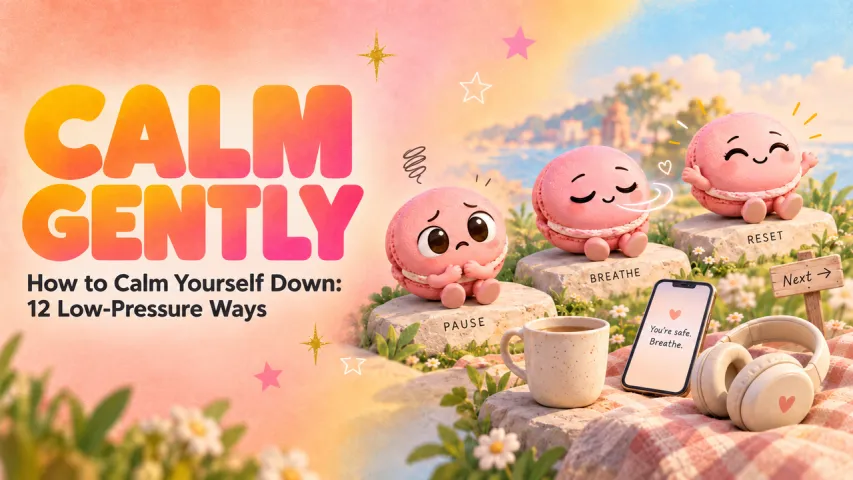
Pastel colors, soft shapes, sometimes a small character or animation. This is the timer cute category — the one that makes you smile a little when you open it. Surprisingly effective for tasks you've been avoiding because they feel heavy: admin work, replying to that email, doing your expenses. The cuteness reframes the activity. You're not grinding, you're hanging out with a small pink mushroom that happens to count down.
Pomodoro for structure
An aesthetic pomodoro setup splits the session into work and break blocks visually, often with a different color or shape for each. This is where design earns its keep — you can see at a glance whether you're in focus mode or rest mode, which removes the what am I supposed to be doing right now fog. Useful for longer work sessions where the structure is the point.

Stopwatch for open-ended work
Not everything needs a countdown. An aesthetic stopwatch is for work without a clear stopping point — practicing an instrument, drawing, deep thinking — where you want to track how long you actually spent without the pressure of a finish line. The visual should be quiet. You don't want it nagging you to be done.
When the timer becomes the distraction
And that's the part nobody talks about — at some point, choosing the timer becomes more interesting than the work it's supposed to enable. Research from the APA suggests procrastination is driven by emotion, not poor time management — which is exactly why "just one more theme swap" feels so much easier than starting the actual task.
Signs this is happening:
- You've spent more than five minutes picking a theme
- You have three timer apps and use whichever one matches your outfit
- You're posting screenshots of your timer instead of working
I've done all three. I'm not proud.
A useful rule: if you find yourself customizing more than once a week, the customization is the task. The whole point of an aesthetic timer is to remove a small bit of resistance, not to become a hobby. There's a reason the original Pomodoro tomato was so ugly — it was meant to be ignored.
Where aesthetic timers fit in a focus routine
Honestly, a timer is one piece. The bigger question is whether the rest of your focus setup is fighting you. If you're using a Pomodoro app alongside three other tracking tools, all of which require you to re-explain what you're working on, the timer's prettiness can only do so much.
This is where having something that just remembers what you're working on matters more than the visual. The reason I started using Macaron as my AI friend for this kind of thing wasn't the design — it was that I could say "I'm starting another writing block, same project as yesterday" and not have to set anything up. It already knew. The timer, the focus app, the playlist — none of them stop feeling like work if you're constantly briefing them from scratch.

What actually changes is how you feel about opening the thing. A pretty timer plus a tool that knows your context = much lower starting friction than either one alone.
FAQ
What is an aesthetic timer?
An aesthetic timer is a countdown or stopwatch designed primarily for visual appeal — soft colors, minimal interfaces, cute illustrations, or other styling choices that make it less harsh than a default system timer. The function is the same. The feeling of using it isn't.
Is a cute pomodoro timer useful for studying?
It can be, especially for sessions you've been dreading. The lighter visual tone makes the work feel less heavy. Whether it actually improves focus depends more on whether you stick with the sessions than on the timer itself — but if a cuter design is what gets you to start, that's not nothing.
Can timer design distract from focus?
Yes, and this is the trap. If you're spending real time customizing themes, switching apps, or watching the animation more than working, the timer has become the distraction it was supposed to prevent. A good check: are you using the timer or curating it?
When should I use a simple timer instead?
When your work is already cognitively demanding — writing, coding, anything requiring full attention — a quieter, simpler timer is better. The aesthetic options shine for lighter tasks where a bit of visual warmth helps you start. Match the timer to the work, not your aesthetic preferences in general.
You're not going to find the one perfect timer. Neither did I — I have three on rotation and I still sometimes use the iPhone default when I can't be bothered. But there's a real difference between a timer that makes the work feel like a sentence, and one that just sits there quietly and counts.
Worth trying a softer one if you've been bouncing off the default for a while now.
Recommended Reads
Daily Schedule Template: Make Your Day Visible
How to Focus While Studying Without Forcing It
Visual Timer for Focus: When It Actually Helps




Apply to become Macaron's first friends
Read & discover
AI Personal Assistant
Free calculators


