How to Budget for a Trip Without Guessing
How to Budget for a Trip Without Guessing

You've picked the dates. You've got a rough idea of where you're going. And when someone asks what the trip will cost, you pause for a second before saying, "I don't know... maybe a few hundred? More?"
That's how most travel budgets begin—with a guess.
The problem isn't that budgeting is complicated. It's that many of the real costs never make it onto your planning list until they show up on your credit card.
I'm Mary, and I've found that the easiest way to avoid overspending isn't tracking every dollar. It's knowing what to budget for before you book.
In this guide, we'll build a travel budget that survives contact with reality, covering the major expense categories, the hidden costs people often overlook, and the budget decisions that are easier to make before your trip than during it. No spreadsheets-as-a-second-job required.
The short version, if you're skimming:
- Estimate by trip type first — driving, flying, and group trips cost in different shapes.
- Build five core categories: transport, lodging, food, activities, and a buffer.
- Add the sneaky stuff: parking, tolls, local transport, tips, small purchases.
- Make your trade-offs on purpose, before booking.
- After the trip, note what your estimate got right. Next time gets easier.
Start With the Trip Type
Before any numbers, name the shape of the trip. The same destination costs completely differently depending on how you get there and who's coming.
Road trip
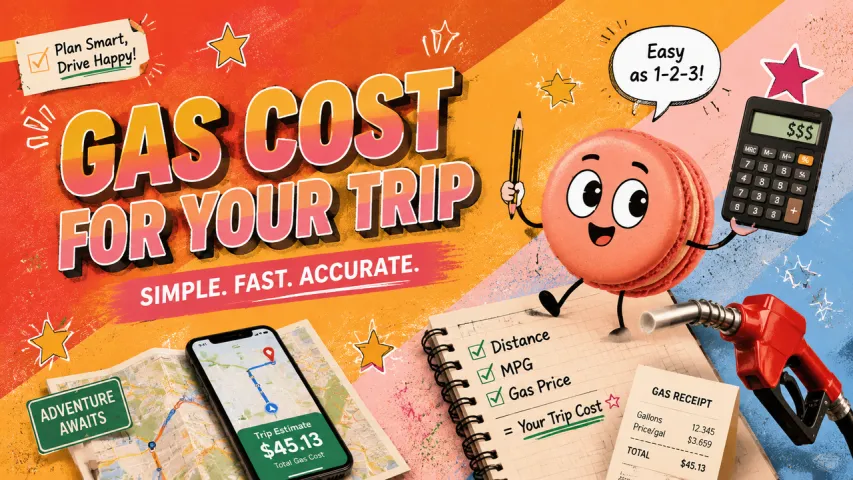
Driving feels cheap until the gas adds up. The honest way to calculate gas cost for trip planning is to take your distance, your car's mileage, and the current fuel price — the U.S. Department of Energy's free trip fuel calculator does exactly that and lets you compare vehicles.

Then add wear-and-tear realism: a long drive usually means a stop or two for food and maybe a night on the road. The fuel is rarely the whole driving cost.
Flight-based trip

Flying front-loads the cost into the ticket, which makes it feel more "done" than it is. Bags, seat selection, and airport transport all stack on top.
Fares also swing a lot by route and timing. If you want a reality check on what's normal for where you're headed, the Bureau of Transportation Statistics publishes average domestic air fares you can look up by airport — useful for sanity-checking a quote before you book.

Family or group trip
More people don't just multiply the bill — it complicates it. Different budgets, different must-haves, and the awkward question of who pays for what.
Sort the money conversation early. Are you splitting evenly, paying your own way, or pooling for shared costs? Deciding this before booking saves a genuinely uncomfortable talk later.
Build the Main Budget Categories
Once you know the shape, fill in the buckets. Almost every trip cost lands in one of these — and a category you forget is a category that surprises you.

Transport
This is everything that moves you: flights or fuel, plus getting to and from airports or stations. If you're driving, knowing how to calculate gas cost for a trip up front turns your biggest variable into a number you can actually plan around — most fuel or petrol expense calculators just need distance, mileage, and price.
Don't forget the transport around the trip, not just to it. More on that below.
Lodging
Lodging is usually the second-biggest line after transport. The trap is comparing the nightly rate and ignoring the rest — resort fees, taxes, and the location tax of staying somewhere cheap but far from everything.
A place that costs less but adds a daily commute isn't always the saving it looks like.
Food
Food is the category people most reliably underestimate, because it's small amounts, constantly. Three meals plus coffee plus a snack, every day, adds up faster than one big expense.
A rough per-day food range, multiplied by your days, beats pretending you'll "just be careful."
Activities and tickets
The fun stuff has real costs, and they're easy to wave off until they're all booked. Tours, museums, entry fees, the one big experience you're actually going for.
If parks are on your route, check current fees and pass options on the National Park Service passes page — fees vary by park, and an annual pass can change the math if you're hitting several. Timed-entry reservations, permits, and campsite bookings often run through Recreation.gov, and those small reservation costs are easy to miss.

Add the Costs People Forget
Here's the part that wrecks otherwise-careful budgets. None of these are big on their own. Together, they're often the gap between your estimate and your statement.
Parking and tolls
Parking at a hotel or airport, and tolls on the drive, quietly pile up. Toll rates are set by individual road authorities, not nationally — the FHWA tracks toll facilities in the United States, but for an actual route cost you'll want the relevant authority's toll calculator before you go.
Airport and city-center parking fees are especially higher than your gut instinct tells you.
Local transport
Once you arrive, you still have to move. Rideshares, transit fares, the occasional cab when you're tired — it's a real daily line that rarely makes the first draft of a budget.
A rough daily allowance for getting around locally is usually more honest than assuming you'll walk everywhere.
Snacks, tips, and small purchases
The miscellaneous category is where good budgets admit they're human. Tips, a coffee, sunscreen you forgot, a souvenir you didn't plan on.
I don't try to predict each one. I just give the trip a small daily "stuff" buffer and stop pretending it's zero.
Make Trade-Offs Before the Trip Starts
Here's the thing about how to plan a budget trip — it isn't about cutting everything. It's about deciding, on purpose, where the money goes.
Pick what matters to you. Maybe it's a nicer hotel and cheaper food. Maybe it's a tight place to sleep so you can spend on experiences. Both are fine. What's not fine is finding out you overspent on the parts you didn't even care about.
So before booking, do one pass: what's worth paying up for, and what's fine to keep lean? Make that call while you still have options, not at hour two of the trip when everything's already locked in.
That single habit — choosing trade-offs in advance — is most of what separates a budget that holds from one that doesn't.
Track What Was Accurate After the Trip
The best budgeting tool you have is the trip you just took. While it's fresh, jot down where your estimate was close and where it was way off.
Which category blew past your guess. What you forgot entirely. The cost that felt small each time and big by the end.
Do this once or twice and your estimates stop being guesses. This is also where an AI friend that remembers — like Macaron — quietly helps, by holding onto your past trip spending patterns so the next budget starts from what actually happened, not a blank page.

That's really it. Estimate by shape, fill the buckets, leave room for the forgettable stuff, and let each trip teach the next.
FAQ
Which trip costs are most commonly underestimated?
Food and the small daily stuff — local transport, parking, tolls, tips, snacks. None feel big in the moment, which is exactly why they slip the budget. Lodging extras like resort fees and taxes are a close runner-up.
When should a trip budget include an explicit buffer?
Almost always. A buffer of a small daily amount for the unplanned — the forgotten item, the surprise fee, the spontaneous meal out — keeps one off-script day from sinking the whole estimate. Longer or further-flung trips deserve a bigger one.
How do group or family trips make budgeting more complicated?
Different budgets, different priorities, and the inevitable question of who pays for what. Decide on the financial structure before booking — whether splitting costs evenly, everyone paying their own way, or pooling money for shared expenses — so it stays a simple logistics detail instead of an awkward mid-trip conversation.
What should you compare or note after the trip ends?
Where your estimate matched reality and where it didn't. Note the category that ran over, anything you forgot to budget at all, and the small recurring costs that added up. Those few lines are the core of how to budget for a trip more accurately next time.
Nobody guesses a trip perfectly. I never have — there's always a cost that sneaks up, a day I spent more than planned, a fee I didn't see coming. But there's a real difference between a budget that's a hopeful number and one built from the actual shape of the trip in front of you. That's the goal. Not exact. Just close enough that the trip feels like the part you remember, instead of the bill.
Recommended Reads











Apply to become Macaron's first friends
Read & discover
Free calculators
Company


