How to keep long-term plans close to daily reality
What not to put in a life planner
When personal AI can connect the layers
FAQ
Life Planner: Connect Goals, Tasks, and Habits
Life Planner: Connect Goals, Tasks, and Habits
A life planner doesn't fail because the app is wrong. It fails because most setups try to make one tool carry four very different jobs — direction, rhythm, proof, and action — and then quietly collapse when those four stop talking to each other.
The fix isn't a better template. It's keeping the layers separate but connected: goals that point somewhere, routines that hold rhythm, habits that record proof, and tasks that turn any of it into today's action. When the layers stay distinct, the system survives a real week. When they get merged into one document, you end up with a planner that's either too vague to use or too detailed to revisit.
What follows is a four-layer setup for a life planner, why each layer needs its own logic, and the simplest test for figuring out which layer is failing yours right now. A coworker glanced at four open documents on my screen — between drafts of a brief neither of us wanted to finish — and asked, "Maren, why does a life planner need four separate files?" Fair question. Here's the long answer.
A life planner is a map, not a master plan
Most planner advice treats the planner as a master plan: one document that holds the whole vision, broken into quarters, weeks, days. Useful in theory. Painful in practice. The thing collapses the first week reality bends — and reality always bends.
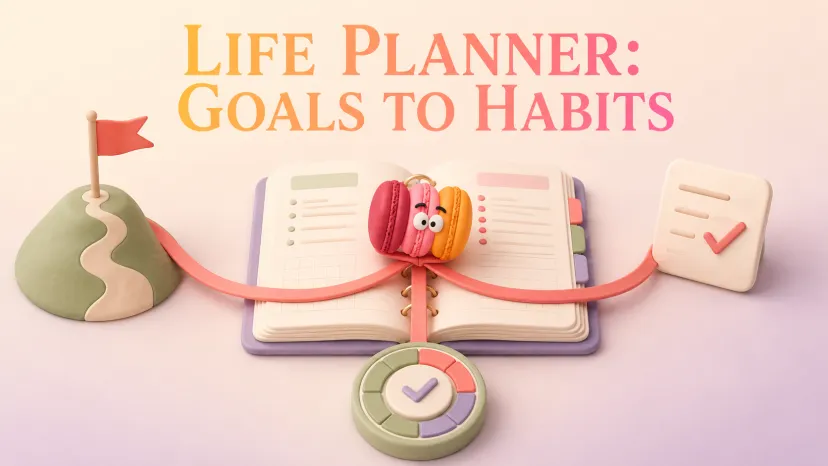
A map is different. A map doesn't tell you what to do. It shows you where things are. A useful life planner is a map of four layers: where you're heading (goals), how your week is shaped (routines), what you've actually been doing (habits), and what's in front of you today (tasks). You read the map. You don't follow it.
The shift sounds small. The downstream effect — being able to step away for a week, come back, and not feel like the whole system has decayed — is the part most planner setups never get to.
The four layers of a useful life planner
Each layer answers a different question. Each fails differently when overloaded. Each needs its own format.
Direction: goals
Goals are the slowest layer. They change on a quarterly, sometimes yearly cadence. A working goal planner is short and specific — not "be healthier" but "run a 10K by autumn" or "ship one client project per quarter without scope creep." Decades of research on goal-setting point in one direction: vague goals fail predictably, and so do goals that aren't connected to a behavior you can actually adjust.
The failure mode here is over-engineering. Twelve goals across six life areas with sub-goals and milestones — that's not a planner, that's a part-time job. Keep it to three or four goals at most. If you can't say them out loud without checking the document, it's already too much.
Rhythm: routines
Routines are the weekly shape. Morning blocks, midweek resets, end-of-day shutdowns. A routine planner isn't about discipline — it's about reducing how many decisions Wednesday morning has to make on your behalf.
This is the layer that fails most often. Routines look easy on paper and feel heavy by Thursday. The fix isn't more willpower. It's stripping the routine down to two or three anchors that survive a bad day. NIMH self-care guidance puts it plainly: predictable rhythms help more than ambitious ones, especially during stretches when energy isn't reliable.
A routine planner I'd actually keep has a morning anchor, an evening shutdown, and one weekly review slot. That's it. Everything else is optional and gets cut the first week it stops happening.
Proof: habits
Habits are the daily record. Did the small thing happen? Yes or no. Habits aren't goals. They're evidence that you're still in motion.
The useful finding from habit formation research is that automation takes far longer than people expect — and variance between habits is enormous. Some land quickly. Others never fully automate. The implication for a life planner: don't track too many habits at once, and don't treat one missed day as a system failure. The check-in matters more than the streak.
What I keep visible: two or three habits at any given time, max. If I can't remember what they are without opening the planner, the list is too long.
Action: tasks
Tasks are the fastest layer. They show up, they get done or deferred, they disappear. They should never live in the same document as goals or habits — they generate too much noise and bury the slower layers.
A separate task list, refreshed daily or twice weekly, keeps the other three layers readable. Mixing tasks into the planner is the single most common reason a life planner becomes unmaintainable. Every time you open it to add a task, you scroll past your goals and habits, and gradually those start to feel like clutter too.
How to keep long-term plans close to daily reality
The connection between layers isn't automatic. It needs one habit: a short weekly review where you walk goals → routines → habits → tasks and ask whether they still line up. Five to ten minutes, not a deep audit.
The test for whether the connection is working: when you open today's task list, can you tell which goal it's serving? If yes, the layers are connected. If no, the planner has decayed into a to-do list.
Worth borrowing from Mayo Clinic on habits: small, sustained changes outperform dramatic overhauls. The same applies to planners. A short weekly review beats an ambitious monthly one you keep skipping.
What not to put in a life planner
A planner holds structure, not content. Keep these out:
Project notes and research. They belong in a separate document. Otherwise the planner gets too dense to revisit.
Emotional processing and journaling. Different purpose, different format. Mixing them turns the planner into something you avoid.
Reference material. Anything you might look up — addresses, account numbers, recipes — belongs elsewhere.
Other people's goals. A life planner is yours. Family goals, team goals, partner goals deserve their own space.
Rule of thumb: if it's not direction, rhythm, proof, or action, it doesn't go in the planner.
When personal AI can connect the layers
The hardest part of a four-layer setup is the connection work — noticing that a quarterly goal isn't showing up in this week's habits, or that a routine has been quietly skipped for ten days. Most people do this manually and most people stop doing it within a month.
This is where Macaron's personal AI starts to feel different from a static planner. Because it remembers what each layer was supposed to do, it can flag the gap without being asked: the goal you set in spring, the habit that hasn't been logged in a couple of weeks, the routine you stopped running on Tuesdays. The connection between layers becomes something you notice, not something you have to maintain.
I'd test it the same way I test any planner — does it survive a Wednesday where everything goes sideways? That's the only review that matters.
FAQ
What is a life planner?
A life planner is a tool — paper, digital, or app-based — that organizes the slower-moving parts of life: goals, routines, habits, and how those connect to what you do today. It's not a calendar and not a task list. It's the layer above both.
How is a life planner different from a daily planner?
A daily organizer planner focuses on today: meetings, errands, time blocks. A life planner sits a level above — it holds the goals and rhythms that make those daily entries meaningful. The two work best together but they're different tools. Using a daily planner as a life planner usually leads to over-detail. Using a life planner as a daily planner usually leads to drift.
How do I keep a life planner from becoming too much?
By accepting that maintenance is the bottleneck. A planner you can't update in a few minutes a week is a planner that will quietly fail. Cut goals down to a small number. Track only the habits that matter right now. Strip routines to anchors. The instinct to add everything is the instinct that kills the system.
When should I use a life planner app?
When the connection between layers is what's breaking, not the content. If you keep losing track of which habits serve which goals, or which routines support which projects, an app — especially one of the self development apps that handles memory across layers — can help. If the layers are clear but you're not following through, a different problem is in the way, and an app won't fix it.
That's the setup. The version worth keeping is the one small enough to revisit on a slow Sunday and specific enough to mean something on a chaotic Tuesday. Test it for a week and pay attention to which layer you stop opening — that's the one telling you something.
I’m Maren, a 27-year-old content strategist and perpetual self-experimenter. I test AI tools and micro-habits in real daily life, noting what breaks, what sticks, and what actually saves time. My approach isn’t about features—it’s about friction, adjustments, and honest results. I share insights from experiments that survive a real week, helping others see what works without the fluff.