Quizlet Alternatives for Better Study Sessions
Quizlet Alternatives for Better Study Sessions

Hitting Quizlet's daily cap two days before an exam is a specific kind of frustration. You're not mad at the product. You're mad at yourself for not reading the fine print, and mad at the situation for picking the worst possible moment.
That's what made me actually look around. Not for something cheaper — for something that works better for how I study.
If you're searching for quizlet alternatives, this is what I'd actually tell you.
Why People Look for Quizlet Alternatives
Pricing, Limits, AI Features, and Study Style
Quizlet's free tier has gotten tighter over the years. The free version lets you create study sets, use Flashcards mode, and play Match — but Learn and Test modes hit caps pretty quickly. You can find the full breakdown of Quizlet's subscription plans and feature limits in their official Help Center.

The paid upgrade removes those caps. As of 2026, Quizlet Plus runs $2.99/month billed annually ($35.99/year), which includes 3 practice tests and 20 Learn rounds per month. Quizlet Plus Unlimited, at $3.74/month ($44.99/year), removes those usage limits entirely.

Whether that's worth it depends on how often you hit the walls. For casual vocab review, free Quizlet is fine. For anyone studying daily across multiple subjects — especially with exams coming — the caps become real friction, and the case for switching starts to make sense.
The other thing I kept noticing: Quizlet was built around cards you create or find. That works well if you're good at making cards. But if you're uploading lecture notes and want something to do the cognitive lifting — finding the key concepts, writing the questions, spacing the review — Quizlet's AI features lag behind what newer tools do natively.
That's what most people are actually looking for when they search for free quizlet alternatives: not just "cheaper," but something that doesn't require manual effort to get started.
Best Quizlet Alternatives by Need
Free Flashcards, AI Quizzes, Spaced Repetition, and Collaborative Study
Here's the honest breakdown — not a ranked list where everything's a "winner," but a match by what you're actually trying to do.

If you want the freest, most powerful option and don't mind a learning curve: Anki
Anki is free on desktop and Android (iOS has a one-time $25 purchase). It's not pretty. The setup takes time. But it uses the most advanced spaced repetition system available — and it supports offline study completely regardless of device. If you want to understand how Anki's spaced repetition algorithm works, its official manual explains the history from Ebbinghaus's 1885 forgetting curve to the modern FSRS scheduler.
Most medical students still use it for a reason — the algorithm is legitimately better at predicting when you'll forget something than almost anything else out there.
The catch is card creation. Everything's manual unless you install add-ons or import pre-made decks. If you have PDFs you want turned into cards automatically, Anki isn't the move.
If you want a free alternative closest to what Quizlet does: Knowt
Knowt offers unlimited Learn mode, matching games, practice tests, and spaced repetition on the free tier. Knowt's free Quizlet import and study modes page shows exactly how the migration works — including the one-click Quizlet set transfer. The AI flashcard generation from PDFs and notes works reasonably well.

The spaced repetition is more basic than Anki's, but for students who just want Quizlet without the paywalls, Knowt is the closest equivalent.
If you're studying for a standardized test (MCAT, GRE, Bar Exam): Brainscape
Brainscape takes a different approach — after each card, you rate how well you knew it on a 1–5 scale, and the algorithm adjusts repetition accordingly. The confidence-based system is intuitive and feels more honest than a binary right/wrong. It also has a library of expert-curated decks for standardized tests and professional certifications, though premium content requires a subscription.
If you're prepping for MCAT specifically, the professionally verified decks alone are worth looking at. Creating and studying your own cards is free.
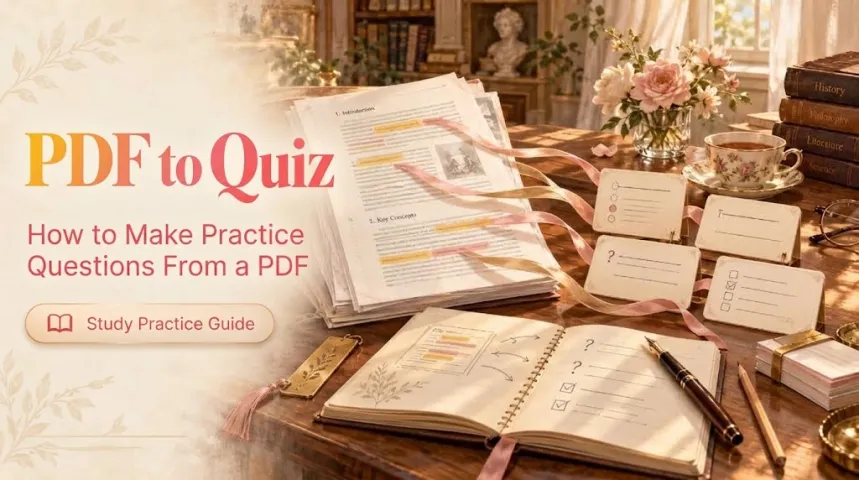
If you want AI to generate cards from your notes and PDFs: RemNote or a newer AI tool
RemNote supports PDF annotation, bidirectional linking between concepts, and a knowledge graph that shows how ideas connect. AI features include automatic card generation from uploaded PDFs and text, with 100 AI credits per month on the free plan. Pro with full AI access runs $18/month.

It's a bit of a beast to learn, but if you take detailed notes and want those notes to become your flashcards automatically, the workflow is genuinely different from anything Quizlet offers.
If you want collaborative study with shared sets: Quizlet still wins here
This is the one category where Quizlet's scale is hard to beat. The library of user-created sets is enormous. If your class already has sets, if your professor shared a deck, if you're studying a common topic — there's probably already a set for it. Knowt can import Quizlet sets, but the creation community around Quizlet is still larger.
How to Choose the Right One
Subject, Device, Budget, and Review Habits
Before you download anything, three quick questions:
How do you learn best? If passive re-reading flashcards is how you've always studied, any of these will work. If you want to actually be quizzed — with wrong answers tracked and spaced repetition doing the scheduling — you need something with a real algorithm (Anki, RemNote, or the spaced repetition tier of Brainscape).
What's your content? If your study material is already out there — common topics, shared sets, textbook chapters — Quizlet or Knowt's existing libraries save you time. If you're studying from your own notes, lecture recordings, or professor PDFs, you want AI generation.
What device are you on? Anki's cross-platform sync and offline access works fully offline across mobile and desktop. Quizlet requires a paid subscription for offline access. Knowt has limited offline functionality. If you study on the train without WiFi, that matters.
The honest answer for most students: start with Knowt if you want free and functional, try Anki if you're in it for the long haul and willing to invest setup time, and don't rule out just keeping Quizlet's free tier for the shared sets while using something else for actual review sessions.
When a Personal AI Study System Helps More
Progress Memory and Adaptive Review
Here's the part nobody really talks about when comparing flashcard apps: most of them don't actually know you. They know your cards. They know your review history in that app. But they don't know that you're the kind of person who does better reviewing in the morning, or that you're studying three subjects at once and your chemistry is crowding out your history, or that you tend to give yourself a 3 when you should give yourself a 2.
That gap — between a tool that tracks your cards and something that tracks you — is where a lot of study sessions fall apart.

Macaron approaches this differently. It's not a flashcard app. It's a personal AI that builds a picture of how you study, what you're working on, and what's getting in the way — and that memory persists across every session. So if you tell it you're prepping for a chemistry exam next week and you're stuck on equilibrium constants, it doesn't reset that context the next time you open it. It already knows. It already has suggestions ready.
The practical difference: instead of managing separate apps for flashcards, practice tests, and study planning, you describe what you need and Macaron generates a tool for that specific session. A quiz on just the concepts you're shaky on. A habit check-in that knows you've been skipping the evening review. A tracker that adjusts when your exam schedule shifts.
Worth trying if you've hit the limit on apps that make you do all the organizing yourself.
FAQ
Is there a completely free Quizlet alternative with no limits?
Knowt comes closest — free Learn mode, practice tests, and spaced repetition with no paywall. Anki is also fully free (desktop and Android), though it requires manual card creation. Neither has the shared-set library that Quizlet does, but for unlimited studying, both work.
Which quizlet alternative is best for AI flashcard generation?
If you're uploading PDFs and want cards generated automatically, RemNote (100 free AI credits/month) and Knowt both handle this well. Newer tools like StudyGlen and Laxu AI are also worth looking at if you want AI generation as the primary feature rather than a bonus.
Can I import my Quizlet sets into another app?
Knowt can import Quizlet sets directly through a Chrome extension. RemNote supports Anki deck import, and Anki can import CSVs that other apps export. The migration is rarely perfect, but it's usually workable.
Does spaced repetition actually matter?
Yes — and there's solid science behind it. The research on retrieval practice and long-term memory from the Association for Psychological Science — including Roediger and Karpicke's repeated testing experiments — consistently shows that active recall outperforms passive re-reading by a significant margin. In practice, better scheduling means fewer review sessions for the same retention. If you're studying something for months, it adds up.
What if I just need something quick before an exam?
Free Quizlet for existing sets, Knowt if you need to upload notes fast. Don't overthink it two days before the exam — the tool matters a lot less than just doing the reviews.
It's been about three weeks since I started treating my flashcard app as just one layer, not the whole system. I still use cards for isolated vocab and definitions. But for anything that requires me to actually understand what I'm studying — the connections, the patterns, the stuff that shows up on essay questions — I stopped expecting a flashcard app to carry that.
The best study session isn't the one with the best app. It's the one where you already know what you're doing before you sit down.
Recommended Reads
AI Study Guide Maker: How to Use One Well
DeepSeek V4 for Students: Helpful or Too Much?








Apply to become Macaron's first friends
Read & discover
AI Personal Assistant
Free calculators


