I took the SBTI test on a Thursday evening expecting a quick laugh. What I got instead was a four-letter code and a description so weirdly specific that I sat with my phone in my hand for a full minute, not sure whether to screenshot it or delete the browser tab. Light daily tools often win for the same reason: they stay easy after the novelty fades, which is why a shortlist of the best free AI calorie tracker apps focuses on what people still open two weeks later. Pair that result with MBTI aesthetic moodboard ideas to visualize the vibe. That's the thing about SBTI test results. They hit a nerve you didn't know was exposed.
The SBTI personality test — short for Silly Big Type Indicator — went viral on Chinese social media in April 2026. It's a parody of MBTI, built by a Bilibili creator originally trying to convince a friend to stop drinking. The test has 27 personality types, zero scientific claims, and a talent for making people feel personally attacked in the most entertaining way possible. It blew past 40 million searches on WeChat within its first 48 hours — crashing the original server twice.
If you've already taken the test and are now staring at your result wondering what it actually means, this is what I put together after going through every single type.
How SBTI Results Work
The test asks around 31 questions — most of them absurd. One involves constipation. Another asks what you'd do if a little girl offered you a lollipop. The scenarios feel random, but they map your answers across 15 dimensions grouped into five models: self-awareness, emotion, attitude, action drive, and social style.
Your answers produce a score profile, and the system matches you to one of 27 types. Each type comes with a four-letter code, a Chinese label, a short roast-style description, and a radar chart. There are also two hidden results — DRUNK (triggered by a secret alcohol question) and HHHH (a fallback when no standard type fits cleanly).
What the Test Measures (Spoiler: Vibes, Not Science)
Let me be clear: SBTI has no scientific basis. It says so itself. Unlike MBTI — which at least claims roots in Jungian psychology, though researchers have long questioned its reliability — SBTI skips the pretense entirely. It's built for satire, self-mockery, and screenshots.
That said, the reason people keep sharing their results isn't randomness. The descriptions are written with enough behavioral specificity that they feel uncomfortably familiar. Not accurate in a clinical sense. Accurate in a "why does this joke know me" sense.
Every SBTI Type Explained
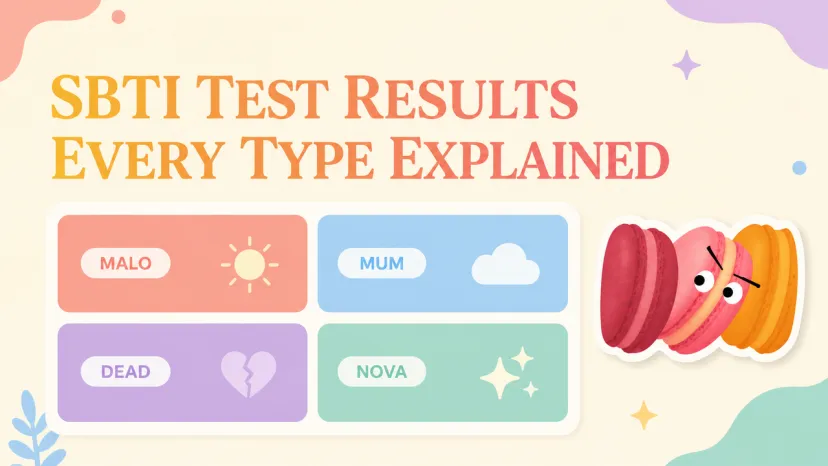
There are 25 standard types, plus DRUNK and HHHH as special outcomes. I'm covering the 13 you asked about here — the ones showing up most in group chats and comment sections right now.
DEAD (The Dead One)
"Am I... still alive?" DEAD is pure burnout energy. You've seen everything, tried everything, and now you're just... here. Not sad, not angry — flatlined. Sixth Tone called it one of the test's most iconic results. If your internal monologue sounds like an out-of-office reply, this is you.
ZZZZ (The Playing Dead)
Not actually dead. Just pretending. ZZZZ looks absent until the deadline breathes on them, then suddenly wakes up with alarming competence. Selective energy, hard prioritization. The difference between DEAD and ZZZZ: DEAD gave up. ZZZZ is strategically conserving.
MALO (The NPC Monkey)
"Life is a dungeon run, and I'm just a little monkey in it." MALO comes from Cantonese slang and captures the anti-hustle vibe perfectly. You're not competing. You're just vibing through the level, picking up whatever drops. TechNode's coverage noted MALO as one of the types that resonated hardest with users rejecting 内卷 (internal competition culture).
ATM-er (The Money Giver)
You pay for everything. Dinner, rides, emotional labor — you're the group's walking resource dispenser. ATM-er isn't about being rich. It's about being the person who gives away time, money, and patience until there's nothing left. The roast is real.
IMSB (The Self-Attacker)
The name is a deliberate pun — "I'm SB" (a crude Chinese insult). Two voices live inside IMSB's head: one screaming "go for it!" and one whispering "you'll embarrass yourself." The result is paralysis dressed up as overthinking. As RedNoteMeme's type guide puts it: what looks like hesitation is an internal civil war.
FAKE (The Hollow)
You show up, you perform, you switch masks so smoothly nobody notices. FAKE isn't dishonest in a malicious way — it's more like you forgot which version of yourself is the original. Borrowed from Chinese horror folklore where means "entities that look human but aren't quite right." Painfully relatable for anyone who's ever felt hollow at a social gathering.
FUCK (The Expressive)
"What the — what kind of personality is this?!" FUCK is the unfiltered type. Zero social filter, maximum chaos. This is the person who says what everyone else is thinking, then deals with the fallout later. Not diplomatic. Not sorry about it either.
OJBK (The Whatever)
When OJBK says "whatever," they genuinely mean it. Not passive-aggressive. Not hiding deeper feelings. Just... not bothered. This type runs on radical indifference, and honestly, it looks kind of peaceful from the outside.
BOSS (The Leader)
One of the rare "positive" labels in a test designed around self-mockery. BOSS speaks first, takes charge, and untangles chaos by instinct. The joke among users: "anyone who tested BOSS is too busy working to be taking SBTI."
MUM (The Mom)
Not a literal mother. MUM is the friend who carries snacks, remembers everyone's allergies, and is still texting "did you get home safe?" at midnight. Takes care of everyone better than themselves. The emotional backbone of every group — and the most likely to burn out without anyone noticing.
JOKE-R (The Clown)
"Turns out we're all clowns." JOKE-R converts emotional mess into polished humor. Loud delivery, suspiciously deep feelings underneath. The class clown who's actually processing something real — they just do it through punchlines instead of therapy.
SHIT (The Cynic)
"This world is one giant pile of crap." SHIT sees the worst in everything and isn't wrong often enough to stop. This isn't edgy for the sake of it. It's a worldview born from paying close enough attention to be permanently disappointed. Uncomfortable to be around. Also, strangely honest.
MONK (The Ascetic)
No worldly desires. None at all. MONK has supposedly transcended wanting things — or at least convinced themselves they have. More extreme than the popular Chinese concept of (Buddha-style detachment). The subtle joke in the original Chinese: the tagline says "no such worldly desires" — and that word "such" quietly suggests maybe there still are some.
Most Common vs Rarest Types
Here's the funny part: the creator labeled every single type as "the rarest in all of China." All 27. The math doesn't work, and that's entirely the point.
Based on what's actually flooding social feeds, DEAD, MALO, IMSB, and OJBK seem to show up most frequently. The types people share less — CTRL, BOSS, SEXY — sit in the "clear-headed" group, which the test treats almost like compliments. In a quiz built on self-deprecation, getting a flattering result feels like a bug, not a feature.
There's no official distribution data. The test runs locally in your browser — no personal data gets uploaded — so nobody's tracking aggregate stats. What gets shared most is what looks funniest in a screenshot.
How to Read Your Result Without Overthinking It
Your SBTI result is not a diagnosis. It's not even a consistent measurement — take the test on a different day, different mood, and you'll likely land somewhere else.
But that doesn't mean it's meaningless. The reason these results resonate is that they describe emotional states, not fixed traits. DEAD isn't who you are. It's how you feel right now. IMSB isn't your identity. It's the argument happening inside your head this week.
The best way to use your result: treat it as a snapshot. Notice which part of the description made you pause. That pause is the interesting part — not the four-letter code.
I keep coming back to something about why this test spread so fast. It's not because the results are accurate. It's because being roasted by a quiz feels better than being flattered by one. There's a strange relief in a test that looks at you and says, "yeah, you're a mess" — and lets you laugh about it instead of fixing it.
FAQ
How many SBTI types are there?
27 total — 25 standard personality types, plus two special outcomes. DRUNK is a hidden type triggered by a specific alcohol-related question. HHHH is a fallback result assigned when your answers don't match any standard type cleanly.
Can you be more than one type?
The test gives you one primary result, but many people feel they overlap between types. That's expected. SBTI measures current emotional states more than stable traits, so your result can shift depending on when you take it. Some sites also offer an SBTI × MBTI cross-analysis with 432 possible combinations.
What's the rarest SBTI type?
Technically, all of them. The creator labeled every type as "the rarest in China" — a deliberate joke. In practice, CTRL, BOSS, and SEXY appear to be shared less often on social media, possibly because they read as compliments in a test built around self-mockery.
Is my SBTI result accurate?
Not in any scientific sense. SBTI makes no claims to validity and is designed purely for entertainment. But the descriptions often feel accurate because they capture relatable emotional states rather than trying to define your permanent personality.
Does the SBTI test store my data?
No. The calculations happen locally in your browser. No personal information gets uploaded to a server, and shared links only contain encoded dimension scores — not personal data.
I’m Maren, a 27-year-old content strategist and perpetual self-experimenter. I test AI tools and micro-habits in real daily life, noting what breaks, what sticks, and what actually saves time. My approach isn’t about features—it’s about friction, adjustments, and honest results. I share insights from experiments that survive a real week, helping others see what works without the fluff.