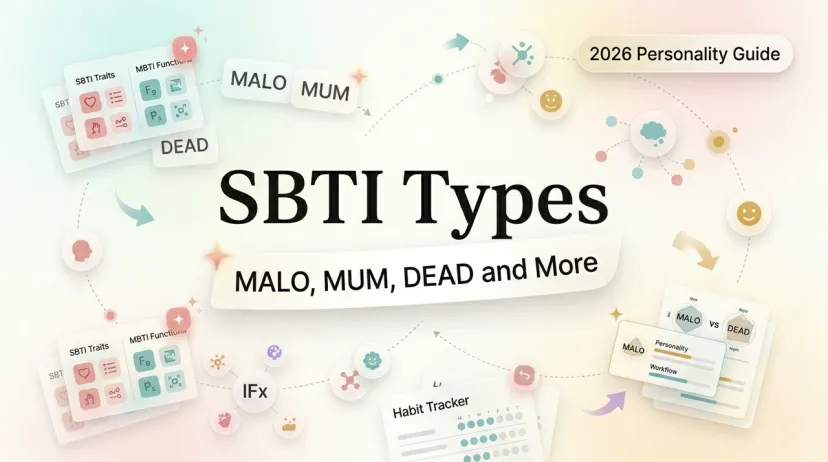
Hi, I’m Maren! I got IMSB on my first try, and I sat there staring at my phone for a solid thirty seconds trying to decide if I should be offended or impressed. Writers testing new generators feel the same mix of curiosity and mild discomfort. A clear look at Perchance AI story generator toolshelps you decide whether the output is worth iterating on or just an entertaining distraction. Turn the feeling into a personal moodboard for your type. The description nailed something I hadn't said out loud in months — that specific feeling of wanting to charge forward and wanting to quit in the same breath. That's SBTI for you. It's a viral personality test born on Bilibili — the Chinese video platform — and it's doing something I didn't expect a joke quiz to do: making people feel uncomfortably seen. For a broader comparison of formats, depth, privacy, and usefulness, see Macaron's guide to the best personality tests in 2026.
SBTI stands for Silly Big Type Indicator (though some translate it differently, and the Chinese name is deliberately crude). It's a parody of the Myers-Briggs Type Indicator, built by a Bilibili creator known as 蛆肉儿串儿, who originally made it to convince a friend to stop drinking. Thirty-one absurd questions. Twenty-seven brutally honest personality types. Zero scientific pretense. And somehow, over 40 million searches on WeChat within a single day of going viral.
Here's what each SBTI type actually means — and why one of them probably describes you better than your MBTI ever did.
How SBTI Types Are Assigned
The test measures 15 behavioral dimensions across five models: Self, Emotion, Attitude, Action, and Social. That's a fancier framework than you'd expect from a quiz that asks how you behave when you're constipated. But the scoring isn't random — your answers get cross-analyzed and matched to whichever of the 27 types fits your pattern best.
There's also a hidden branch. If you answer a specific alcohol-related question a certain way, the system skips normal scoring and assigns you a secret type called DRUNK. And if your answers don't match any standard profile closely enough, you get HHHH — the system's fallback, basically the test shrugging at you.
Unlike MBTI, which slots you into neat four-letter codes that sound like airport terminals, SBTI types are named after the raw slang of Chinese internet culture. The labels are blunt. Some are vulgar. All of them hit harder than "INFJ."
Full Type Meanings
MALO — The Worker Monkey
Chinese origin: 吗喽 (mǎ lóu), Cantonese slang for a small monkey. Online, it describes the feeling of being a low-level worker grinding through tasks without recognition. MALO's tagline is "Life is a dungeon run and I'm just a little monkey in it." Work, for MALO, is performance art — looking busy while quietly questioning everything. This is the type people screenshot most. It's the collective sigh of an overworked generation packaged into four letters.
MUM — The Group Mom
Chinese origin: 妈 (mā). MUM is the person who asks if you've eaten, reminds you to wear a jacket, and emotionally adopts everyone around them. They carry the group's well-being on instinct — not because anyone asked, but because they can't not. The emotional radar is always on. It's warm, it's genuine, and it's also exhausting in a way MUM rarely admits.
DEAD — The Flatlined
Chinese origin: 死者 (sǐ zhě). DEAD has transcended desire, ambition, and most bodily motivation. Their daily achievement is existing. While others grind, DEAD is horizontal. Not depressed — just deeply, philosophically done. Cancel plans for a nap? That's not laziness. That's DEAD operating at peak efficiency.
MONK — The Fake Zen Master
Chinese origin: 和尚/佛系 (fó xì culture). MONK has seen through worldly attachments — or at least convinced themselves they have. Personal space is their temple. Boundaries are non-negotiable. They don't cling, don't chase, don't beg. It reads as enlightenment. It might just be avoidance dressed in a robe. Still, there's something real underneath: MONK genuinely believes people function better with distance between them.
IMSB — The Self-Attacker
The name is a deliberate abbreviation: I'm SB (a very rude Chinese insult directed at oneself). Two voices live in IMSB's head — one screaming "go for it" and the other whispering "you're an idiot." They want to slack off but fear falling behind. They want to hustle but find it pointless. It's thirty browser tabs open at once, emotionally. The most conflicted type in the system, and probably the most honest.
FAKE — The Social Chameleon
Chinese origin: 伪人 (wěi rén), meaning hollow person. FAKE adapts to every social situation so perfectly that nobody — including FAKE — is sure which version is real anymore. They're not manipulative. They're just so practiced at fitting in that authenticity became a distant memory. The SBTI community describes this type as "there are no humans left." That line is funnier and sadder than it should be.
ATM-er — The Walking Wallet
Chinese origin: 送钱者 (sòng qián zhě). ATM-er can't say no. Someone needs money? Covered. Someone needs a favor? Done. The emotional transaction is always one-sided. ATM-er says "no problem" while quietly falling apart. This is the type that makes people uncomfortable — not because it's mean, but because recognizing it in yourself means admitting how much you've been giving away.
BOSS — The Reluctant Leader
Chinese origin: 领导者 (lǐng dǎo zhě). BOSS didn't sign up for leadership. They just kept making decisions while everyone else hesitated. Now they're in charge, and half the time they'd rather not be. The authority is real. The enthusiasm is debatable. BOSS types often get this result and immediately use it to justify their management style, which is exactly what a BOSS would do.
OJBK — The Whatever Person
OJBK comes from Chinese internet slang — O几把K, a crude way of saying "whatever, it's fine." OJBK has achieved a state of radical indifference. Not apathy — they genuinely mean it when they say anything works. Decisions that paralyze others take OJBK roughly two seconds. The personality test community calls this one transcendent, which is generous. It might just be efficiency taken to its logical extreme.
SHIT — The Angry Realist
Chinese origin: 狗屎人 (gǒu shǐ rén). SHIT hates everything, says so loudly, and somehow ends up being right more often than not. Every complaint doubles as a public service announcement. They're a walking one-star review — but their observations genuinely save people from bad decisions. The anger isn't performative. It's just that SHIT noticed the problems everyone else is politely ignoring.
JOKE-R — The Clown
Chinese origin: 小丑 (xiǎo chǒu). JOKE-R is the atmosphere controller in any group. Always laughing, always on. But peel back the layers and there's not much holding the center together — just the faint echo of another punchline. JOKE-R uses humor to mask sensitivity, which is the oldest trick in the human playbook and still works every time.
ZZZZ — The Professional Sleeper
Chinese origin: 装死者 (zhuāng sǐ zhě), meaning the person playing dead. ZZZZ isn't actually asleep. They're strategically dormant — doing nothing until the absolute last second, then exploding into action right before the deadline. It's a time management style that looks like neglect and somehow produces results. Barely.
FUCK — The Rage Machine
Chinese origin: 草 (cǎo), slang with layers. FUCK finds fault with everything and everyone. But here's the twist — this type is surprisingly popular because they say what the rest of the room is thinking. The rage isn't destructive. It's cathartic. FUCK types have the vitality of a weed: unkillable, uncontrollable, and weirdly necessary.
Which Type Resonates Most
Here's what I noticed after watching people share their results for a week straight: the types that spread fastest aren't the flattering ones. MALO, DEAD, and IMSB dominate group chats because they describe states people recognize but don't usually name. That's different from MBTI, which tends to give you a label you can put on a dating profile. SBTI gives you a label you'd whisper to your therapist.
The test works as entertainment. It's explicitly designed that way — no clinical claims, no career guidance, no life decisions. But the reason it resonated with tens of millions of people in a single week has less to do with the quiz mechanics and more to do with timing. A generation tired of optimizing, performing, and self-improving found a test that said: yeah, you're a mess, and that's the whole point.
If you're curious where you land, the Big Five personality model remains the most scientifically validated framework for understanding personality traits on a spectrum. SBTI isn't trying to compete with that. It's doing something else entirely — turning self-awareness into a shared joke, which might be the most honest form of self-help I've seen in a while.
I'm still thinking about why IMSB hit me harder than any MBTI result ever did. Probably because it didn't try to make the contradiction sound like a strength.
FAQ
What does SBTI stand for?
SBTI stands for Silly Big Type Indicator, though some sources expand it as Self-Behavioral Type Indicator. The Chinese name is intentionally crude — "SB" is shorthand for a well-known Chinese insult, which sets the tone for the entire test. It's a parody of MBTI built for self-deprecation, not self-improvement.
What is the SBTI Monk type?
MONK represents someone who has withdrawn from worldly entanglements — or at least tells themselves they have. It draws from China's 佛系 (Buddhist-style) trend of radical detachment. MONK types guard their personal space fiercely and maintain emotional distance as a default setting. Whether that's wisdom or avoidance depends on who you ask.
What is the SBTI MUM type?
MUM is the caretaker personality — the person who emotionally parents their entire friend group without being asked. They check in, they remember details, they worry. The Chinese origin (妈) literally means "mom." It's one of the warmer types in a system that mostly roasts you, but it carries its own weight: MUM rarely turns that care inward.
Are SBTI types based on real psychology?
No. The creator has been clear that SBTI is entertainment, not a diagnostic tool. It uses a five-model, fifteen-dimension framework that sounds structured, but the type names and descriptions are satirical. If you want scientifically validated personality measurement, the Big Five (OCEAN) model is the standard in academic psychology. SBTI exists in a completely different lane — closer to memes than to metrics.
How many SBTI types are there?
There are 27 types total: 25 standard results, one hidden type (DRUNK, triggered by a specific answer to an alcohol-related question), and one fallback type (HHHH, assigned when your answers don't clearly match any standard profile). The full roster includes CTRL, ATM-er, Dior-s, BOSS, THAN-K, OH-NO, GOGO, SEXY, LOVE-R, MUM, FAKE, OJBK, MALO, JOKE-R, WOC!, THIN-K, SHIT, ZZZZ, POOR, MONK, IMSB, SOLO, FUCK, DEAD, and IMFW.
I’m Maren, a 27-year-old content strategist and perpetual self-experimenter. I test AI tools and micro-habits in real daily life, noting what breaks, what sticks, and what actually saves time. My approach isn’t about features—it’s about friction, adjustments, and honest results. I share insights from experiments that survive a real week, helping others see what works without the fluff.