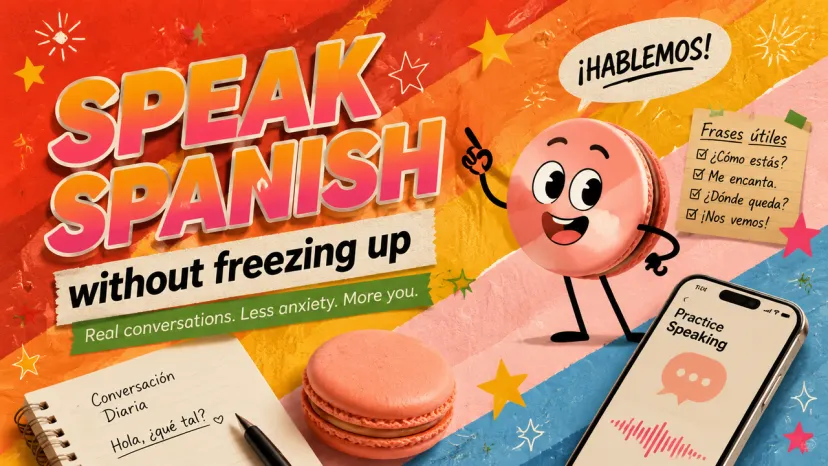
You're three words into ordering a coffee. The barista tilts her head, waiting. And something in your throat closes — not because you don't know the words, but because you know them and they've gone somewhere you can't reach.
Then you point at the menu. You always point at the menu.
Mary here. As a travel writer, I’ve pointed at menus in more countries than I care to admit. I spent years obsessing over workflows and systems to strip the bloat out of my life, only to realize my language practice was completely overengiSpanishneered for the messy reality of a bustling cafe.
This piece isn't about grammar. It's about the twelve seconds where your Spanish disappears, what's actually happening in those seconds, and how to build practice that holds up inside them.
The short version
Freezing isn't a skills gap. It's a load problem.
Rehearse situations, not vocabulary lists.
Keep phrases you can reach for without assembling.
AI roleplay is good rehearsal and bad correction.
Freezing Is Part of Conversation Practice
I used to think the freeze meant I wasn't ready yet. That if I studied six more months, it would go away on its own. It didn't. What changed was understanding what the freeze is.
Speaking a second language asks you to plan meaning, find words, conjugate, and monitor how you sound — all at once, while someone watches. Add a mild fear of looking foolish and something gives. Research on foreign language anxiety and willingness to communicate describes exactly this: learners reporting sudden blankness, mental blocks, a fear of judgment that shuts down speech before it starts. Not a vocabulary problem. A capacity problem.
Which is exactly why "just be confident" is such empty advice. You can't will yourself out of a bottleneck. You can only make fewer things compete for the same seconds.
Two things help, and both are boring. The first is rehearsal: if the situation is familiar, the planning load drops. The second is prepared language you don't have to build from parts. A review of interventions that reduce language anxiety found that the approaches that move the needle tend to change the conditions of speaking — the stakes, the preparation, the predictability — rather than trying to talk learners out of the feeling.
What the freeze actually costs you
What's competing
What you can pre-load
Choosing what to say
A rehearsed situation
Finding the words
Saved phrases, whole
Conjugating on the fly
Fixed openers you never change
Monitoring your accent
Nothing. Let this one go.
Let the accent go first. It's the only item on that list nobody is grading in a café.
Practice Real Spanish Situations First
Here's the shift that made Spanish conversation practice feel possible for me: I stopped practicing Spanish and started practicing situations.
There's a difference. Practicing Spanish means drilling the subjunctive on a Tuesday and hoping it shows up in a conversation in April. Practicing a situation means rehearsing the four minutes at the pharmacy counter until the shape of it is familiar, and letting the grammar arrive inside that shape.
The situations worth rehearsing share three traits. They repeat in your actual life. They have a predictable arc — someone asks, you answer, they clarify. And they end. A conversation you can finish is a conversation you can practice.
This is also where exam Spanish parts ways with life Spanish. The oral sections of the DELE ask you to describe a photo, sustain a monologue, argue a position against a clock — you can see the shape in the official DELE exam format by level. Useful skills. Not the skills that get you through a pharmacy counter. Rehearse whichever one you actually need next, and don't pretend one trains the other.
One more thing before the scenarios. Spanish is not one Spanish. The word for a bus changes across a border, and so does the word for a straw, a pen, and a small child. The Asociación de Academias de la Lengua Española keeps a free Diccionario de americanismos covering roughly 70,000 regional terms — worth a bookmark the first time a phrase you learned confidently gets a blank stare.
Ordering food, small talk, travel, work, and family updates
Five situations. Different demands, different prep.
Ordering food. The friendliest place to start because the script barely varies. Para mí, un café con leche.¿Algo más?Nada más, gracias. Rehearse the follow-up question, not just the order — the freeze almost always happens on the second turn, when they say something you didn't script.
Small talk. Hardest of the five, and everyone underestimates it. There's no goal, so there's no shape. Give yourself three questions you can always ask and two answers you can always give. That's not cheating. That's what fluent speakers have.
Travel. High stakes, low complexity. Directions, tickets, a room with a problem. Practice these out loud before the trip, not during — silent reading does nothing for those twelve seconds.
Work. Introductions, a status update, a polite disagreement. Register matters more than range here — knowing one careful way to disagree beats knowing six casual ones.
Family updates. Personal, repetitive, emotionally warm. If you practice conversational Spanish with anyone who knows you, this is where the real progress hides, because you'll say the same twenty sentences about your week fifty times a year.
Pair any of these with fifteen minutes of Spanish language listening practice — a podcast episode you replay, not a new one each day — and you'll notice the second-turn panic shrinking first.
Save Short Phrases You Can Reach For
For a long time I saved words. Aprovechar. Menudo. Soler. I knew what they meant and could not deploy a single one under pressure, because a word still has to be assembled into a sentence, and assembly is the thing that fails.
Phrases don't need assembly. They arrive whole. Work on lexical chunks and speaking fluency keeps pointing the same direction: learners who hold multi-word expressions ready produce longer, smoother runs of speech with shorter pauses. Not because they know more. Because they retrieve bigger pieces.
What to save
Stallers.Bueno, a ver… / Pues, la verdad es que… Buy three seconds without silence.
Repair lines.Perdona, ¿cómo has dicho? / No te he entendido bien. This is the single highest-value category and almost nobody drills it.
Your five sentences. Where you're from, what you do, why you're learning, how long you've been here, what you did this weekend. Word for word.
One closing.Nada, que me alegro de verte. Endings are surprisingly hard.
Save each with the situation attached — where you'd say it, who to, and how it felt the last time you tried. A phrase filed under "useful" is a phrase you'll never find again. A phrase filed under "the moment I panicked at the bakery" comes back on its own.
Say them aloud. Ten times, badly. Spanish language practice games — flashcard streaks, timed matching, whatever keeps you opening the app — are fine for keeping phrases warm, but they train recognition, and the café asks for production. Different muscle.
Use AI Roleplay Without Overtrusting It
The obvious problem with rehearsing a situation is that you need a second person. The obvious problem with a second person is that they're a person, and the whole difficulty is that people make you freeze.
So: roleplay. And here's where I resisted for a long time, because every AI I'd tried made me re-explain everything. My level, the region I care about, that I always stall on the past tense, that last week I practiced the pharmacy scene. Ten minutes of setup for five minutes of practice.
Macaron holds that. Deep Memory means the phrases you saved in March are still there in June, still tied to the moment you saved them, and the roleplay picks up where the last one ended instead of starting from zero. It's an AI friend that happens to remember your Spanish — you can ask it to run the bakery scene again, or to spin up a small tracker for the phrases you keep dropping, and it builds one from a single sentence. That's the mini-app part, and it's the only reason my phrase list ever got reviewed at all.
Where I hold back: it's a rehearsal partner, not a teacher. I've had it hand me a phrase that was technically correct and slightly off — the kind of thing a native speaker would never say in that café, in that city, on that Tuesday. Twice. A human speaker caught both. An AI friend is good at repetition, patience, and remembering; it should not be your last word on whether something sounds natural.
Worth trying if you've rehearsed the same conversation in your head fifty times and never out loud. Start with Macaron — one situation, five minutes, no setup.
FAQ
What if AI uses Spanish that feels too advanced?
Say so, plainly, and say it in the roleplay: más despacio, por favor — más sencillo. Then check the level against something external. If the reply reads harder than a B1 description of everyday events, it's above where practice does its work. Rehearsal should sit slightly below your comfort ceiling, not above it. Difficulty that impresses you isn't difficulty that trains you.
Should travel Spanish and exam Spanish stay separate?
Yes, until roughly two months before an exam. Travel Spanish rewards short, fast, socially smooth exchanges. Exam Spanish rewards sustained monologue under a clock. Blending them tends to produce a person who can't do either — over-formal at the taquería, under-structured in the oral test. Keep travel practice daily and give exam tasks their own dedicated blocks.
When should a human speaker review practice notes?
Before you fossilize something. If a phrase has survived three weeks of rehearsal without a native speaker seeing it, get it checked — a tutor, a language exchange, a patient friend. Rehearsal makes things automatic, and automatic includes the wrong things. I'd rather find out at week three than year two.
How should private topics be kept out of roleplay?
Decide the boundary before you're mid-scene, not during. Health details, finances, other people's names, anything you'd hesitate to say in a café where strangers can hear you — keep those out of the practice, and swap in placeholder details when a scenario asks. Rehearsing "how to describe a symptom" doesn't require rehearsing your symptom. Practice the structure, protect the specifics.
What if regional vocabulary changes the conversation?
Pick a region and lean into it, then treat the rest as listening. Whichever Spanish surrounds you — Mexican, Argentine, Peninsular — that's the one your production should sound like. But your ear should stay wide open, because you'll be understood far more often than you'll be understanding. When a word lands strangely, that's not a mistake, it's a border.
I still freeze sometimes. Last month, at a bakery I've been going to for a year, I asked for a croissant and the word vanished entirely. I pointed. She smiled. I said the word two seconds later and we both laughed.
It didn't ruin anything. That's the part nobody tells you — the freeze doesn't cost what you think it costs. It just feels like it does, right up until it stops feeling that way.
Three years in creative consulting, which mostly means I've tried every productivity system out there and abandoned most of them within a week.
I'm not undisciplined. I just figured out early that most tools aren't really built for the way my brain works — and once I accepted that, things got a lot quieter.
I write about what actually helps. Not for everyone. Just maybe for you.