Größter gemeinsamer Teiler Rechner
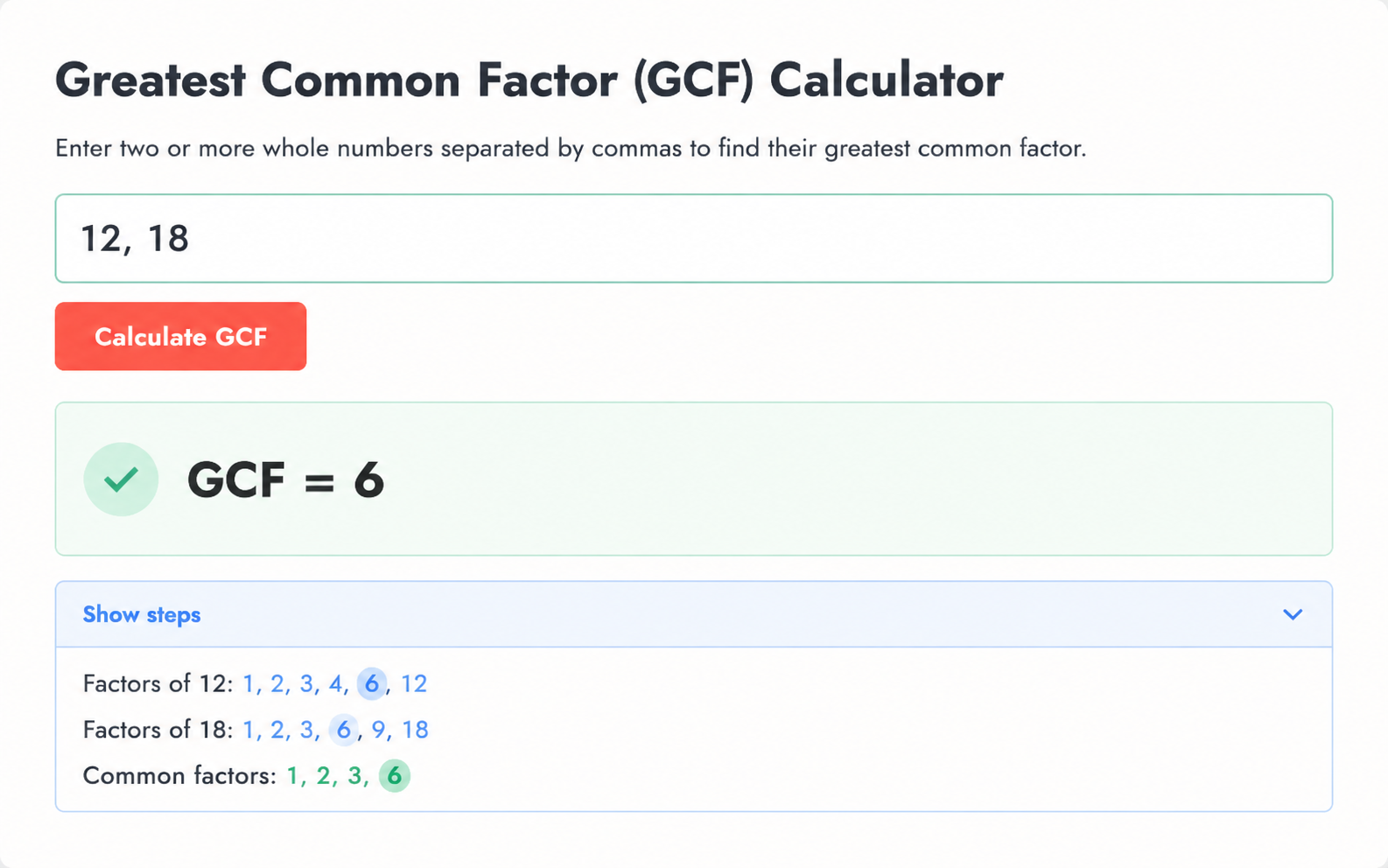
Berechne den GGT von zwei oder mehr Zahlen mittels Primfaktorzerlegung und Euklidischem Algorithmus. Erhalte sofortige Ergebnisse mit Schritt-für-Schritt-Erklärungen.
If you need to calculate GCF for homework, simplify a fraction, compare GCF and LCM, or check the GCF of 3 numbers, this page gives you both the answer and the method behind it.
Was ist der Größte Gemeinsame Teiler (GGT)?
Der Größte Gemeinsame Teiler (GGT), auch bekannt als Größter Gemeinsamer Divisor (GGD) oder Höchster Gemeinsamer Faktor (HGF), ist die größte positive ganze Zahl, die zwei oder mehr Zahlen ohne Rest teilt. Es ist ein grundlegendes Konzept in der Zahlentheorie und hat breite Anwendungen in Mathematik, Algebra und Informatik.
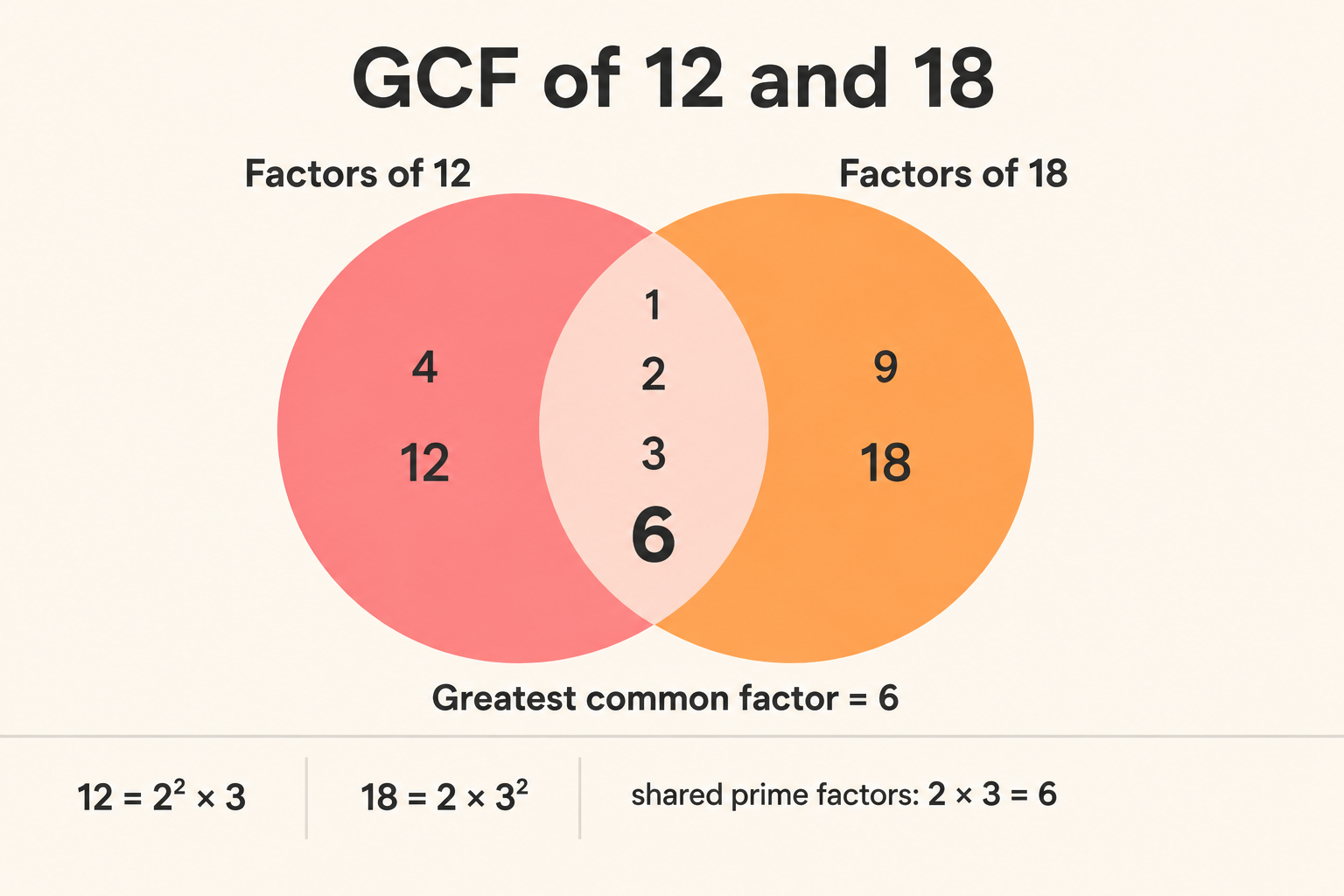
Zum Beispiel ist der GGT von 12 und 18 gleich 6, weil 6 die größte Zahl ist, die sowohl 12 als auch 18 ohne Rest teilt. Der GGT ist besonders nützlich beim Vereinfachen von Brüchen, Finden gemeinsamer Nenner und Lösen von Problemen, die Verhältnisse und Teilbarkeit betreffen.
GCF vs GCD vs HCF — are they the same?
Yes. GCF, GCD, and HCF usually mean the same thing. GCF means greatest common factor. GCD means greatest common divisor. HCF means highest common factor. Different textbooks and regions may use different names, but all three refer to the largest number that divides the given numbers evenly.
Wie benutzt man den GGT-Rechner
Use this section if you are wondering how to find GCF on calculator tools without doing every step by hand.
- Gib deine Zahlen ein: Tippe zwei oder mehr positive ganze Zahlen in das Eingabefeld, durch Kommas getrennt (z.B. 330, 75, 450, 225).
- Klicke auf Berechnen: Drücke den 'GGT berechnen'-Button, um den größten gemeinsamen Teiler zu berechnen.
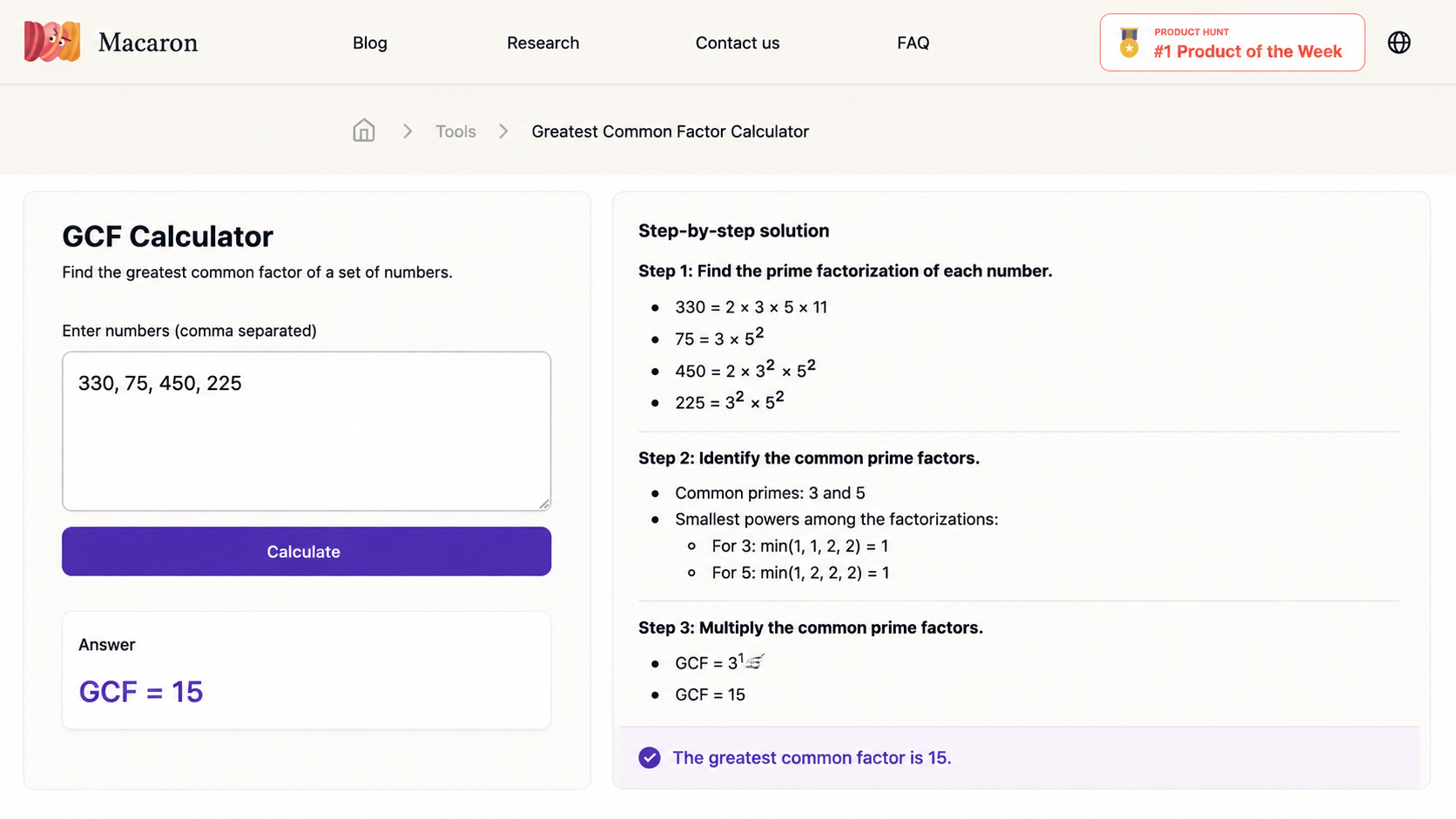
- Ergebnisse ansehen: Der Rechner zeigt den GGT-Wert, die Primfaktorzerlegung jeder Zahl mit hervorgehobenen gemeinsamen Faktoren und Schritt-für-Schritt-Berechnungen mit dem Euklidischen Algorithmus (für zwei Zahlen) an.
Wichtige Einblicke zum GGT
- Mehrere Berechnungsmethoden: Der GGT kann mit verschiedenen Methoden berechnet werden, einschließlich der Auflistung aller Faktoren, der Primfaktorzerlegung oder des Euklidischen Algorithmus. Jede Methode hat ihre Vorteile, abhängig von der Größe und Anzahl der beteiligten ganzen Zahlen.
- Wesentlich für die Vereinfachung von Brüchen: Der GGT ist entscheidend, um Brüche auf ihre einfachste Form zu reduzieren. Indem du sowohl den Zähler als auch den Nenner durch ihren GGT teilst, erhältst du den vereinfachten Bruch.
- Anwendungen in der Kryptographie: Der GGT und verwandte Algorithmen spielen eine wesentliche Rolle in der modernen Kryptographie, insbesondere bei der RSA-Verschlüsselung und anderen auf Zahlentheorie basierenden Sicherheitssystemen.
- Immer eine positive ganze Zahl: Der GGT ist immer eine positive ganze Zahl, und für jede Menge von Zahlen ist der GGT mindestens 1 (da 1 alle ganzen Zahlen teilt).
- Effizienz ist entscheidend: Für kleine Zahlen ist die Primfaktorzerlegung intuitiv und leicht verständlich. Für größere Zahlen ist der Euklidische Algorithmus effizienter und rechnerisch schneller.
Methoden zur Berechnung des GGT
There are three common ways to calculate the GCF: listing the factors, using prime factorization, and using the Euclidean algorithm. Each one gives the same answer, so how to calculate the GCF really comes down to which method fits your numbers.
1. Auflisten aller Faktoren
Diese Methode beinhaltet das Auflisten aller Faktoren jeder Zahl und die Identifizierung des größten gemeinsamen Faktors. Während sie für kleine Zahlen einfach ist, wird sie für größere ganze Zahlen unpraktisch.
tools.gcfCalculator.method1Example
This method is simple for small numbers and is a good way to learn what "common factor" means.
2. Primfaktorzerlegung
Teile jede Zahl in ihre Primfaktoren auf und multipliziere die gemeinsamen Primfaktoren (mit den niedrigsten Potenzen), um den GGT zu finden. Diese Methode ist anschaulich und hilft, die Struktur der Zahlen zu verstehen.
Beispiel: 12 = 2² × 3 und 18 = 2 × 3². Gemeinsame Faktoren: 2¹ × 3¹ = 6, also ist GGT = 6.
Prime factorization is useful when you want to see the structure of each number and understand why the answer works.
3. Euklidischer Algorithmus
Dieser alte und effiziente Algorithmus wendet wiederholt den Teilungsprozess an: Teile die größere Zahl durch die kleinere, ersetze die größere durch die kleinere und die kleinere durch den Rest. Fahre fort, bis der Rest 0 ist. Der letzte von Null verschiedene Rest ist der GGT.
Beispiel: GGT(48, 18): 48 = 18 × 2 + 12, dann 18 = 12 × 1 + 6, dann 12 = 6 × 2 + 0. GGT = 6.
Factor Out the GCF of Variables, Monomials & Polynomials
A factoring GCF calculator helps with the same core idea: find the largest factor shared by every term, then factor it out. For a numeric expression: 6 + 12 = 6(1 + 2). For an algebraic expression: 6x + 12 = 6(x + 2).
For monomials and polynomials, the GCF may include numbers, variables, or both. Example: 8x² + 12x = 4x(2x + 3). This page's calculator focuses on numeric GCF for positive integers. If you are looking for a factor out GCF calculator for variables, monomials, or polynomials, use the same rule: find the shared numerical factor and the shared variable part with the lowest exponent.
GCF and LCM Calculator – Find Both Together
A GCF and LCM calculator helps you compare two related ideas. GCF is the greatest number that divides the given numbers evenly. LCM is the smallest number that the given numbers divide into evenly.
For two positive integers:
GCF × LCM = product of the two numbers
Example: for 12 and 18: GCF = 6, LCM = 36, 12 × 18 = 216.
The relationship between GCF and LCM
That formula is more than a trick. Because every prime factor of the two numbers ends up in either the GCF (the shared part) or the LCM (the combined part), multiplying them always rebuilds the original product. So if you already know the GCF, you can find the LCM fast:
LCM = (a × b) ÷ GCF
For 12 and 18: (12 × 18) ÷ 6 = 216 ÷ 6 = 36.
Note that this shortcut works cleanly for two numbers. For three or more, calculate the LCM directly instead of dividing the full product by the GCF.
Simplify Fractions Using the GCF
Simplifying fractions using the GCF is one of the most common reasons people reach for a GCF fraction calculator. The idea is simple: divide the numerator and the denominator by their GCF, and the fraction is reduced to lowest terms in one step.
Example: reduce 24/36. The GCF of 24 and 36 is 12. 24 ÷ 12 = 2, 36 ÷ 12 = 3. So 24/36 simplifies to 2/3.
If you divide by a common factor that is not the greatest one, you will still need to simplify again. Using the GCF gets you to lowest terms immediately, which is why it is the cleanest method for reducing any fraction.
Find the GCF of 3 or More Numbers
A GCF of 3 numbers calculator works the same way as it does for two numbers. The GCF of a longer set is the largest integer that divides every number in the set. By hand, the easiest approach is to take the GCF two numbers at a time: find GCF(a, b), then find GCF of that result and c.
Find GCF(a, b), then find GCF of that result and c.
Example: find the GCF of 24, 36, and 60. GCF(24, 36) = 12, then GCF(12, 60) = 12. So the GCF of 24, 36, and 60 is 12.
This pairwise method scales to any number of values, and it is exactly what the calculator does internally when you enter a longer set.
Worked Examples – Common GCF Calculations
These are some of the GCF pairs people look up most often. Each one is worked the short way so you can check your own answer quickly.
| Numbers | Shared factors | GCF |
|---|---|---|
| 12 and 18 | 1, 2, 3, 6 | 6 |
| 8 and 12 | 1, 2, 4 | 4 |
| 16 and 24 | 1, 2, 4, 8 | 8 |
| 18 and 24 | 1, 2, 3, 6 | 6 |
| 15 and 25 | 1, 5 | 5 |
| 24 and 36 | 1, 2, 3, 4, 6, 12 | 12 |
For the most common classroom example, the GCF of 12 and 18 is 6, because 6 is the largest number that divides both 12 and 18 without leaving a remainder.
Coprime numbers — when the GCF is 1
Sometimes two numbers share no common factor other than 1. When that happens, the GCF is 1, and the numbers are called coprime (or relatively prime).
Example: 8 and 15. Factors of 8: 1, 2, 4, 8. Factors of 15: 1, 3, 5, 15. The only shared factor is 1, so the GCF of 8 and 15 is 1. A fraction like 8/15 is already in lowest terms, because there is nothing left to divide out.
Reale Anwendungen des GGT
- Brüche vereinfachen: Reduziere Brüche auf ihre niedrigsten Terme, indem du sowohl den Zähler als auch den Nenner durch ihren GGT teilst.
- Gemeinsame Nenner finden: Beim Addieren oder Subtrahieren von Brüchen hilft der GGT, das kleinste gemeinsame Vielfache (KGV) für gemeinsame Nenner zu finden.
- Algebraische Gleichungen lösen: Faktoriere den GGT aus polynomiellen Ausdrücken, um Gleichungen einfacher zu lösen.
- Zahlentheorie und Kryptographie: Der GGT ist grundlegend in Algorithmen, die für Verschlüsselung, digitale Signaturen und sichere Kommunikation verwendet werden.
- Optimierungsprobleme: In der Informatik wird der GGT verwendet, um Algorithmen zu optimieren, die rechnerische Komplexität zu reduzieren und Probleme zu lösen, die Teilbarkeit und modulare Arithmetik betreffen.
Häufig gestellte Fragen (FAQ)
Was ist der Unterschied zwischen GGT und KGV?
Der GGT (Größter Gemeinsamer Teiler) ist die größte Zahl, die alle gegebenen Zahlen ohne Rest teilt, während das KGV (Kleinste Gemeinsame Vielfache) die kleinste Zahl ist, die ein Vielfaches aller gegebenen Zahlen ist. Sie sind verwandt: GGT × KGV = Produkt der beiden Zahlen (für zwei Zahlen).
Kann der GGT größer als die kleinste Zahl sein?
Nein, der GGT kann nicht größer als die kleinste Zahl in der Menge sein. Der GGT ist immer kleiner oder gleich der kleinsten Zahl.
Was ist der GGT von zwei Primzahlen?
Der GGT von zwei verschiedenen Primzahlen ist immer 1, da Primzahlen keine gemeinsamen Faktoren außer 1 haben.
Wie finde ich den GGT von mehr als zwei Zahlen?
Du kannst den GGT von mehreren Zahlen finden, indem du zuerst den GGT von zwei Zahlen bestimmst, dann den GGT dieses Ergebnisses mit der nächsten Zahl und so weiter. Alternativ kannst du die Primfaktorzerlegung verwenden, um alle gemeinsamen Primfaktoren zu identifizieren.
Warum ist der Euklidische Algorithmus effizient?
Der Euklidische Algorithmus ist effizient, weil er die Problemgröße mit jedem Schritt schnell reduziert, was ihn viel schneller macht als das Auflisten aller Faktoren, insbesondere für große Zahlen. Seine Zeitkomplexität ist logarithmisch.
Was ist der GGT von 0 und einer beliebigen Zahl?
Der GGT von 0 und einer beliebigen von Null verschiedenen Zahl n ist n selbst, da jede ganze Zahl 0 teilt. In praktischen Anwendungen arbeiten wir jedoch typischerweise nur mit positiven ganzen Zahlen.
Need More Than a Calculator? Meet Macaron
A GCF calculator solves one problem well. But homework, study sessions, and everyday questions rarely stop at a single calculation.
Macaron is a personal AI that remembers what you are working on and can build small tools, walkthroughs, and study help around the way you actually learn. If you find yourself reaching for one calculator after another, it is a way to keep all of that in one place that adapts to you.
Create your own tools with MacaronRelated tools and reading
Referenzen und weiterführende Literatur
Lesen & entdecken
Persönlicher KI-Assistent
Kostenlose Rechner


