Last week my group chat turned into a wall of screenshots. Not vacation photos, not memes — personality test results. But instead of the usual four-letter MBTI codes, everyone was posting things like DEAD, MALO, and FAKE. Traditional lists still start with the ranking of introverted personality types. I had no idea what I was looking at. Three days and one rabbit hole later, I have some thoughts on what's actually going on with SBTI, how it stacks up against MBTI, and why so many people seem ready to trade psychological frameworks for internet roasts. For a broader comparison of formats, depth, privacy, and usefulness, see Macaron's guide to the personality test guide.
My name — Maren is on a content strategy deck every other week, and I've watched personality labels creep into everything from Slack bios to first-date openers. I've taken the official MBTI twice — got INFJ both times, which tracks — and I've also now sat through the full SBTI quiz on my phone at 11pm on a Tuesday. So I'm comparing these from the position of someone who's actually done both, not someone summarizing a press release.
What MBTI Gets Right
16 Types in 30 Seconds
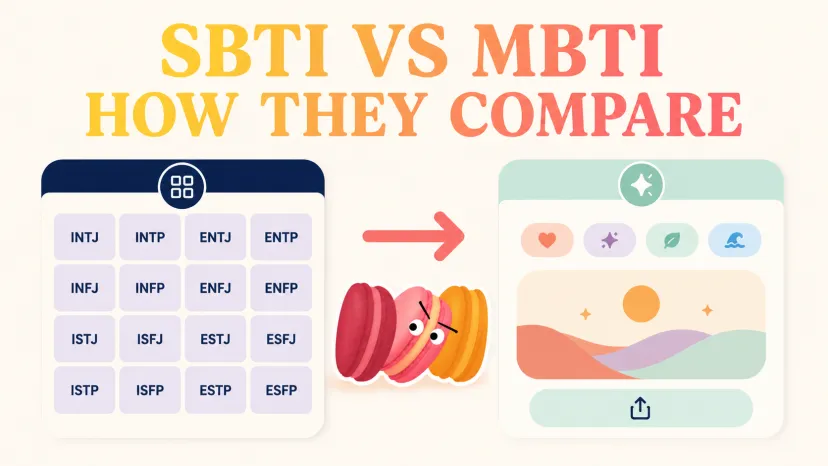
MBTI sorts people into 16 personality types based on four binary dimensions: how you get energy (Introversion vs Extraversion), how you take in information (Sensing vs Intuition), how you make decisions (Thinking vs Feeling), and how you structure your life (Judging vs Perceiving). You answer a questionnaire, get a four-letter code like ENFP or ISTJ, and that code becomes your shorthand.
MBTI became the default personality language for a reason. It gave people a vocabulary for differences that are real — how your coworker processes conflict isn't the same as how you do, and having a label for that made the gap feel navigable instead of personal. The Myers-Briggs Company reports that 88% of Fortune 500 companies have used the assessment at some point. It shows up in leadership workshops, onboarding packets, and college orientation programs.
That said — the science is genuinely contested. A peer-reviewed analysis published in Social and Personality Psychology Compass found the underlying theory doesn't hold up well against rigorous criteria, noting issues with testability and internal contradictions. Meanwhile, defenders of MBTI argue that the deep theoretical roots and decades of refinement give it more grounding than critics acknowledge.
I'm not here to settle that debate. But it's the backdrop for why something like SBTI even exists.
What SBTI Gets Right
Where It Came From
SBTI stands for "Silly Big Type Indicator" — though the Chinese abbreviation carries an intentionally crude double meaning that's part of the joke. It was created by a Bilibili content creator known as QuRouErChuan in early April 2026, originally as a gag to convince a friend to stop drinking. The quiz even has a hidden "drunkard" personality type triggered by specific answer combinations.
Within a day of going live, the original video pulled over 2 million views. WeChat Index searches for "SBTI" hit 40.85 million on April 9th alone. The test link crashed from traffic and had to be restored.
The quiz asks around 31 absurd questions, scores you across 15 behavioral dimensions, and assigns you one of 27 personality types with names like DEAD (professional burnout), MALO (hustle-culture dropout), CTRL (the controller), ATM-er (the friend who always pays), and FAKE (the social shapeshifter).
Why It Spread Faster
No signup. No paywall. Results that are built to be screenshotted. That's the formula.
But it's more than just convenience. As Global Times cultural reporter Ji Yuqiao noted, SBTI taps into something real about how young people relate to identity right now — with humor and self-mockery replacing rigid categorization. Nobody shares their SBTI result because they think it's scientifically accurate. They share it because it's funny, it's specific enough to sting a little, and it gives their group chat something to argue about for twenty minutes.
MBTI says "you're an intuitive thinker." SBTI says "you're emotionally flatlined and can't even muster the energy to disagree." One of those gets a screenshot. The other gets filed away.
Side-by-Side Comparison
Purpose
MBTI aims to help people understand their psychological preferences — how they perceive the world and make decisions. It's designed for self-discovery, team dynamics, and professional development.
SBTI aims to make you laugh, feel seen, and send a screenshot to your friends. It's designed for entertainment and social sharing, full stop.
Methodology
MBTI uses forced-choice questions mapped to Jungian theory, producing one of 16 types across four dimensions. It's been refined through decades of research, even if that research is disputed.
SBTI uses 31 absurd scenario-based questions across 15 behavioral dimensions and five models (Self, Emotion, Attitude, Action, Social). There's no peer review. The creator has openly said she's not a psychology professional.
Tone
MBTI is aspirational. Your type description reads like a LinkedIn summary — strengths, growth areas, ideal careers. It's framed to make you feel understood.
SBTI is a roast. Your type description reads like your most honest friend describing you after three drinks. It's framed to make you laugh at yourself.
Social Media Shareability
MBTI gets shared in bios and dating profiles. It's identity branding — "I'm an ENFJ" signals something about how you want to be seen.
SBTI gets shared in group chats and stories. It's social currency — "I got DEAD" is a punchline, not a personal statement.
MBTI
SBTI
Origin
1940s, USA
April 2026, Bilibili (China)
Types
16
27
Basis
Jungian psychology
Internet culture + humor
Tone
Affirming, professional
Self-deprecating, absurdist
Scientific validity
Debated but decades of research
None claimed
Primary use
Self-understanding, teams
Entertainment, social sharing
Cost
Often paid (official version)
Free, no signup
Why People Are Choosing SBTI Over MBTI Right Now
Self-Roast > Self-Branding
There's a fatigue around personality-as-personal-brand. MBTI became the language of LinkedIn bios and dating app prompts — which means it also started feeling performative. When someone says "I'm an INTJ," there's an implied flex. When someone says "I got DEAD," there's an implied shrug.
As Sixth Tone reported, SBTI captured the mood of a generation exhausted by hustle culture and social performance. The test offers something MBTI can't right now: catharsis through comedy.
Lower Stakes, Higher Relatability
Nobody's building a career development plan around their SBTI type. Nobody's filtering dates by it. That's the appeal. When a personality test explicitly tells you it has zero scientific basis, it removes the pressure to agree with the result or build an identity around it. You can just... laugh.
That small friction got me thinking — the reason SBTI feels refreshing isn't that it's better. It's that it asks nothing of you. MBTI asks you to take it seriously. SBTI asks you to take a screenshot.
Do You Still Need MBTI?
Honestly? It depends on what you're using it for.
If you want a shared vocabulary for talking about real differences in how people work, think, and communicate — MBTI still does that, imperfect science and all. It's not going anywhere in corporate settings or coaching sessions anytime soon.
But if you're looking for something that matches how personality actually gets discussed online right now — fast, funny, low-commitment, and designed to be shared rather than studied — SBTI is where the energy is.
I don't think SBTI replaces MBTI. I think it exposes something MBTI was never built for: the way a generation that grew up online prefers to talk about themselves. Not with frameworks. With memes.
Worth trying if your setup looks anything like mine — genuinely curious but allergic to anything that takes itself too seriously.
FAQ
Is SBTI replacing MBTI?
Not in any formal sense. MBTI is still embedded in corporate training, academic research, and professional coaching. SBTI is a viral entertainment quiz with no institutional backing. They serve completely different purposes. What's true is that SBTI is replacing MBTI in casual online conversation — particularly among younger users in China and increasingly beyond.
Is SBTI based on psychology?
No, and it doesn't claim to be. The creator has stated publicly that the quiz was made for entertainment, and the test's own description calls it a joke-first parody. It touches on behavioral dimensions like attachment style and motivation, but these aren't validated through any psychological methodology.
Which is more accurate?
Neither test gives you a clinical diagnosis. MBTI has more research behind it, but its test-retest reliability has been questioned — studies suggest a significant percentage of people get a different type when they retake it. SBTI makes no accuracy claims at all. If "accurate" means "feels like it describes me," both tests can hit that mark, for very different reasons.
Can you use both?
Of course. They're not competing systems — they're different species entirely. Use MBTI when you want a structured way to think about personality differences. Use SBTI when you want to roast yourself in a group chat. I took both in the same week and got something useful from each, just in completely different ways.
Why is SBTI going viral outside China?
Because screenshot culture is universal. The test results are visually shareable, the type names are memorable and funny, and the barrier to entry is zero — no signup, no payment, takes five minutes. The self-deprecating humor translates well across cultures, especially among audiences already familiar with MBTI as a reference point.
I’m Maren, a 27-year-old content strategist and perpetual self-experimenter. I test AI tools and micro-habits in real daily life, noting what breaks, what sticks, and what actually saves time. My approach isn’t about features—it’s about friction, adjustments, and honest results. I share insights from experiments that survive a real week, helping others see what works without the fluff.