Simple Counter: Tiny Tracking for Habits and Tasks
Simple Counter: Tiny Tracking for Habits and Tasks

You wanted to know how many times you did the thing. Not a chart, not a streak, not a dashboard — just the number. So you opened a habit app, got asked to name your goal, set a reminder, pick a color, and twenty seconds later you'd forgotten what you were even counting.
Here's the thing — most tracking fails not because people quit, but because the tracking asked for more than the moment was worth.
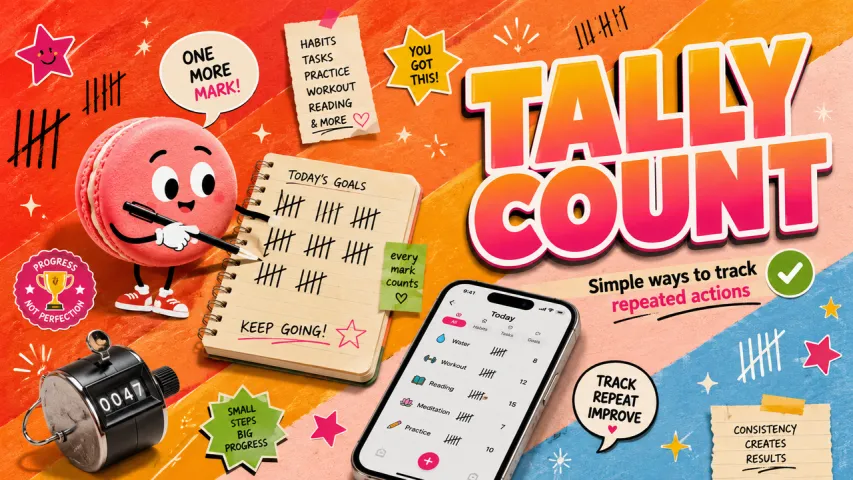
A simple counter solves a smaller problem than a habit app, and that's the point. One tap, one number, no setup. This is about the workflows where that's genuinely useful — what to count, when to tap, and when to stop — so the counting stays in service of doing the thing, not the reverse. If you’re new here, I’m Mary. I write about intentional productivity and building habits without the bloat. Here is the TL;DR of how I approach tracking:
Short version: Use a simple counter when you need to mark something the instant it happens and a full app would be overkill. Count actions you want to repeat, attempts, or small wins. Don't count things you can't act on. And when the number stops changing what you do, stop counting it.

A simple counter works when tracking needs to be instant
The whole value of a counter is the gap between noticing and recording being basically zero. Something happens, you tap, you're done. No deciding which category it goes in, no typing, no opening three screens.
That instant quality matters more than it sounds. A counter app earns its place precisely in the moments a heavier tool would lose you — mid-conversation, mid-set, mid-task, when stopping to log properly would mean not logging at all. The number is captured before the thought disappears.
It helps that the research on building habits points the same direction. Self-monitoring — just keeping track of whether you did the thing — is one of the better-supported supports for following through, and a large meta-analysis found the effect is stronger when you physically record it.

This is also where a counter quietly beats a note or a mental tally. Your memory rounds. "I did that a bunch today" is not the same as a number you actually marked each time.
What to count and what not to count
Not everything deserves a number. The fastest way to make a counter useless is to count things that don't change what you do next. So before you start tapping, it's worth knowing which kinds of things a counter is actually good for — and which it isn't.
Repeated actions
This is the natural fit. Anything you do more than once and want to do again: glasses of water, pushups, pages, times you stepped away from the desk to stretch. The counter turns a vague intention into a visible tally, and the visibility is most of the nudge.
The trick with repeated actions is to tap as it happens, not at the end of the day. A counter tap in the moment is accurate. A reconstruction at bedtime is a guess wearing a number's clothes.
Attempts
This one's underrated. Count the tries, not just the wins — pitches sent, times you spoke up, days you showed up even when it went badly. Counting attempts takes the pressure off the outcome and puts it on the part you control. When the result is out of your hands, a number that only measures whether you tried is the honest one to watch.
Small wins
Tiny things that normally go unmarked: a hard conversation you didn't avoid, a task you closed, a moment you chose the better option. These rarely feel "trackable" because each one is small. The counter is what makes them add up to something you can see.
Interruptions
Here's the counterintuitive one — sometimes the useful number is the bad thing, not the good thing. Count the times you got pulled out of focus, picked up your phone, or context-switched. You're not punishing yourself; you're making an invisible pattern visible, which is the first step to changing it. One caution: only count an interruption if you intend to look at the number later. Counting something you'll never review is just a new way to feel bad in the moment.

Counter app workflows for real life
Knowing what to count is half of it. The other half is the actual rhythm — when the tap happens, and what you do with the number afterward. Here are three workflows that hold up.
Habit count
Pick one behavior you want to repeat. Every time you do it, tap once. That's the entire system. No streak math, no grading yourself — when instant tapping matters, a number counter clicker beats a structured habit app because there's nothing between the action and the record.
The honest caveat from the research: tapping a counter every time isn't the same thing as the behavior becoming automatic. Studies on app-prompted habits note that repetition driven by a tool can differ from a true, context-triggered habit. So treat the count as a scaffold — useful while you're building, not the goal itself. For longer-term tracking, a structured habit tracker template does more than a bare counter.
Task count
Some days the work is the same small thing, many times. Tickets cleared, emails handled, reps of a chore. A counter gives that grinding kind of day a shape — you see the pile shrinking instead of just feeling buried. Tap as each one closes. The satisfaction is real and it's cheap.
Focus reset count
A gentler use. Instead of counting how often you got distracted, count how often you came back — every time you noticed you'd drifted and returned to the task. It reframes attention as something you practice rather than something you failed at.
When a counter is too simple
A counter is a starting tool, not a permanent one, and pretending otherwise is how good tracking goes stale.
It's too simple the moment the number stops answering a question. If you're counting but never looking, or looking but never changing anything, the count has become a ritual instead of a signal. That's the cue to stop — not to track harder.
It's also too simple when you need context, not just frequency. A counter tells you how many. It can't tell you when, why, what else was going on, or whether it's trending the right way over weeks. The moment those questions matter, a bare tally isn't enough, and a fuller progress tracker gives you the higher-level view a counter never will. This is the part I started handing to Macaron, and it's worth being precise about how. Macaron isn't where I tap the count — it's where I think about it afterward. After a stretch of counting something, I'll tell it what I tracked and ask the questions a number can't answer on its own: what changed after I started counting this? Is this still worth tracking? What pattern am I not seeing? Because it remembers what I told it last time, the reflection builds instead of resetting. The counter holds the number. Macaron helps me decide what it means, and whether to keep counting at all.

That division is the whole point. Tap to capture. Reflect to understand. Don't ask one tool to do both.
FAQ
What is a simple counter?
It's a tool for one job: marking how many times something happened, one tap at a time, with no setup or structure around it. If you want the longer story of why a bare tally works and where the idea comes from, our piece on tally counting covers the concept. This page is more about the workflows — when reaching for one actually helps.
How do I use a counter app for habits?
Pick a single behavior, and tap once each time you do it, in the moment rather than at day's end. Keep it to one or two things so the tapping stays effortless. Then, every so often, look at the number and ask whether it's still telling you something. If the count has stopped influencing what you do, that habit has either stuck or stopped mattering — either way, the counter's job there is done.
What is the difference between a click counter app and a tracker?
A click counter app does one thing: increments a number when you tap. A tracker does more — dates, notes, trends, categories, sometimes reminders. The click counter wins on speed and zero friction; the tracker wins when you need to look back and understand patterns over time. Most people need the counter in the moment and a tracker for the longer view, which is why they're better as two tools than one overloaded one.
When should I use a count tracker instead?
Reach for a fuller count tracker when frequency alone stops being enough — when you need to see when things happened, attach context, or watch a trend across weeks rather than within a day. A simple counter is for the instant, in-the-moment mark. A count tracker is for the review later. If you find yourself wishing your counter remembered more than just the total, that's the signal to move up.
You don't need to track your whole life. Most of it doesn't need a number, and the things that do usually need just one.
A simple counter is good at exactly that — one number, captured the instant it matters, kept only as long as it's still telling you something. Tap what helps you act. Let the rest go uncounted. That's not under-tracking — it's paying attention to the part that actually moves.
Recommended Reads







Apply to become Macaron's first friends
Read & discover
Free calculators
Company


