Use case 2: Writing with a more cautious assistant
Use case 3: Reflecting without treating AI as therapy
Where Macaron-style personal AI goes further
FAQ
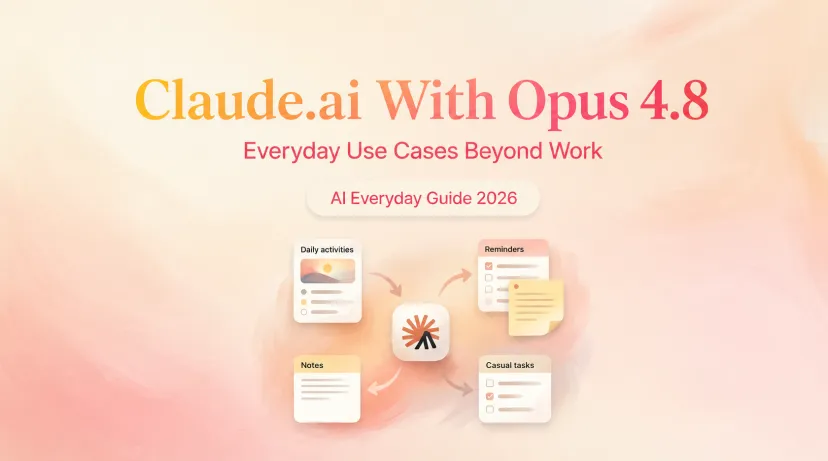
Claude.ai With Opus 4.8: Everyday Use Cases Beyond Work
Claude.ai With Opus 4.8: Everyday Use Cases Beyond Work
Thursday afternoon I was staring at my phone, four browser tabs open, a grocery list abandoned midway, a message I'd been rewriting for twenty minutes, and a vague sense that the week had gotten away from me again. I opened Claude almost by accident — just to think out loud. What happened next wasn't dramatic. More like "oh, I can put this down now."
If you occasionally find your brain at capacity before noon, this might feel familiar. Claude.ai with Opus 4.8 isn't marketed to you — it's mostly described in terms of agentic coding and benchmark numbers. But there are a few things everyday users actually get from it, and none of them require technical background.
I'm Anna and this is what I noticed.
Why everyday users may care about Opus 4.8
Most coverage of Claude AI Opus 4.8 focuses on dynamic workflows and parallel subagents — useful if you're building software. For everyone else, the practical news is smaller but real.
The version released May 28, 2026 introduced two changes that matter outside work. First, a new honesty posture: Anthropic's official release notes describe Opus 4.8 as "more likely to flag uncertainties about its work" and roughly four times less likely than its predecessor to let errors pass unremarked. In practical terms, it's more willing to say "I'm not sure." That's more useful than confident wrong answers when you're making personal decisions you'll live with.
Second, effort control. There's now a dial next to the model selector on claude.ai — available on all plans, including free — that lets you choose how deeply Claude reasons before answering. Lower effort means faster responses; higher effort means more careful thinking. For everyday use, the default is fine. But the lever exists.
Not earth-shattering. But real.
Use case 1: Planning a messy week
What to ask Claude
I used to make weekly plans and lose them by Tuesday. The problem wasn't organization — it was optimism. I'd plan in a vacuum, and then reality would arrive.
What works better: telling Claude what's actually on the table. Not "make me a schedule," but something like — "I have a dentist appointment Wednesday, need a birthday gift before Friday, haven't done laundry in two weeks, and I tend to lose momentum after lunch. Can you help me think through this?"
Claude will ask what matters most, flag conflicts you didn't notice, and sometimes point out you're fitting eleven things into a four-day week. The Opus 4.8 everyday users benefit that's easy to miss: because the model is less likely to generate a confident-sounding plan regardless of feasibility, you end up with something closer to reality.
What to double-check yourself
Claude doesn't know your actual calendar unless you paste it in. The plan it helps you make is only as accurate as the information you give it. More importantly, it won't make the decisions — it surfaces tradeoffs, but the choices are still yours.
Where a personal AI app could go further
The gap is continuity. Claude on claude.ai starts fresh each conversation. It doesn't remember that the laundry keeps showing up uncompleted, or that you always underestimate Wednesday. A personal AI with memory can notice those patterns. For now, Claude AI personal use works well for one-off planning sessions — a thinking partner, not a long-term one.
Use case 2: Writing with a more cautious assistant
What to ask Claude
This is where Claude for daily life earns its place most clearly. I'm a decent writer on good days. On bad days I write the same sentence four times. Claude works in both cases.
The things I keep using it for: messages I can't find the right tone for (I describe the relationship and the worry, it offers a few approaches, I pick and edit); complaints that need to be firm without being aggressive; and summarizing something I understand into something I can explain to a family member who doesn't have background in the topic.
What I've noticed about Opus 4.8 specifically: it's less likely to generate an "improved" version when the original was fine. Earlier versions had a habit of rewriting regardless. This version is more likely to say the original works.
What to double-check yourself
Claude doesn't know your relationship history with the person, your usual communication style, or what happened before this message. The output needs to sound like you — which means editing. For anything high-stakes, the calibrated honesty standards Anthropic describes are real, but Claude is still working from limited context. The draft is a starting point, not a final version.
Where a personal AI app could go further
A personal AI that had learned your communication style over time could flag when you're drifting from your own voice — writing more formally than usual, or hedging more than you typically do. That's a different proposition than a general chatbot that's meeting you for the first time each session.
Use case 3: Reflecting without treating AI as therapy
What to ask Claude
This is the use case I'm most cautious about, and also the one I find genuinely interesting.
There are moments when I want to think something through out loud but don't want to call someone. Something happened and I haven't processed what I think about it. I want to externalize the thought without performing it for an audience.
Claude works for this in a narrow way. I'll write out what's on my mind and ask it to reflect back what it's hearing, or ask questions I might not be asking myself. Sometimes that's enough — the act of writing something coherently, with the expectation that something will respond, changes how I hold it.
What I don't do: treat these conversations as therapy. The American Psychological Association classifies AI as "emerging adjuncts" — things that can support reflection but don't replace clinical care. That framing is right. Useful for processing ordinary moments. Not for anything heavier.
What to double-check yourself
Claude doesn't have genuine empathy. It can model what a caring response looks like, but it's not sensing how you're doing. You're still responsible for knowing the difference between a rough afternoon and something that warrants actual support.
Where a personal AI app could go further
A personal AI that remembered your emotional patterns over time — what kinds of weeks tend to be harder, what situations generate this particular kind of uncertainty — could offer something Claude can't: a perspective that comes from actually knowing you, not just the paragraph you just typed.
Where Macaron-style personal AI goes further
Claude.ai is a powerful general tool. For one-off tasks, Claude AI Opus 4.8 extends comfortably into daily life — the honesty improvements make it a slightly more trustworthy thinking partner than earlier versions.
But the limits follow a pattern: they show up wherever continuity would matter. Claude doesn't accumulate knowledge of you. It doesn't notice that Tuesday is always harder, or that the laundry has appeared in your weekly plans four times running.
A personal AI built around memory and warmth — the kind Macaron is designed to be — addresses exactly this gap. Not by being smarter than Claude, but by being for you specifically, over time. The general chatbot is a thoughtful stranger. The personal AI is something closer to someone who's been paying attention.
FAQ
What can I use Claude.ai with Opus 4.8 for?
Beyond developer features, Claude AI Opus 4.8 works for everyday tasks. The most common Claude Opus 4.8 use cases for non-technical people: thinking through a messy week, drafting stuck messages, explaining something complicated in plain terms, and talking through decisions you keep circling. The May 2026 update emphasizes honesty — Claude is now more likely to say when it's uncertain rather than generate a confident wrong answer.
How can I use Claude Opus 4.8 for daily planning?
Give it your actual week, not an idealized one. Tell it what's competing, where your energy drops, and what you've been avoiding. It's more useful as a thinking partner than a calendar tool. The new effort control in claude.ai (available on all plans) lets you dial up more careful reasoning when the decision actually matters.
Is Claude Opus 4.8 safe to use for personal decisions?
For low-stakes decisions — prioritizing your week, wording something, thinking through a situation — it's a fine sounding board. For anything involving medical, legal, financial, or mental health weight, it's a starting point at best. Opus 4.8 is designed to flag its own uncertainty, but it doesn't know the full context of your life. Treat it like a well-read friend, not a professional.
When is a personal AI app better than a general chatbot?
When continuity matters. Claude.ai starts fresh each session — it doesn't remember your patterns or what you were working through last week. A personal AI designed to hold context over time offers something different: not smarter answers to individual questions, but a perspective that comes from sustained attention. For habit formation, emotional support, or anything where patterns matter more than single answers, a memory-first app fills a gap that general chatbots leave open.
That week sorted itself out, the way weeks do. The message got sent. The laundry still didn't get done.
Some things Claude can't fix. But for the part where I was trying to see the week clearly — it helped. That's about the right expectation.
Hi, I'm Anna, an AI exploration blogger!
After three years in the workforce, I caught the AI wave—it transformed my job and daily life. While it brought endless convenience, it also kept me constantly learning. As someone who loves exploring and sharing, I use AI to streamline tasks and projects: I tap into it to organize routines, test surprises, or deal with mishaps. If you're riding this wave too, join me in exploring and discovering more fun!