Tally Count: Simple Ways to Track Repeated Actions
Tally Count: Simple Ways to Track Repeated Actions

You're three sets into a workout and you've lost count of your reps. Was that eight? Nine? You start over, half-annoyed, because there was nothing holding the number except your own head.
Hi, I’m Mary. As a digital minimalist, I believe keeping count of something — reps, glasses of water, how many times you caught yourself reaching for your phone — shouldn't take more than a stroke on a page. That's the whole idea behind a tally count: one mark per thing, no setup, nothing to open.
This is a quick tour of when tallying actually earns its place, what's worth counting, and when to put the pen down.
The quick version
- A tally is the fastest record there is: one mark, in the moment.
- Count things that are small, repeat often, and where you mainly want the number.
- Paper, app, or clicker — pick by the moment, not by which is "best."
- The number is only useful if it changes something.
- A good count has an end.
Tally counting is useful when speed matters
The appeal of a tally count is speed. You make one mark the instant something happens, and you're back to what you were doing before the thought fully lands. No app to unlock. No row to fill in. No deciding which bucket it belongs in.
There's a reason the marks bunch into fives. Four straight lines, then a diagonal slash across them — the five-bar gate — so you read the page in groups instead of counting every line. It's a tiny trick that's been around for thousands of years, and it still works.

That's the trade you're making: a tally gives up detail to gain speed. It won't tell you when or why something happened. It only tells you how many. When how many is the whole question, nothing beats it.
What repeated actions are worth tallying
Not everything deserves a mark. Tallying pays off when an action is small, repeats often, and the count is the thing you actually care about. A few cases fit that shape well.

Habits
Counting a habit is the quietest way to notice it. Glasses of water, days you stretched, times you stepped outside — a mark each makes the pattern visible without any judgment attached. And the recording itself is a nudge: noticing how often you do something is a recognized way to start shifting the behavior, whether you mark it on paper or in an app.
Tasks
For small, repeating tasks — emails cleared, problems solved, reps of a chore — a tally turns invisible effort into something you can see. It's less about output and more about proof: yes, you did the thing, this many times.
Events
Some counts are about things happening around you, not by you. How many times a toddler asks "why," how many cars pass, how often a class raises a hand. In classrooms and behavior settings this even has a name — event recording, counting how often a specific thing occurs in a set window. A margin full of marks does the job.
Small wins
And then the gentlest use: counting small wins. Not to hit a target, but to watch them stack. Five marks for five times you chose the harder-but-better thing this week is a small, real record that the effort happened.
Tally count app vs paper marks
Paper has one unbeatable quality: it's already there. No battery, no unlock, no notification pulling you somewhere else. For most quick counts, the corner of a notebook is plenty.
A tally count app earns its place when you want the number to survive — to still be there next week, synced across your phone and laptop, without a photo of a scribbled page. A good tally tracker will also total things for you and start fresh with a tap.
In between sits the humble clicker. A counting clicker — that little handheld counter, the classic tally counter you press with your thumb — is perfect when your hands are busy or your eyes are elsewhere: counting people through a door, laps, birds, reps. One press, no looking.
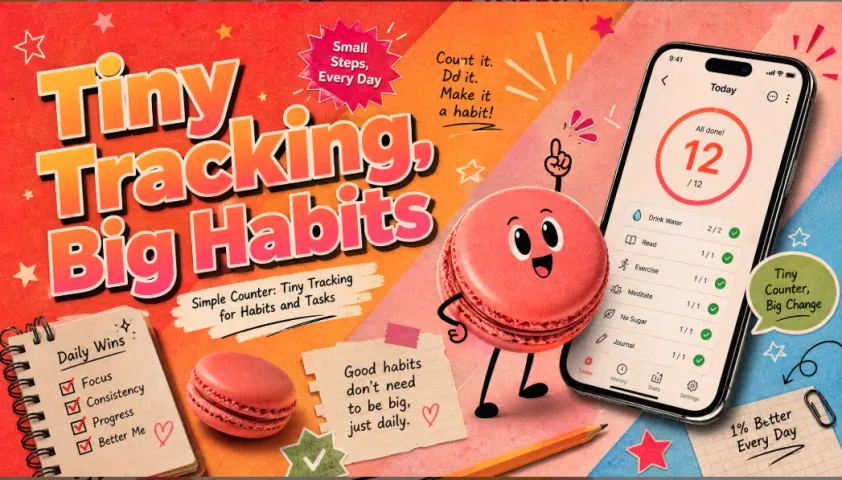
None of these is "better." They suit different moments. If you mostly want the app version with a clean, reusable count, our Simple Counter is made for exactly that — this piece is about the method; that one walks you through the tool itself.

When tallying becomes noise
Counting has a tipping point. Past it, the marks stop helping and start nagging.
The sign is simple: if the number never changes what you do, you're just collecting it. A tally of how many times you sighed at your desk isn't insight — it's one more thing to maintain. Counting everything is its own kind of busywork, and research on self-tracking notes that people quietly drop it once it stops feeling worth the effort.
Here's the mistake I kept making: I'd start counting three things at once, miss a day, then abandon all of them because the record felt "ruined." One clean count you actually keep beats four you give up on by Thursday.
A tally also stops at the number. It tells you how many, never so what. That's the moment a count is worth talking through — and where Macaron can quietly help, less as another thing to set up and more like a friend who remembers what you've been counting and asks the obvious next question: is this going the way you wanted? Thanks to Deep Memory, it picks up where you left off instead of making you start the explanation over. The mark is yours. The reflection is the part worth sharing.

FAQ
What does tally count mean?
A tally count is a running count kept with simple marks — one stroke for each thing, usually grouped in fives so it stays readable. It's counting in its most stripped-down form: no categories, no timestamps, just how many.
How do I use a counting clicker?
Hold it in one hand and press the button once each time the thing you're counting happens. The number climbs on the little dial. When you're done, read it off and reset it to zero for the next round. A counting clicker shines when you can't look away — counting people, laps, or reps — because it asks for no screen and no writing.
Is a tally tracker better than a habit tracker?
They do different jobs. A tally tracker answers how many, right now, with as little friction as possible. A habit tracker is built for the long game — streaks, weeks, patterns over time. If you're following something for months, a Habit Tracker Template fits better. If you just need today's count, a tally wins on speed. Neither replaces the other.
When should I stop counting?
Stop when the count stops changing anything. If you already know the answer, or the number no longer points to a decision, the tally has done its job — keeping it going past that just adds upkeep. A good count has an end. (For tracking meant to run longer and show movement over time, a Progress Tracker is the wider view — a tally is immediate and narrow; a progress tracker is the slow, longer arc.)
A tally count is almost too plain to write about — a few marks, a number, done. But maybe that's the point. The things that actually stick are usually the ones that ask the least of you. Pick one thing worth counting this week, and keep count only as long as the number still tells you something. When it stops — let it.
Recommended Reads






Apply to become Macaron's first friends
Read & discover
Free calculators
Company


