Guitar Power Chords: Shapes, Muting, and Simple Riffs
Guitar Power Chords: Shapes, Muting, and Simple Riffs

A power chord can have the right fingering and still sound untidy. One open string ringing by accident is enough to blur it. I prefer to learn guitar power chords with a clean tone first: locate the root, add its fifth, and make every unused string stay quiet.
The diagrams and two-bar riff below are original. Their notes and string relationships have been checked against instructor-authored and manufacturer sources. All main examples use a six-string guitar in standard tuning.
Find the Root and Fifth
A power chord contains two different notes: a root and its perfect fifth. A third note may repeat the root one octave higher. Fender’s power chord explanation shows why the chord name ends in 5.

G5: G root + D fifth G5 with octave: G + D + G
C5: C root + G fifth C5 with octave: C + G + C
There is no third. G major contains B, while G minor contains B-flat; G5 contains neither. That is why a power chord alone does not state major or minor quality.
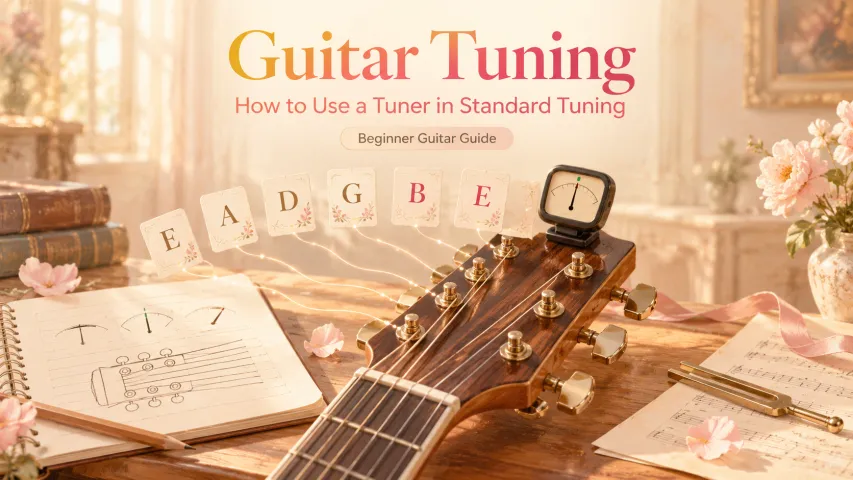
The diagrams assume standard tuning, E–A–D–G–B–E from the sixth string to the first, as listed in Fender’s standard tuning guide.
In each diagram, R is the root, 5 is the fifth, 8 is the octave, and x means that the string must remain silent. n represents the root fret; n+2 is two frets higher.
Use Two Movable Shapes
The first shape places its root on the sixth string. The second places it on the fifth. Berklee’s instructor-authored Guitar Fundamentals course treats these as separate beginner skills, which is also how I would practise them.
Roots on the Sixth String
Place the root on the sixth string and the fifth two frets higher on the fifth string. Add the octave on the fourth string at the same fret as the fifth.
Sixth-string root

String:   1e   2B   3G   4D    5A    6E
Two-note:  x    x    x    x    n+2    n
Role:                         fifth  root

Three-note:
           x    x    x   n+2   n+2    n
Role:                    octave fifth root
For G5, the root fret is 3:
G5, low to high: 3–5–5–x–x–x
6th string, fret 3 = G root 5th string, fret 5 = D fifth 4th string, fret 5 = G octave
Use the index finger for the root, ring finger for the fifth, and little finger for the octave. Move the entire shape without changing its spacing. Fret 1 gives F5, fret 3 gives G5, and fret 5 gives A5. Open E5 uses 0–2–2–x–x–x.

Roots on the Fifth String
Now place the root on the fifth string. The fifth is two frets higher on the fourth string, and the optional octave sits at that same higher fret on the third string. The sixth string must be muted.
Fifth-string root

String:   1e   2B   3G    4D    5A   6E
Two-note:  x    x    x    n+2    n    x
Role:                    fifth  root

Three-note:
           x    x   n+2   n+2    n    x
Role:          octave fifth root
For C5, n is fret 3:
C5, low to high: x–3–5–5–x–x
5th string, fret 3 = C root 4th string, fret 5 = G fifth 3rd string, fret 5 = C octave
Move the shape two frets higher for D5: x–5–7–7–x–x. The chord name always follows the root. A guitar power chords chart becomes much easier to read once you know which dot represents that root.
Keep Unwanted Strings Quiet
The x marks are part of the chord. Fender’s guide to chord-chart symbols defines an x as a string that should be muted or left unplayed.

For a sixth-string-root shape, let the fretting fingers rest lightly against the higher strings. For a fifth-string-root shape, allow the tip or upper edge of the index finger to touch the low sixth string. That contact should stop the string without pressing it onto a fret.
Use this check before moving either shape:
- Form the chord without strumming.
- Pluck all six strings separately.
- Confirm that the root, fifth, and optional octave ring clearly.
- Confirm that every
xstring produces only a quiet click. - Strum only the intended string group.
- Release fretting pressure while keeping contact with the strings to stop the sound.
If an intended note buzzes, move the fingertip closer to the fret and check whether another finger is touching that string. If an unused string rings, add light fretting-hand contact and narrow the picking motion.
Record one slow strum of each shape if the problem is hard to locate while playing. Listen to the recording string by string: a bright high note usually points to an unmuted first, second, or third string, while an unexpected low note in a fifth-string-root chord usually comes from the sixth string.
Palm muting is a separate action. Rest the edge of the picking hand lightly on the sounding strings close to the bridge. The pitch should remain audible, but the note should become shorter. This can control a riff; it does not replace the fretting-hand contact that silences unwanted strings.
Use comfortable pressure and keep the wrist relaxed. Stop if you feel persistent pain, tingling, or numbness, and seek appropriate help from a qualified teacher or healthcare professional.
Put the Shape Into a Short Riff
This original riff uses both root positions. E5, G5, and A5 begin on the sixth string; C5 and D5 begin on the fifth. It is in 4/4, and every chord shown is an eighth note. R is an eighth-note rest.
Count: | 1  &  2  &  3  &  4  & | 1  &  2  &  3  &  4  & |
Chord: | E5 E5 G5 G5 A5 A5 G5 R | C5 C5 D5 D5 E5 E5 E5 R |
1 & 2 & 3 & 4 & 1 & 2 & 3 & 4 & e|------------------|------------------| B|------------------|------------------| G|------------------|5-5-7-7-----------| D|2-2-5-5-7-7-5-----|5-5-7-7-2-2-2-----| A|2-2-5-5-7-7-5-----|3-3-5-5-2-2-2-----| E|0-0-3-3-5-5-3-----|--------0-0-0-----| R R
Numbers aligned vertically sound together. Start with slow downstrokes. Lightly palm-mute the paired chords on beats 1, 2, and 3, then let the chord on beat 4 ring until the rest.
Practise `E5–G5–A5–G5` and `C5–D5–E5` separately before joining the bars. Release most fretting pressure during each move, but keep the fingers close to the strings. Listen for a clear root and fifth, followed by complete silence on each rest.
If the move itself creates noise, pause after every chord and check the next shape before striking it. Then shorten the pause gradually while keeping the same clean result.
## FAQ
### Can I move these shapes onto a seven-string guitar's lowest strings?
Yes, when the tuning preserves the same interval between adjacent strings. In common B–E–A–D–G–B–E tuning, a seventh-string root uses a fifth two frets higher on the sixth string and an octave at that same fret on the fifth. Check the tuning first; a dropped lowest string can change the required shape.
### Can power chords replace both major and minor chords in a song?
Sometimes. Since the third is missing, a power chord can sit over some major or minor harmony without stating either quality. It cannot preserve every arrangement. A melody or another instrument may depend on the missing third, seventh, or another chord tone.
### How does drop D change a sixth-string power chord shape?

Drop D lowers the sixth string from E to D. The lowest strings become D–A–D, allowing the root, fifth, and octave to line up at one fret across strings 6, 5, and 4. Yamaha’s [drop D guide](https://hub.europe.yamaha.com/articles/the-beginners-guide-to-guitar-tunings-standard-drop-d-open-tunings-and-more) confirms this relationship. Fifth-string-root shapes remain unchanged.
### Do power chords need distortion to sound right?
No. They work through a clean amplifier and on an acoustic guitar. Distortion makes the sound denser, but it also exposes poor muting. Learning the shape cleanly makes it easier to tell whether every intended note rings and every unwanted string stays silent.
### Can I use the same shapes on a bass guitar?
The root-and-fifth idea transfers to a bass. In standard E–A–D–G tuning, the adjacent-string, two-fret relationship still works. The low register can sound crowded, so bass parts often play the notes separately or use only the two-note form. Follow the instrument’s tuning rather than copying the guitar shape by appearance.
Begin with one G5 and one C5. Check all six strings, move each shape without squeezing, and then play the riff slowly. Clear notes and quiet unused strings are what make **guitar power chords** sound finished.
***
**Previous posts:**
* [Guitar Music Theory for Beginners: Notes, Scales, and Chords](https://macaron.im/blog/life/guitar-music-theory-notes-chords)
* [Guitar Fretboard Notes: Find the Notes Step by Step](https://macaron.im/blog/life/guitar-fretboard-notes)
* [Guitar Chord Progressions for Beginners](https://macaron.im/blog/life/guitar-chord-progressions-beginner-patterns)
* [Barre Chords for Guitar: Get Clearer Notes](https://macaron.im/blog/life/barre-chords-guitar-clear-notes)
* [Guitar Tuning: How to Use a Tuner in Standard Tuning](https://macaron.im/blog/life/guitar-tuning-with-a-tuner)











Candidatar-se para se tornar Os primeiros amigos de Macaron
Ler e descobrir
Assistente pessoal de IA
Calculadoras gratuitas


