Calculadora do Maior Fator Comum
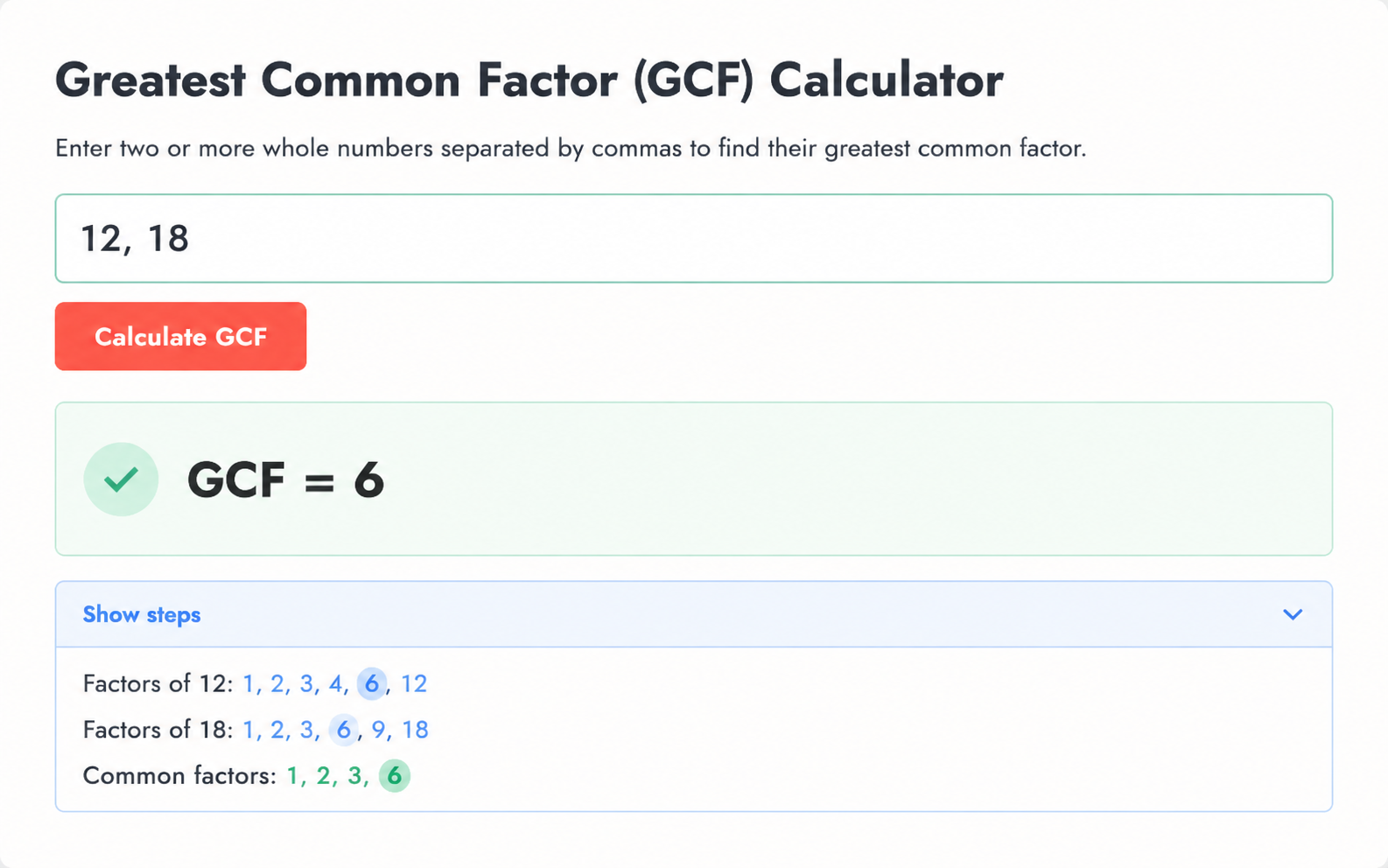
Calcule o MFC de dois ou mais números usando métodos de fatoração primária e algoritmo de Euclides. Obtenha resultados instantâneos com explicações passo a passo.
If you need to calculate GCF for homework, simplify a fraction, compare GCF and LCM, or check the GCF of 3 numbers, this page gives you both the answer and the method behind it.
O que é o Maior Fator Comum (MFC)?
O Maior Fator Comum (MFC), também conhecido como Máximo Divisor Comum (MDC) ou Maior Divisor Comum (MDC), é o maior número inteiro positivo que divide dois ou mais números sem deixar resto. É um conceito fundamental na teoria dos números e tem ampla aplicação em matemática, álgebra e ciência da computação.
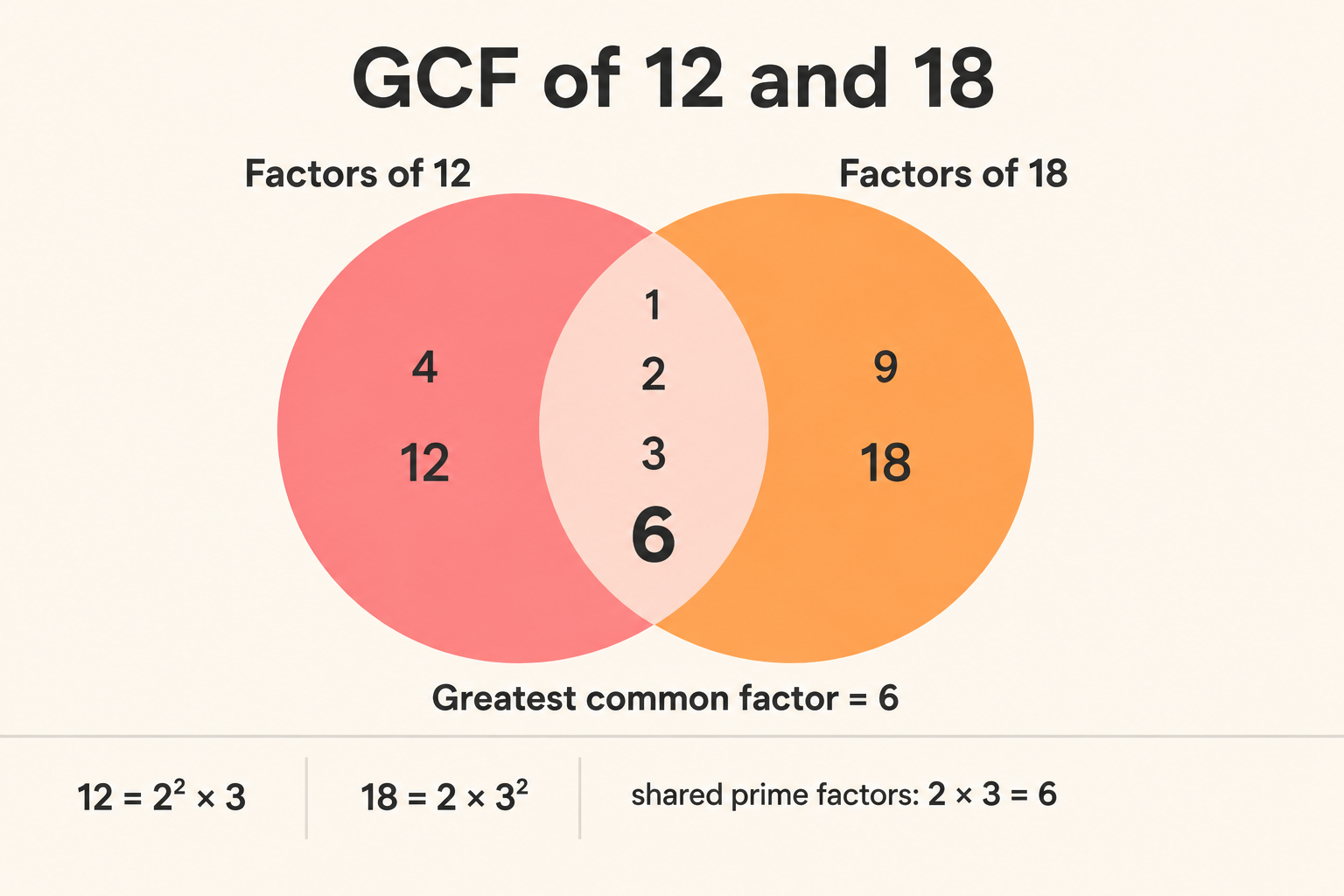
Por exemplo, o MFC de 12 e 18 é 6, porque 6 é o maior número que divide tanto 12 quanto 18 igualmente. O MFC é particularmente útil na simplificação de frações, na busca de denominadores comuns e na resolução de problemas que envolvem razões e divisibilidade.
GCF vs GCD vs HCF — are they the same?
Yes. GCF, GCD, and HCF usually mean the same thing. GCF means greatest common factor. GCD means greatest common divisor. HCF means highest common factor. Different textbooks and regions may use different names, but all three refer to the largest number that divides the given numbers evenly.
Como Usar a Calculadora de MFC
Use this section if you are wondering how to find GCF on calculator tools without doing every step by hand.
- Insira Seus Números: Digite dois ou mais números inteiros positivos separados por vírgulas no campo de entrada (ex.: 330, 75, 450, 225).
- Clique em Calcular: Pressione o botão 'Calcular MFC' para computar o maior fator comum.
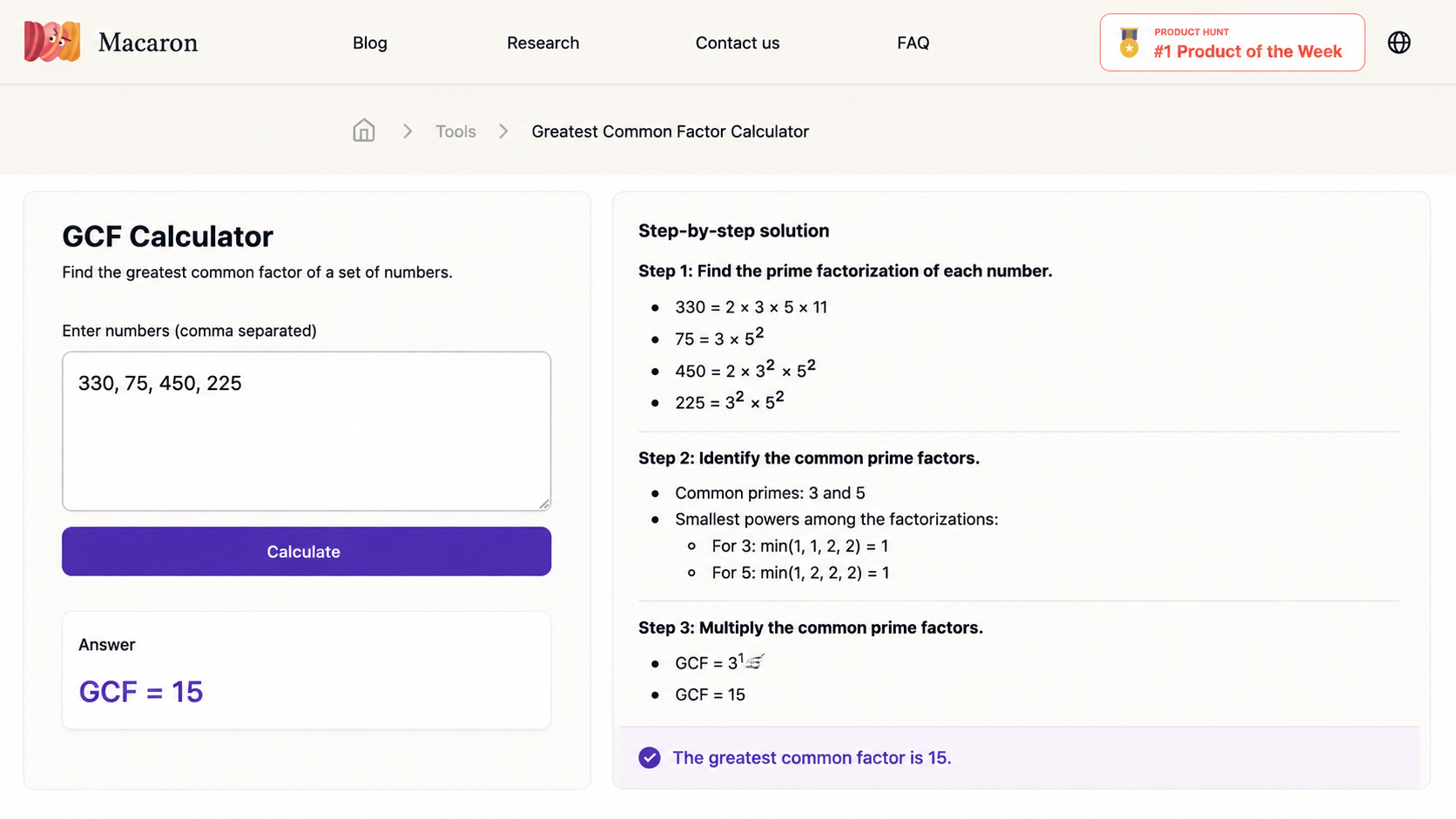
- Veja os Resultados: A calculadora exibe o valor do MFC, a fatoração primária de cada número com fatores comuns destacados e cálculos passo a passo usando o algoritmo de Euclides (para dois números).
Insights Principais Sobre o MFC
- Múltiplos Métodos de Cálculo: O MFC pode ser calculado usando vários métodos, incluindo listar todos os fatores, fatoração primária ou o algoritmo de Euclides. Cada método tem suas vantagens, dependendo do tamanho e do número de inteiros envolvidos.
- Essencial para Simplificação de Frações: O MFC é crucial para reduzir frações à sua forma mais simples. Dividindo tanto o numerador quanto o denominador pelo seu MFC, obtém-se a fração simplificada.
- Aplicações em Criptografia: O MFC e os algoritmos relacionados desempenham um papel vital na criptografia moderna, particularmente na criptografia RSA e outros sistemas de segurança baseados na teoria dos números.
- Sempre um Número Inteiro Positivo: O MFC é sempre um número inteiro positivo e, para qualquer conjunto de números, o MFC é pelo menos 1 (já que 1 divide todos os inteiros).
- A Eficiência Importa: Para números pequenos, a fatoração primária é intuitiva e fácil de entender. Para números maiores, o algoritmo de Euclides é mais eficiente e computacionalmente mais rápido.
Métodos para Calcular o MFC
There are three common ways to calculate the GCF: listing the factors, using prime factorization, and using the Euclidean algorithm. Each one gives the same answer, so how to calculate the GCF really comes down to which method fits your numbers.
1. Listando Todos os Fatores
Este método envolve listar todos os fatores de cada número e identificar o maior fator comum. Embora direto para números pequenos, torna-se impraticável para inteiros maiores.
tools.gcfCalculator.method1Example
This method is simple for small numbers and is a good way to learn what "common factor" means.
2. Fatoração Primária
Divida cada número em seus fatores primos, depois multiplique os fatores primos comuns (com as menores potências) para encontrar o MFC. Este método é visual e ajuda a entender a estrutura dos números.
Exemplo: 12 = 2² × 3 e 18 = 2 × 3². Fatores comuns: 2¹ × 3¹ = 6, então MFC = 6.
Prime factorization is useful when you want to see the structure of each number and understand why the answer works.
3. Algoritmo de Euclides
Este algoritmo antigo e eficiente aplica repetidamente o processo de divisão: divida o número maior pelo menor, substitua o maior pelo menor e o menor pelo resto. Continue até que o resto seja 0. O último resto não nulo é o MFC.
Exemplo: MFC(48, 18): 48 = 18 × 2 + 12, depois 18 = 12 × 1 + 6, depois 12 = 6 × 2 + 0. MFC = 6.
Factor Out the GCF of Variables, Monomials & Polynomials
A factoring GCF calculator helps with the same core idea: find the largest factor shared by every term, then factor it out. For a numeric expression: 6 + 12 = 6(1 + 2). For an algebraic expression: 6x + 12 = 6(x + 2).
For monomials and polynomials, the GCF may include numbers, variables, or both. Example: 8x² + 12x = 4x(2x + 3). This page's calculator focuses on numeric GCF for positive integers. If you are looking for a factor out GCF calculator for variables, monomials, or polynomials, use the same rule: find the shared numerical factor and the shared variable part with the lowest exponent.
GCF and LCM Calculator – Find Both Together
A GCF and LCM calculator helps you compare two related ideas. GCF is the greatest number that divides the given numbers evenly. LCM is the smallest number that the given numbers divide into evenly.
For two positive integers:
GCF × LCM = product of the two numbers
Example: for 12 and 18: GCF = 6, LCM = 36, 12 × 18 = 216.
The relationship between GCF and LCM
That formula is more than a trick. Because every prime factor of the two numbers ends up in either the GCF (the shared part) or the LCM (the combined part), multiplying them always rebuilds the original product. So if you already know the GCF, you can find the LCM fast:
LCM = (a × b) ÷ GCF
For 12 and 18: (12 × 18) ÷ 6 = 216 ÷ 6 = 36.
Note that this shortcut works cleanly for two numbers. For three or more, calculate the LCM directly instead of dividing the full product by the GCF.
Simplify Fractions Using the GCF
Simplifying fractions using the GCF is one of the most common reasons people reach for a GCF fraction calculator. The idea is simple: divide the numerator and the denominator by their GCF, and the fraction is reduced to lowest terms in one step.
Example: reduce 24/36. The GCF of 24 and 36 is 12. 24 ÷ 12 = 2, 36 ÷ 12 = 3. So 24/36 simplifies to 2/3.
If you divide by a common factor that is not the greatest one, you will still need to simplify again. Using the GCF gets you to lowest terms immediately, which is why it is the cleanest method for reducing any fraction.
Find the GCF of 3 or More Numbers
A GCF of 3 numbers calculator works the same way as it does for two numbers. The GCF of a longer set is the largest integer that divides every number in the set. By hand, the easiest approach is to take the GCF two numbers at a time: find GCF(a, b), then find GCF of that result and c.
Find GCF(a, b), then find GCF of that result and c.
Example: find the GCF of 24, 36, and 60. GCF(24, 36) = 12, then GCF(12, 60) = 12. So the GCF of 24, 36, and 60 is 12.
This pairwise method scales to any number of values, and it is exactly what the calculator does internally when you enter a longer set.
Worked Examples – Common GCF Calculations
These are some of the GCF pairs people look up most often. Each one is worked the short way so you can check your own answer quickly.
| Numbers | Shared factors | GCF |
|---|---|---|
| 12 and 18 | 1, 2, 3, 6 | 6 |
| 8 and 12 | 1, 2, 4 | 4 |
| 16 and 24 | 1, 2, 4, 8 | 8 |
| 18 and 24 | 1, 2, 3, 6 | 6 |
| 15 and 25 | 1, 5 | 5 |
| 24 and 36 | 1, 2, 3, 4, 6, 12 | 12 |
For the most common classroom example, the GCF of 12 and 18 is 6, because 6 is the largest number that divides both 12 and 18 without leaving a remainder.
Coprime numbers — when the GCF is 1
Sometimes two numbers share no common factor other than 1. When that happens, the GCF is 1, and the numbers are called coprime (or relatively prime).
Example: 8 and 15. Factors of 8: 1, 2, 4, 8. Factors of 15: 1, 3, 5, 15. The only shared factor is 1, so the GCF of 8 and 15 is 1. A fraction like 8/15 is already in lowest terms, because there is nothing left to divide out.
Aplicações no Mundo Real do MFC
- Simplificação de Frações: Reduza frações aos seus termos mais baixos dividindo tanto o numerador quanto o denominador pelo seu MFC.
- Encontrando Denominadores Comuns: Ao adicionar ou subtrair frações, o MFC ajuda a encontrar o menor múltiplo comum (MMC) para denominadores comuns.
- Resolvendo Equações Algébricas: Fatore o MFC de expressões polinomiais para simplificar e resolver equações mais facilmente.
- Teoria dos Números e Criptografia: O MFC é fundamental em algoritmos usados para criptografia, assinaturas digitais e comunicações seguras.
- Problemas de Otimização: Em ciência da computação, o MFC é usado para otimizar algoritmos, reduzir a complexidade computacional e resolver problemas que envolvem divisibilidade e aritmética modular.
Perguntas Frequentes (FAQ)
Qual é a diferença entre MFC e MMC?
O MFC (Maior Fator Comum) é o maior número que divide todos os números dados igualmente, enquanto o MMC (Mínimo Múltiplo Comum) é o menor número que é múltiplo de todos os números dados. Eles estão relacionados: MFC × MMC = Produto dos dois números (para dois números).
O MFC pode ser maior que o menor número?
Não, o MFC não pode ser maior que o menor número do conjunto. O MFC é sempre menor ou igual ao menor número.
Qual é o MFC de dois números primos?
O MFC de dois números primos diferentes é sempre 1, porque os números primos não têm fatores comuns além de 1.
Como encontro o MFC de mais de dois números?
Você pode encontrar o MFC de múltiplos números encontrando primeiro o MFC de dois números, depois encontrando o MFC desse resultado com o próximo número, e assim por diante. Alternativamente, use a fatoração primária para identificar todos os fatores primos comuns.
Por que o algoritmo de Euclides é eficiente?
O algoritmo de Euclides é eficiente porque reduz o tamanho do problema rapidamente a cada passo, tornando-o muito mais rápido do que listar todos os fatores, especialmente para números grandes. Sua complexidade de tempo é logarítmica.
Qual é o MFC de 0 e qualquer número?
O MFC de 0 e qualquer número não nulo n é o próprio n, porque todo inteiro divide 0. No entanto, em aplicações práticas, normalmente trabalhamos apenas com números inteiros positivos.
Need More Than a Calculator? Meet Macaron
A GCF calculator solves one problem well. But homework, study sessions, and everyday questions rarely stop at a single calculation.
Macaron is a personal AI that remembers what you are working on and can build small tools, walkthroughs, and study help around the way you actually learn. If you find yourself reaching for one calculator after another, it is a way to keep all of that in one place that adapts to you.
Create your own tools with MacaronRelated tools and reading
Referências e Leituras Adicionais
Ler e descobrir
Assistente pessoal de IA
Calculadoras gratuitas


