Piano Practice Routine: What to Do Each Day
Piano Practice Routine: What to Do Each Day

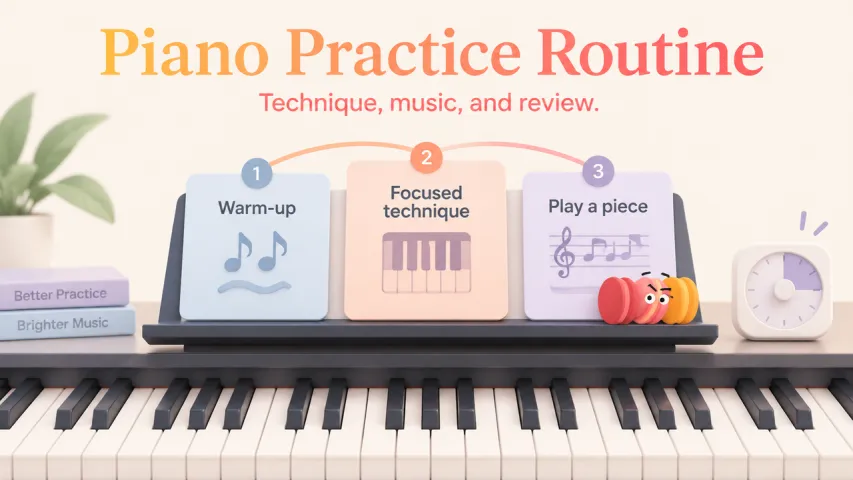
A useful piano practice routine begins with one improvement to work on today. If you have already started learning but hesitate when you sit down, follow this Session Spine: settle → focus → repair → complete → leave a next-start note. Prepare comfortably, work on a relevant skill, repair a small passage, play something through, and record where to begin next time.
Fifteen, thirty, and sixty minutes change how deeply you explore those steps. They do not promise particular progress or determine whether a session counts.
Decide What Today's Practice Needs to Improve
Open your last note or teacher's assignment. Choose something you can hear or describe: keeping a transition moving, clarifying a rhythm, or noticing an uncomfortable starting motion. “Improve this piece” is too broad; “connect these two measures without the usual pause” gives you a place to begin.
Choose a target that fits today's attention and available time. The phone illustrations here show conceptual planning flows, not actual product screens.

Build a Repeatable Practice Session
The Session Spine gives each activity a purpose. A beginner piano practice routine can use familiar material throughout; you do not need a new exercise for every block.
Arrive, Settle, and Warm Up
Take a moment for comfortable posture and gentle movement before playing familiar, undemanding material. BAPAM warm-up guidance emphasizes preparation, posture awareness, breaks, and stopping when pain occurs.
These movement and timing suggestions are educational examples. Stop playing if you experience pain, numbness, persistent tension, or other concerning symptoms, and consult a qualified teacher and an appropriate healthcare professional.
Work on One Technical Skill
Use a teacher-assigned or already understood pattern connected to your music. Decide what you are listening for, such as even rhythm or a controlled change between positions. Keep the task narrow. If you cannot explain the intended movement, bring that question to your teacher rather than inventing a drill.
Fix a Small Section of Music
Find the specific point where the music breaks down. Work on a manageable fragment at a pace that lets you attend to accuracy. Then include the notes just before and after it. A fragment that works alone still needs a dependable entrance and exit.
Play Something From Beginning to End
Play a whole manageable piece or coherent section with continuity. Let musical shape matter alongside accuracy. When something slips, note it afterward rather than turning this block into another repair session. Before leaving, write one specific starting point for tomorrow.

Choose a Routine for Fifteen, Thirty, or Sixty Minutes
Use the Time Elasticity Rule: protect a brief beginning and ending; expand or contract the middle skill and repair work. These allocations are adjustable examples, including room for enjoyment and breaks:
- Fifteen minutes: two to settle, three on a skill, five repairing a passage, four for a manageable play-through or familiar favorite, and one for the next-start note.
- Thirty minutes: three to settle, five on a skill, ten repairing, two away from the keys, eight for continuity and enjoyable playing, and two for notes.
- Sixty minutes: four to settle, ten on a skill, twenty repairing in shorter blocks, six for breaks between blocks, fifteen for continuity and enjoyment, and five for reflection.
A piano practice schedule should accommodate fatigue and interruptions. Shorten or stop whenever needed; sixty minutes is not the preferred option by default. Protecting the ending can mean writing a note after an unexpectedly short session.
Practice Difficult Passages Without Repeating Mistakes
When deciding how to practice piano after an error, use Locate → Reduce → Correct → Reconnect → Recheck:
- Locate: identify the uncertain note, rhythm, movement, or transition.
- Reduce: isolate enough music to understand the problem.
- Correct: clarify the intended result and choose a manageable pace.
- Reconnect: add neighboring material without rushing the join.
- Recheck: return later and see whether the connection still works.
ODU practice guidance recommends slowing passages, dividing them into smaller segments, and reconnecting them. This is university brass-studio guidance, not universal piano research; adapt the principle with your teacher.
If the same error returns, change the task instead of restarting the whole piece. Avoid chasing a fixed tempo increase or repetition count.
Keep Enjoyment Inside the Routine
Familiar music, modest improvisation, or exploring a sound can belong inside daily piano practice. Enjoyment does not have to wait until a passage is perfect. Choose something within your comfortable ability and let it occupy part of the complete-playing block, even when focused work remains unfinished.
Review the Week and Adjust the Next One
Look across your notes: what became more reliable, what remained confusing or tense, and what needs teacher feedback? Keep observations concrete. “The transition worked alone but stopped in context” is more useful than “bad practice.”
Berklee's lesson below distinguishes purposeful practice from simply playing and connects daily goals with a weekly journal. Use that distinction to adjust your piano practice plan: retain a useful target, reduce an oversized one, or bring an unresolved question to a lesson.

Use a Personal AI to Remember What Happened at the Piano
For personal tracking with Macaron, keep the information limited to what you enter: your goal, available time, difficulty, completion feeling, and next starting point. A short note might read: “Joining the bars felt uncertain; calmer at the end; start with that join tomorrow.”
Use this written context when planning the next session. It does not establish what the piano sounded like or replace a teacher's technique guidance. The illustration represents a note-taking concept, not audio analysis or a verified Macaron interface.

FAQ
Can siblings share one piano practice schedule fairly?
Yes. Share a household calendar while keeping separate goals and notes. Fairness can mean predictable access and alternating desirable slots, rather than identical minutes. Agree on how missed turns and lesson preparation affect the arrangement.
Should neighbors receive advance notice about daily piano practice?
There is no universal notice rule. Check your lease, building quiet hours, and local requirements. A brief conversation about regular playing times may reduce friction. Household and recording-rights guidance here is general information, not legal advice.
Do digital pianos store practice history without an account?
It depends on the model and connected app. Check the current manual for onboard recording, local memory, account sync, overwriting, and resets. A recording function does not necessarily create a practice log. If storage behavior is undisclosed, treat it as unknown.
Can a piano teacher reuse recordings after lessons end?
Check informed permission, the lesson agreement, intended audience, purpose, and retention period. The Copyright Office guide explains that recordings and underlying musical works can involve separate rights. This is general U.S. information; it does not establish who owns or may reuse your recording.
Are practice recordings deleted when a music app closes?
Closure does not guarantee deletion. Check shutdown notices, local copies, cloud retention, and export options; save permitted copies early. If policy is silent, retention is unknown. FTC sharing advice recommends permission before sharing others' images or videos and warns that deleted content may survive in copies. Its youth-oriented advice is not an app-retention policy.
Conclusion
A repeatable session needs a clear target, focused work, musical continuity, and a usable next-start note. Adjust the time around those purposes. You should leave knowing what to return to, even when today's work remains unfinished.
Previous posts







Candidatar-se para se tornar Os primeiros amigos de Macaron
Ler e descobrir
Assistente pessoal de IA
Calculadoras gratuitas


