MBTI and Zodiac: Two Ways People Read Personality
MBTI and Zodiac: Two Ways People Read Personality

I get why people put these two side by side.
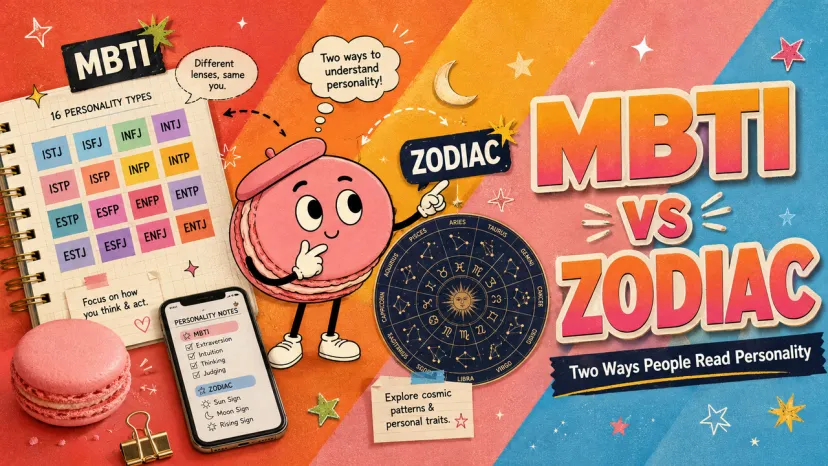
MBTI gives you four letters. Zodiac gives you a sign. Both are easy to share, easy to meme, and weirdly satisfying when they seem to explain why someone texts like that. Structure preferences sit on the MBTI Judging Perceiving axis. Before mixing systems, read what the SBTI test is.
But mbti zodiac comparisons can get messy fast.
MBTI and astrology do not start from the same premise. They do not use the same kind of evidence. And neither one should be used to predict your relationship, career, mental health, or future.
So yes, compare them if it helps you reflect.
Just keep the stakes low.
MBTI and Zodiac Start From Different Premises

MBTI is built around reported personality preferences, according to the Myers-Briggs Company’s description of the assessment. Zodiac signs come from birth-date symbolism within astrology.
That is the core difference.
The Myers-Briggs Company describes MBTI as a preference framework: how people tend to focus energy, gather information, make decisions, and deal with the outer world. It also says MBTI does not describe a whole person and should not be used for mental health diagnosis, hiring, or selection.

Astrology begins from a different premise: it is based on symbolic interpretations of celestial positions rather than a self-report personality preference model. The APA Dictionary of Psychology defines astrology as a pseudoscience based on the belief that planetary positions in relation to the zodiac influence people’s lives and events.

Reported preferences versus birth-date symbolism
Here’s the simplest comparison:
That does not mean MBTI is perfect science and astrology is secretly the same thing in prettier clothes.
It means we should not mix them into one big personality soup.
A person can identify as an INFP and a Leo. That combination may feel meaningful to them. But it does not create a verified personality formula.
What Each System Can and Cannot Claim
MBTI can offer self-reflection language.
Astrology can offer symbolic language.
Both can become social shorthand: “I’m such a Virgo about my desk,” or “That was a very ENFP way to start a group chat.” Fine. A little silly. Sometimes useful.
The problem starts when either system becomes evidence for what someone can do, who they should date, what job they should take, or whether their feelings are valid.

Self-reflection language and limits of evidence
MBTI has its own evidence debates, and the official MBTI materials are careful about scope. The Myers-Briggs Company says preferences do not indicate skill or ability, and that no personality assessment describes an entire person.
More broadly, the Standards for Educational and Psychological Testing, developed by AERA, APA, and NCME, are a useful reminder that psychological tests need evidence for reliability, validity, fairness, and appropriate use. So any personality tool should be judged by what it can actually support, not by how satisfying the label feels.
Astrology has a much weaker evidence position as a personality prediction system. Shawn Carlson’s classic double-blind test, “A double-blind test of astrology,” published in Nature in 1985, tested whether astrologers could match natal charts to personality profiles better than chance; the study did not find support for that claim.
Another study indexed on PubMed, “Signs of the zodiac and personality,” looked for correlations between zodiac signs and personality traits in a large sample of young men and did not find meaningful support.
So when someone says, “My zodiac sign proves I’m like this,” I’d soften it.
Maybe: “This symbol helps me think about myself.”
That’s different.
Why neither system should control life decisions
Please don’t use either system to decide:
- whether a relationship is doomed
- whether someone is trustworthy
- whether you are smart enough
- whether you should take a job
- whether a friend is “toxic”
- whether you need professional support
- whether your future is fixed
A label can start a conversation.
It should not hold the steering wheel.
If a choice affects your health, money, safety, legal situation, school path, career, or relationships, bring in real evidence and qualified support where needed. A chart or type code may be emotionally interesting. It is not enough.
Why People Combine Them Anyway
Because identity shorthand feels good.
Honestly, I understand it.
“Scorpio INTJ” or “Pisces INFP” can feel like a tiny character sketch. It gives people a way to say, “Here is the flavor of how I experience myself,” without writing a full memoir in the group chat.
That is not nothing.
Identity shorthand, community, and storytelling
People combine mbti astrology content because it creates:
The key phrase is low-stakes.
If saying “Cancer ISFJ” helps someone talk about care, memory, and home, fine. If it becomes “Cancer ISFJs should never date Sagittarius ENTPs,” we have left the cute little room and entered the spreadsheet of doom.
No thank you.
Compare Without Creating a Hybrid Score
The internet loves charts.
MBTI x zodiac compatibility. MBTI star sign pairings. Personality type horoscope rankings. “Best match for each type and sign.”
I would not build that table.
Not because tables are bad. Tables are innocent. It’s the false certainty that gets us.
Use reflection questions, not predictions
Instead of “What does my MBTI-zodiac combo predict?” ask:
That kind of reflection stays grounded.

It does not need to predict anything.
For a broader, non-diagnostic discussion of personality-test limits, Macaron’s personality test accuracy guide can be a useful companion. For research standards, though, rely on primary or professional sources such as test manuals, peer-reviewed studies, and psychological testing guidelines.
Record contradictions instead of forcing a match
Contradictions are not a problem.
They are usually the useful part.
Maybe your MBTI result suggests you like structure, but your zodiac content talks about spontaneity. Maybe your star sign description says you are bold, but you know you become careful in unfamiliar groups. Maybe the labels clash because one is wrong, both are vague, or the situation matters more than either label.
Write that down.
Try:
- “This description fits me at work, but not with friends.”
- “This label feels true when I’m rested.”
- “This one sounds flattering, but I don’t have evidence for it.”
- “This claim would be unfair if I applied it to someone else.”
That last question is sneaky-good.
If you would not use a label to judge another person, be careful using it to trap yourself.
Keep Personalization Grounded in Real Behavior
The best personalization comes from real behavior over time.
Not just labels.
Not just a birthday.
Not just one test result from a Tuesday when you were hungry and feeling dramatic.
Observed preferences, routines, goals, and changing context
If you want useful self-knowledge, save observations like:
A personal AI can help organize this kind of record if you use it carefully. It can store your own words, recurring preferences, goals, and reflections. It should not treat MBTI or zodiac labels as facts about who you are.
A better prompt is not: “Tell me what my Leo ENFP future is.”
A better prompt is: “Here are five notes from my week. What patterns do I keep mentioning?”
See the difference?
One asks for prophecy.
The other asks for attention.
FAQ
Why can two people with the same MBTI type or zodiac sign behave differently?
Because a label is not a whole person.
Two people with the same MBTI type may differ in culture, family history, skills, stress, values, age, health, and experience. Two people with the same zodiac sign may also live completely different lives. Shared labels can suggest themes, but they cannot erase context.
What if a friend uses either system to judge relationship compatibility?
Bring it back to behavior.
You can say, “I’m happy to talk about what helps us communicate, but I don’t want a type or sign to decide the relationship for us.” Compatibility is not proven by a chart. It is built through honesty, boundaries, repair, timing, and mutual care.
Should these labels appear in a dating profile?
Only if you want them there, and only as light context.
“Libra, ENFP, loves long walks and overthinking menus” is a vibe. “No Scorpios” or “Only dating INFJs” turns labels into filters that may say more about stereotypes than compatibility.
If you include labels, make sure your real values and boundaries are there too.
How should parents talk about personality labels with teenagers?
Keep it flexible.
Teens should not hear that a type or sign limits their intelligence, future, emotions, friendships, or identity. A better framing is: “This can be a fun reflection tool, but you get to keep learning who you are.”
That gives them room to grow.
Which is kind of the whole point.
How can I verify the source of an online MBTI-zodiac chart?
Ask four questions:
- Who made it?
- Is it based on official MBTI material, astrology tradition, personal opinion, or memes?
- Does it cite evidence for any prediction?
- Is it trying to sell certainty?
If the chart makes fixed claims about personality, romance, intelligence, health, or destiny without sources, treat it as entertainment.
Not guidance.