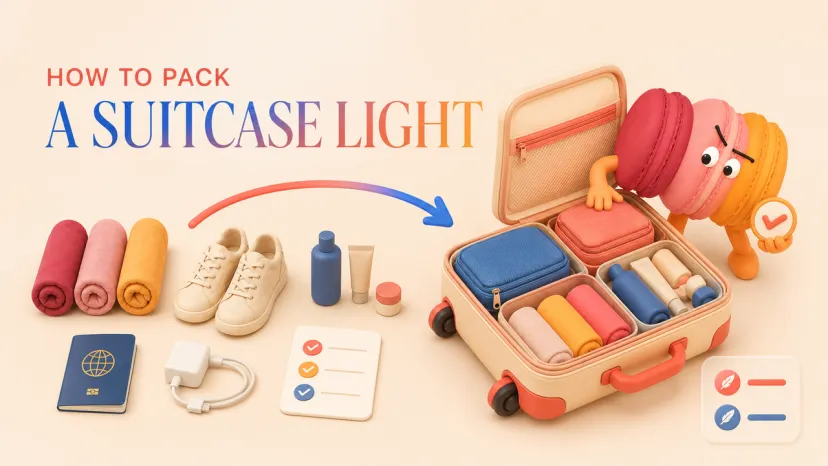
If you're staring at a suitcase with two outfits piled inside and three more on the bed — and a small voice insisting you might need both pairs of jeans even though you only ever wear one — this is the piece I wish I'd had before my last six trips.
Most guides on how to pack a suitcase walk you through method (roll vs fold, packing cubes vs no), as if the method is the problem. It's usually not. The problem is upstream: the suitcase is bigger than your trip actually needs, the list got made by your worst-case-scenario brain, and half the items you're pre-folding tonight will go home unworn.
Maren has a small post-trip ritual — dump the suitcase contents on the bedroom floor, then take inventory of what didn't get touched. The unused pile has gotten significantly smaller over the past few years, not because folding improved but because the gap between "what I thought I'd need" and "what I actually wore" narrowed.
Here's the version of how to pack a suitcase that's worked for me — starting from the trip itself, not from the packing list; building a list that subtracts before it adds; choosing a folding method that fits the clothes you actually own; and the small reusable system that makes the next trip easier than this one.
Start With the Trip, Not the Suitcase
The mistake I made for years was opening the suitcase first. Reverse it. Open a blank note about the actual trip first — what kind of days you'll have, what activities are confirmed, what the weather is doing. The suitcase comes last.
Trip length
Three nights and ten nights are different problems. For trips under five days, you almost always need fewer outfits than instinct says. Background from WHO on travel health on planning by trip type lines up with what most experienced travelers eventually figure out — preparation depends on the actual shape of the trip, not a default checklist that ignores duration. Pack for the nights you'll actually have, not for a generic week-shaped trip.
Weather and activities
Look up the actual forecast — not the climate average. A "warm destination" can have a cold spell. A "rainy season" might mean two specific afternoons. Lock in confirmed activities: a wedding requires a different garment than a hike. The activities you've actually committed to dictate clothes, not the ones you're vaguely hoping for.
Laundry and outfit repeating
If the place you're going has laundry — or you don't mind hand-washing one shirt in a sink — you can cut clothing by close to half. Most travelers I know overpack because they assume zero laundry and zero outfit repeating. Both assumptions are usually wrong. Outfit repeating among strangers is invisible. This is the easiest single place to cut weight.
Build a Packing List Before You Fold Anything
A packing list is the cheapest tool that exists for stopping overpacking. It also has to be made carefully — most lists default to additive thinking, where every item suggests another item.
Must-pack items
Start with what's truly non-negotiable: passport or ID, prescription medications, chargers for what you're bringing, payment methods. Write these first. Everything else should be evaluated against the must-pack items, not added equally beside them.
Nice-to-have items
This is where the leak happens. A second jacket "in case." A backup pair of shoes "just in case." General research from research from APS on cognitive load and decision-making lines up here — when we're tired or anxious, we tend to add items rather than evaluate them. The default move at midnight before a 6 a.m. flight is to add, not to subtract.
Items to remove before closing the suitcase
This step is non-negotiable for me. Once everything is packed, look at it and remove three items. Not "evaluate three items." Remove. Almost every time, the trip goes fine without them. That's the kind of thing I would have called a quirk last year and now I call a signal — the easier it is to remove items, the more overpacked the suitcase was.
Choose a Packing Method That Fits Your Clothes
Roll vs fold is treated like a moral question. It isn't. Different clothes want different things.
Folding
Folding works for structured items — blazers, dress shirts, anything that wrinkles aggressively. Folded items stack flat and use space predictably. The downside: stack height is fixed by your tallest item.
Rolling
Rolling works for soft items — T-shirts, light dresses, jeans, underwear. Rolled items fit into gaps that folded items can't. Don't roll structured items — they crease in ways ironing won't fix.
Packing cubes
Packing cubes work well if you organize by category (shirts in one, underwear in another) or by day (one cube per outfit). They don't add space; they redistribute it. The pro is unpacking on the other end — you pull out cubes, not loose clothes. The con is the cubes themselves take up volume.
Bundle or flat packing
Bundle packing — wrapping clothes around a central core — works for trips where you want minimal wrinkling. It takes practice. Worth trying once before relying on it. General guidance from CDC travelers' health on what travelers should keep accessible (medications, first-aid) applies regardless of method — whatever you choose, essentials shouldn't be at the bottom of the suitcase.
How to Pack a Suitcase Efficiently
Once the list is right and the method is chosen, the actual packing is mostly about layering.
Put heavy items near the wheels
Wheeled suitcases stand more stable when heavy items sit at the wheel end. Shoes, books, toiletries kits go near the bottom (wheel end). Soft clothes layer on top. This also keeps the suitcase from tipping when you stand it up.
Use gaps without creating clutter
Rolled socks and underwear fit into shoe interiors. Small items fill gaps between larger packed sections. The mistake here is filling gaps just because they exist — filling gaps with items you wouldn't have packed otherwise is how overpacking happens disguised as "being efficient."
Separate shoes, liquids, and small items
Shoes go in dust bags or plastic. Liquids go in a sealed pouch — for US travelers, TSA travel rules on the 3-1-1 carry-on liquid limits are the baseline if you're not checking the bag, and equivalent regulations exist in most other countries' security frameworks. Small items (chargers, cables, adapters) go in one dedicated pouch so you're not hunting through the whole suitcase later.
What to Do the Night Before You Leave
This is where most trips quietly go off the rails — forgotten documents, last-minute additions, items packed somewhere unfindable.
Re-check documents and chargers
Re-confirm passport (or ID for domestic), boarding pass access, hotel/destination addresses, payment cards. For international trips, State Department travel coverage of document requirements is the obvious US starting point, with parallel resources existing for travelers from other countries. Documents go in the same place every single trip — same pocket, same bag — so you don't have to think about where they are at the gate.
Keep first-day items reachable
Whatever you'll need within the first six hours of arrival — a change of shirt, toothbrush, phone charger — goes at the top or in an outer pocket. You should not have to fully unpack to get to first-day essentials.
Leave space for return items
If you're traveling for a wedding, a gift exchange, a conference with materials, or somewhere with shopping you've planned, leave space for the return. Stuffing the suitcase to capacity on the outbound trip is the most common cause of broken zippers on the return. I run smaller tests when the bigger ones leak — this one was learned the hard way after a broken zipper in a train station bathroom on a Tuesday I'd rather not relive.
Build a Reusable Packing System
The hardest part of how to pack a suitcase isn't any single trip. It's that each trip teaches you something you'll forget by the next one.
Turn trip details into a checklist
A reusable checklist — one you adjust slightly per trip — saves about an hour per trip and eliminates the "did I pack X?" mental loop. Three categories work: clothing (by day), essentials (always pack), trip-specific (this trip only). The same skeleton, with the third category swapped per trip.
Remember what you always forget
Everyone has a personal blind spot. For some people it's chargers. For others it's prescription refills. For me it was always sunscreen — until I added it as a permanent line item on the checklist. Most of this comes down to whether your packing list survives a Wednesday-morning departure — when you're rushing, the list is the safety net, not your memory.
Reuse the system for future trips
The mini-app I built for this stores three things: my standing packing skeleton, what I forgot on each previous trip, and what I didn't use. Before a new trip I tell it the trip type, length, and weather range, and it generates a checklist that already accounts for past mistakes. Six trips in, the unused pile is significantly smaller — and I now know which items to stop packing altogether unless something specific changes.
A boundary worth naming: if you only travel a few times a year, and your trips are wildly different shapes (a beach week, then a business conference, then a winter ski trip), the reusable-checklist system is overengineered. A simple per-trip note works fine. The compound benefit shows up with frequency.
FAQ
Is rolling or folding better when packing a suitcase?
Both, for different items. Roll soft clothes (T-shirts, underwear, jeans). Fold structured ones (blazers, dress shirts). The moral question of "is rolling better" usually comes from people who don't separate clothing types — once you do, the right answer becomes obvious per item, not per suitcase.
How do I stop myself from overpacking?
Three moves. First, pack from a list, not from looking at your closet. Second, before closing the suitcase, remove three items. Third, after the trip, take inventory of what you didn't wear and update the list. Most overpacking is solved by feedback loops, not by willpower at packing time.
What should go at the bottom of a suitcase?
Heavy items near the wheel end for stability. Shoes, books, toiletries kits at the bottom; soft clothes layered on top. Items you'll want quickly (first-day essentials, documents) stay near the top or in outer pockets — not at the bottom.
How do I pack toiletries without leaks?
Use a sealed pouch — a zip-top bag works. Decant large bottles into smaller travel-size containers. Squeeze excess air out of half-empty bottles before sealing (pressure changes during flight cause leaks). Liquids go in a designated section, never loose among clothing.
How can I make a reusable packing list?
Build a skeleton list with three categories: always-pack essentials, clothing by day, and trip-specific items. After each trip, update the skeleton — add what you forgot, remove what you didn't use. A list that doesn't update after each trip stops being useful within two trips. The point of the list isn't completeness on day one; it's compounding accuracy over time.
I'm planning to test a single-cube setup on my next trip — one cube for clothes, one for everything else, no folding hierarchy at all. Curious whether it changes the unused-items pile at the other end, or whether it just moves the overpacking somewhere harder to see. Reporting back after a few trips through it.
I’m Maren, a 27-year-old content strategist and perpetual self-experimenter. I test AI tools and micro-habits in real daily life, noting what breaks, what sticks, and what actually saves time. My approach isn’t about features—it’s about friction, adjustments, and honest results. I share insights from experiments that survive a real week, helping others see what works without the fluff.