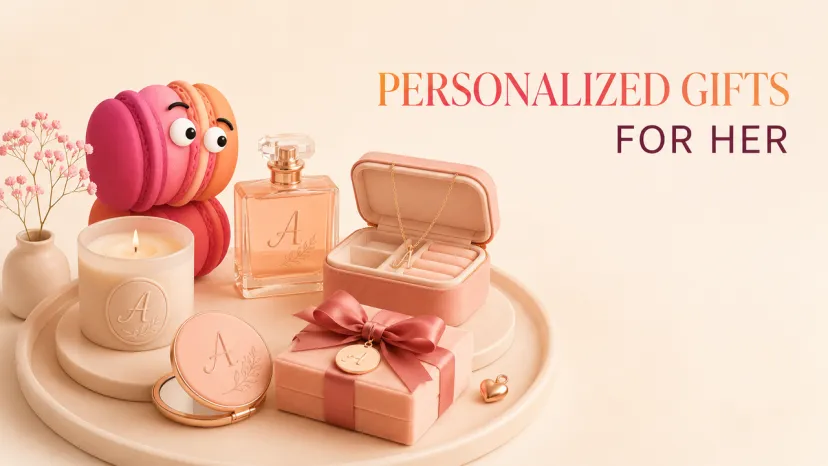
Personalized Gifts for Her That Don’t Feel Generic
Personalized Gifts for Her That Don’t Feel Generic
There are two kinds of personalized gifts for her. One reveals you were paying attention. The other reveals you weren't — even when expensive, beautifully made, and arriving in a velvet box. The difference between them isn't the level of customization. It's whether the customization came from something you actually noticed about the person, or from a category dropdown on a gift website.
Most write-ups on personalized gifts for her focus on what to engrave, which font to pick, what to put on the photo book. That's the wrong layer. The actual question is upstream: do you have enough specific information about this person to make the customization mean something — and if you don't, no amount of monogramming will fix it.
What I've started calling Maren's substitution test: if you can swap the recipient's name for someone else's and the gift still works, it isn't personalized — it's just expensive.
Here's what makes thoughtful personalized gifts for her actually land, where the relationship changes the rules, which formats hold up more often than they fail, where most attempts go wrong, and how to keep enough context about the people in your life that this gets easier every year, not harder.
What Makes a Personalized Gift Thoughtful
Thoughtful isn't a synonym for expensive, elaborate, or even visibly personalized. It's a synonym for specific.
Personal memory
The strongest layer of personalization references something only you would know. A shared in-joke, a moment she mentioned in passing months ago, a song that played in the background of a specific evening. These signals tell the recipient: "I was paying attention when you didn't expect me to be." Research compiled by APA on relationships points at the same finding in different words — perceived attentiveness is what reads as care, not effort or expense.
Practical routine
A surprisingly underrated layer: customization that hooks into something she actually does every day. A monogrammed travel mug for someone whose morning involves a thirty-minute commute and a temperamental coffee maker. An engraved key fob for someone who's been losing her keys since college. These customized presents for her sit alongside daily life, get used, and quietly reinforce the relationship every time.
Taste and style
The third layer is aesthetic alignment — knowing whether she leans minimalist or maximalist, soft tones or saturated, classic typography or playful script. A "personalized" gift in a style she'd never have chosen for herself is still a stranger object, even with her name on it. This is where I notice the friction before I notice the feature: a gift that doesn't match the visual world she's already curated reads as someone else's idea of what she should like.
Ideas by Relationship
The same person at different relational distances calls for different gifts. Custom gifts for her shift category depending on who's giving.
Partner or wife
The closest relationships get the most license for sentimental personalization. Personalized gifts for wife or long-term partner can lean into shared history — a custom map of where you met, a piece of jewelry referencing a private detail, a book of letters across years. The Harvard adult development work on long-term relationships consistently points to the same theme: attentiveness compounds. A gift that recalls something from year three works harder than one that performs newness.
Friend
Friendships ask for a lighter touch. Custom gifts for girlfriend or close friend land when they reference an inside joke, a recent obsession, or a specific shared experience — without overstepping into sentimentality that wasn't established in the friendship. The miscalibration here is usually overdoing it: a deeply emotional engraved keepsake from a casual friend reads as misjudged closeness.
Mom or family member
Family personalization works best when it threads through generations or shared memory. A photo gift from a meaningful family moment, a piece of art commissioned from one of her children's drawings, a recipe book with handwritten contributions from family. The personalization mechanism here is continuity, not novelty.
Coworker boundary
This is the relational distance where personalization most often misfires. A coworker's name on a desk item is often the right ceiling. Anything that references personal preferences crosses a line that wasn't invited. Closer to neutral than personal is the safer move at this distance.
Formats That Usually Work
After watching a few years of these land or fail, certain formats hold up more reliably than others.
Engraved items
Engraved jewelry, leather goods, and small home objects work when the engraving references something specific — a date, a place, a short phrase from a real conversation. They fail when the engraving is generic ("Always & Forever" on a bracelet that could have been anyone's). The pattern in Pew social trends data on what people keep versus discard lines up with what gift-givers eventually figure out: emotional specificity outlasts material quality almost every time.
Photo gifts
Photo-based personalised gifts for her — albums, framed prints, custom puzzles, calendars — work when the photos were chosen carefully and the format suits her aesthetic. They fail when the photo selection is obvious (the most-Instagrammed shots) or when the format conflicts with her home style. Three carefully chosen photos in a clean frame land harder than thirty photos in a glossy album.
Custom home gifts
Home objects with personalization — a custom illustration of her apartment, an embroidered throw with a meaningful coordinate, a piece of pottery commissioned in her color palette — work when they fit her aesthetic. They fail when they ignore it. The substitution test applies here too: if the same object with someone else's name would also work in someone else's home, the personalization is doing less than the price suggests.
Experience-linked gifts
Customized presents for her sometimes work best as object + experience pairings. A personalized travel journal with a planned weekend trip inside it. A custom recipe card holder with a cooking class booked together. The object becomes a marker of the experience rather than a standalone item to display.
What Makes Personalized Gifts Feel Forced
Most well-intended attempts fail in three predictable ways.
Too much text
A long engraving, a verse, a multi-line dedication — these usually feel like the gift is performing the relationship rather than referencing it. Short and specific outperforms long and emotional, almost without exception. A three-word engraving that references a real moment lands harder than a paragraph that could have been on anyone's gift.
Generic names only
A name on its own — without context, without a date, without anything that signals you chose this for her — is the bare minimum of personalization. It reads as obligatory. Name-only customization is the gift world's version of writing "Dear Friend" at the top of a letter.
Ignoring style
A gift that's beautifully personalized but stylistically wrong — wrong color palette, wrong font, wrong material — gets thanked politely and then quietly stored away. The work summarized in Greater Good research on what people experience as meaningful in close relationships highlights the same thing under different language: gifts that feel like they were chosen for the recipient land differently than gifts chosen as a category. The framing was useful. The prescription was a trap — most "personalized gift for women" templates ignore the individual entirely.
How Macaron Can Help Use Memory Better
The hardest part of giving consistently good personalized gifts for her over years isn't taste. It's memory. What she mentioned wanting last fall. The fact that she's allergic to a specific metal. The store she walked past and lingered in. I forget about 60% of this between occasions.
Recall shared moments
The mini-app I built for the people I give to most often just stores small notes — overheard preferences, places we've been together, things she said she wanted to try someday. Six months later, when an occasion comes up, the notes are there. Telling the tool once means I don't have to depend on remembering at the exact moment I need it.
Turn preferences into themes
When I ask for gift suggestions, I feed it what's in the notes: "She mentioned wanting a quieter morning routine. She has too many candles already. Budget around $80. We've known each other twelve years." It pulls together three shortlist options that thread through the stored context. Background reading from BPS Research Digest on memory and decision-making helps make sense of why this works — externalizing context lets you make better decisions than holding everything in your head.
Build a recurring occasion list
The setup that's stuck: one running profile per person I give to often, with what I gave last year, what she reacted to, and her current obsessions. A week before each occasion, the mini-app surfaces the profile and asks me what's new. I run smaller tests when the bigger ones leak — this started after I bought my sister a near-duplicate of a gift I'd given her two birthdays earlier.
FAQ
What are good personalized gifts for her that feel thoughtful?
The most thoughtful personalized gifts for her reference something specific you noticed — a moment, a preference, a phrase she used. Generic personalization (name + date) is the lowest tier. Engraved items with a specific phrase, photo gifts with carefully chosen images, and objects that hook into her daily routine tend to land harder than expensive but generic customizations.
How do I make a personalized gift feel less generic?
Apply the substitution test. If you can swap her name for someone else's and the gift still works, the personalization isn't doing real work. Add a layer of specificity that only applies to her — a date, a place, a phrase from a real conversation, a reference to a shared moment. The goal is for the gift to feel chosen for her, not chosen for women in general.
What should I avoid when personalizing a gift for her?
Three things. Long engraved text that performs emotion instead of referencing a moment. Name-only customization with no other specific context. Aesthetic choices that ignore her existing style. A beautifully personalized gift in the wrong style is still a stranger object with her name on it.
Are photo or memory-based gifts still a good idea?
Yes, when the photo selection and format are deliberate. Three carefully chosen images in a frame she'd actually display land harder than thirty photos in a generic album. Memory-based gifts work because they make the relationship itself visible. They fail when the curation is lazy or the format doesn't fit her space.
How can AI help me choose a personalized gift based on shared memories?
By holding small details across long stretches of time. Overheard preferences, things she mentioned wanting, places you've been together, what you gave last year — context that's easy to forget but transforms gift choice when it's available. AI is most useful here as a memory layer, not as a recommendation engine. The recommendations are only as good as the context you've stored.
A question to end on: when was the last time she mentioned something in passing — a place, a small wish, a craving — that you'd already half-forgotten by the next morning? That's the layer where the actually thoughtful personalized gifts for her live. Most of us just need a way to stop losing those small notes between the moment they're said and the moment we need them.
I’m Maren, a 27-year-old content strategist and perpetual self-experimenter. I test AI tools and micro-habits in real daily life, noting what breaks, what sticks, and what actually saves time. My approach isn’t about features—it’s about friction, adjustments, and honest results. I share insights from experiments that survive a real week, helping others see what works without the fluff.