For about eleven days last winter I ran a small, slightly embarrassing experiment on myself. I wrote down every time my partner did something that felt like love — and every time I did something I thought counted as love but clearly didn't land. By day four the pattern was obvious, and not in a way I expected. I'd been giving the version of love I wanted to receive, and he'd been giving the version he wanted to receive, and we'd both been quietly wondering why the other person seemed a little off. That's when I started reading about MBTI love language patterns seriously — not as a personality quiz, but as a diagnostic.
I'm Maren, and I write about micro-experiments like this one — the kind that cost you nothing to run but change how you read the next three weeks. What I found isn't a rulebook. It's a starting point for a much better conversation.
Love Languages Quick Recap
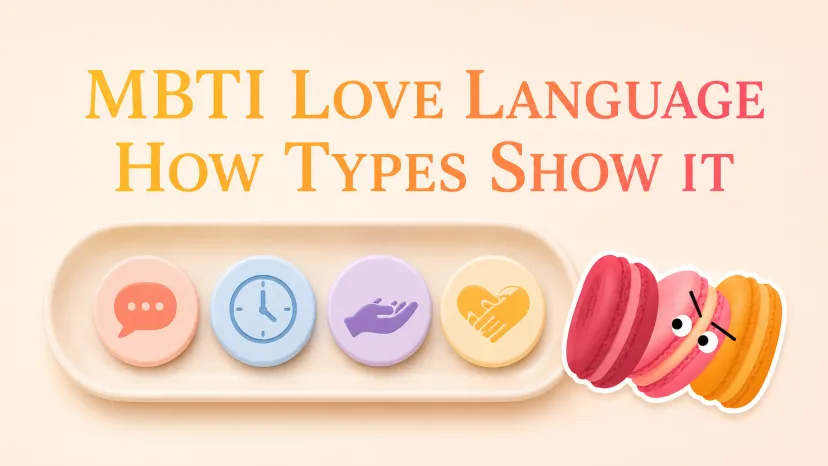
Before we get to type, the five categories Dr. Gary Chapman popularized are: words of affirmation, quality time, acts of service, physical touch, and receiving gifts. You can read the original framework on the official 5 Love Languages site. Most people lean toward one or two primary languages and feel mildly confused by the others. That confusion is the whole point — the gap between how you give love and how your partner receives it is where most friction lives.
Quick reality check: the empirical research on love languages is mixed — a 2023 review noted limited evidence that matched languages predict relationship satisfaction. That doesn't make the framework useless. It makes it a vocabulary, not a formula. Same goes for MBTI itself. The Myers & Briggs Foundation is explicit that type describes preference, not capacity.
Hold both those caveats. We're using this to talk, not to predict.
How Each Type Tends to Show Love
The 16 types group into four temperaments, and each temperament has a signature way of saying I'm showing up for you. These are tendencies — your mileage will vary by roughly a mile. If you're reading a description of your type and it doesn't fit, trust yourself over the chart.
Analysts (INTJ, INTP, ENTJ, ENTP)
Analysts tend to express love through acts of service and a very specific flavor of quality time — the kind that involves a shared problem to solve. If an INTJ sends you a two-page breakdown of your car's maintenance schedule, that's a love letter. I'm not joking. They thought about you. They allocated time. They produced something only you would use.
They also struggle with words of affirmation because verbal praise feels imprecise to them. Ask an ENTP why they love you and you'll get a thoughtful, sometimes surprising answer; ask for the same answer three times a week and they'll start to feel like they're repeating a script. Don't read the restraint as distance. Read it as a preference for showing over telling.
Diplomats (INFJ, INFP, ENFJ, ENFP)
Diplomats run on quality time and words of affirmation. Most INFJ-focused research backs this up — one well-cited write-up found quality time is the dominant preference, closely followed by verbal affirmation.
I'll tell you what this looks like from the inside, because I'm an INFJ. I don't want a lot of words — I want the right ones, remembered from a conversation three weeks ago. That's the trap with diplomats. We set an extremely specific bar and then fail to tell anyone what it is. If you're with one of us, ask us to name the words that would matter. We'll know. We've just never been asked.
Sentinels (ISTJ, ISFJ, ESTJ, ESFJ)
Sentinels are the acts of service specialists. The breakfast that appears without you asking. The bill paid on time. The weird car noise already booked into the shop. A sentinel is showing love in every single one of those moments, and will feel genuinely hurt if you don't notice or thank them for it.
Here's where it gets specific — sentinels often receive love the same way they give it, which means flowers without context can land surprisingly flat. A load of laundry folded the way you actually like it will land hard. The signal they're reading for is reliability, not grandeur.
Explorers (ISTP, ISFP, ESTP, ESFP)
Explorers lean physical touch and shared experience. An ESFP planning a spontaneous weekend is saying I want to make something with you. An ISTP fixing the thing you've been complaining about is saying the same thing, just without words.
They can be surprisingly private about verbal affection. The physical presence is the affection. Trying to talk an explorer into long emotional conversations when they'd rather go on a walk together misreads the signal entirely. Go on the walk. You'll find out more in thirty quiet minutes of movement than in two hours of trying to pin them down at the dinner table.
Common Mismatches and How to Bridge Them
The biggest mismatch isn't between incompatible types — it's between people assuming their own love language is universal. That was my eleven-day trap, exactly.
Three patterns I've seen repeatedly:
The Analyst–Diplomat gap. Analyst solves a problem as love; diplomat wanted to be listened to, not fixed. The bridge: the analyst asks, do you want me to help or just hear this? That single question is worth ten books.
The Sentinel–Explorer gap. Sentinel plans the anniversary three weeks ahead; explorer would rather decide Friday night. Neither is wrong. One feels loved through preparation, the other through presence. The bridge is alternating who plans — not compromising on both.
The silent-diplomat trap. We say I just want to be understood without saying what understanding looks like. That's not fair, and I've had to learn to actually name the thing: "when I come home stressed, what I want is for you to sit with me for ten minutes before asking what's wrong."
Specificity is the bridge. Every single time.
Your MBTI Is Not Your Whole Love Story
This is the part I want you to hold most carefully. MBTI is useful as a conversation opener — nothing more. The Wikipedia overview of the instrument lays out the test-retest reliability issues honestly, and the Myers-Briggs Company itself frames type as preference, not destiny.
Attachment style matters more than type for how someone does love under stress. The American Psychological Association has a good primer on this — and crucially, attachment patterns can change over time. So can your love language, honestly. Mine shifted after a year of remote work. Quality time started to mean undivided attention for thirty minutes, not a whole Saturday.
Turns out, doing this experiment worked differently than I expected. The type gave me a starting point; the conversation gave me the actual answer.
Worth trying if your setup looks anything like mine: run the same eleven-day log. Note what landed. Note what didn't. Then talk about the list.
FAQ
What love language does INFJ prefer?
Most INFJs — myself included — lean quality time first, words of affirmation second. But we're picky about both. Quality time means undivided presence, not parallel play. Words of affirmation means specific, remembered, sincere — not generic compliments.
Do thinking types show less affection?
No — they show it differently. Thinking types (analysts especially) tend to express care through problem-solving, planning, and acts of service. If you're waiting for a Feeling-type verbal declaration from a Thinking-type partner, you may miss the sixteen other things they're actively doing for you.
Can MBTI predict relationship success?
Not reliably. Neither the MBTI nor love languages frameworks have strong predictive validity in peer-reviewed research. What they do offer is shared vocabulary. Shared vocabulary is how couples stop fighting about the same thing repeatedly.
How do I communicate love to a different type?
Ask, specifically. Not what's your love language — that's too abstract for most people cold. Try: what's something I've done recently that felt like love, and what's something I thought counted but didn't? You'll get a more honest answer in two minutes than a quiz will give you in twenty.
Does my love language ever change?
Yes, often. Major life transitions — new jobs, becoming a parent, loss, chronic stress — can shift what actually lands. The framework is a snapshot, not a life sentence. Retaking the official love languages quiz every couple of years is honestly a reasonable idea.
I'm still running the log, on and off. The version that worked wasn't the one I planned. That's usually how these things go.
I’m Maren, a 27-year-old content strategist and perpetual self-experimenter. I test AI tools and micro-habits in real daily life, noting what breaks, what sticks, and what actually saves time. My approach isn’t about features—it’s about friction, adjustments, and honest results. I share insights from experiments that survive a real week, helping others see what works without the fluff.