SBTI Meaning: From Viral Labels to Real-Life Patterns
SBTI Meaning: From Viral Labels to Real-Life Patterns

What SBTI Means

In the viral personality-test context, SBTI is a meme-style quiz commonly expanded as “Silly Big Personality Test.” It gives people playful, sometimes sharply worded result labels designed for entertainment and sharing. That is the clearest answer to *sbti meaning*, but the wording needs a confidence boundary: the creator-linked page uses “SBTI” without stating a single official English full form, while later English-language versions use several expansions. A result is therefore best treated as a funny snapshot—not a stable personality fact, diagnosis, or prediction.
SBTI can also refer to unrelated subjects, including a climate-target organization often styled “SBTi.” Here, the term means the internet personality meme, not the corporate initiative.
The Full Form and Meme Context
“Silly Big Personality Test” is the most common SBTI full form in English coverage. It should still be described as a common expansion rather than an undisputed official name. A later English terminology note documents alternatives such as “Silly Big Type Indicator,” showing how the expansion drifted as mirrors and rewrites appeared. That page is evidence of inconsistent usage, not official provenance.

Source note, checked August 17, 2026:
- Verified: the accessible creator-linked mirror credits Bilibili creator Q肉儿串儿, identifies UID 417038183, describes the test as entertainment, and says it began as an attempt to discourage a friend from drinking.
- Verified: the mirror links to a Bilibili-hosted version, describing it as a further version authenticated by the creator.
- Archived: the public source archive preserves the page code, repeats the creator attribution, and explicitly notes that the original author did not publish an open-source license.
- Corroborated: an accessible Sina Finance report names Q肉儿串儿, describes the launch-video context, and reports that the video was later removed.
- Uncertain: the original page does not declare one authoritative English expansion. Multiple later versions use the SBTI label, so none should be promoted to “official” without creator-linked evidence.
Why One Result Is Not a Life Pattern
A quiz answer can be influenced by mood, recent events, who is nearby, or how a translated phrase lands. Even when a result feels uncannily accurate, that feeling is not proof that the label captures you across situations or over time.
Suppose a result describes someone as avoidant. You may immediately remember postponing a difficult message and think, “That is absolutely me.” But perhaps you answered the message promptly when a friend needed help, or you communicate directly at work but hesitate in family conflict. The first example is evidence of one behavior. The exceptions reveal context. Neither needs to win.
Turn a Viral Label Into Better Reflection Questions
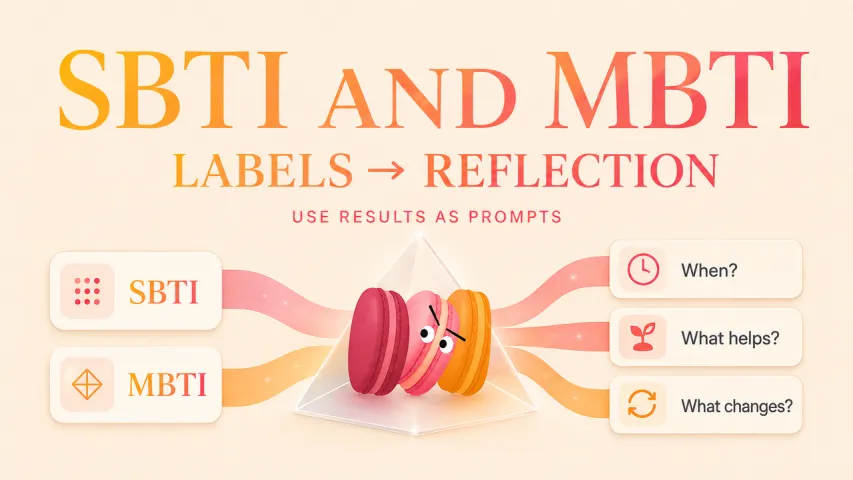
The most useful move is a snapshot-to-pattern loop:
- Snapshot: Save what the result said, where it came from, and when you saw it.
- Evidence: Notice one concrete event that seems to fit, without forcing a match.
- Exception: Record a moment when the label did not fit or the setting changed your behavior.
- Revision: Revisit the wording and decide whether to keep, soften, or discard it.
The loop does not produce a new score. It makes your interpretation correctable.

Look for Context, Exceptions, and Change
Ask small questions that can be answered with real examples:
- Where does this description show up most clearly?
- Around whom does it disappear?
- What happened just before the behavior?
- Is this a preference, a coping response, or simply a rough week?
- What evidence would make me revise the label?
An exception is not a failed observation. It is often the detail that turns a catchy label into a more accurate pattern.
Build a Record You Can Revisit
You do not need a permanent profile or an elaborate daily system. A few dated notes can keep one result card from becoming the whole story. For a broader routine, use a dedicated guide to daily reflection with AI.
Separate the Result From Real-Life Examples
Keep two kinds of information distinct:
- Result: the exact label, wording, source URL, language, and date.
- Observation: what happened, the setting, your response, and any exception you noticed.

For example: “I delayed raising a billing error with a stranger, but calmly corrected a teammate the same day.” The result stays intact; the observation stays open to interpretation.
Update Patterns When Your Context Changes
Revisit the description after a meaningful change, not on a rigid schedule. A new job, different relationship, illness, move, or calmer period may reveal that what looked like a trait was partly situational. Updating your interpretation is not inconsistency. It is evidence that the record belongs to you, not to the quiz.
What Personal AI Should and Should Not Remember
A Personal AI can be useful here only if memory remains voluntary, specific, and revisable. It may help preserve a user-chosen note such as, “I sometimes delay difficult messages when I expect conflict,” alongside dated examples and corrections.
It should not turn “my SBTI result was IMSB” into a permanent identity claim, infer a type from private material, treat a label as diagnosis, or use it to predict ability, compatibility, or risk. Before saving sensitive reflection, check whether the product lets you review, correct, delete, and understand how that information is used. Those are criteria to verify, not assumed Macaron features.

Macaron illustrates the broader idea: personal memory should preserve chosen observations, exceptions, and corrections—not harden a meme result into a profile.
Limits of Test-Based Self-Reflection
SBTI can supply language, humor, and a starting prompt. It cannot establish why you behave a certain way, whether a pattern will continue, or what decision you should make. Do not use it for diagnosis, treatment, grading, discipline, hiring, admissions, or other high-stakes judgments.
If a result touches a painful subject, you can reject the wording or discuss the concern without the label. For persistent distress, seek appropriate professional support.
FAQ
Can teachers use SBTI as a classroom icebreaker?
Only as an optional, low-stakes activity. Do not grade students, group them by result, or require disclosure. Offer a label-free alternative, such as choosing a fictional character or describing a current mood. Teachers should also check current school privacy and accessibility policies. This is general guidance, not educational-policy or legal advice.
Can creators quote SBTI result cards in public content?
A brief quotation for commentary is different from reposting an entire card or result library. Check the original creator’s and platform’s current terms, identify the source, and seek permission when needed. Rights depend on jurisdiction and context, so this is not legal advice.
What happens if the original SBTI page disappears?
Keep the source URL, creator attribution, access date, and your own permitted note about the result. An archive can help establish provenance, but it does not grant reuse rights. If the original disappears, do not promote the nearest functioning clone to official status.
Can translated SBTI labels carry different cultural meanings?
Yes. Humor, insult, warmth, and self-mockery can shift in translation. Keep the original wording beside the translation, note who translated it and when, and ask the person what the phrase means to them instead of imposing one cultural reading.
Should accessibility needs change how an SBTI result is discussed?
They should change the format, pace, and participation options—not the interpretation of someone’s personality. Offer text, audio, extra time, simpler wording, or an opt-out as appropriate. Never treat an access need as evidence for or against a label.
Conclusion
The safest short definition is this: SBTI is a meme-style personality quiz, commonly expanded as Silly Big Personality Test, whose labels work best as shareable snapshots. Its origin and entertainment boundary are better supported than any claim that one English full form or clone is official.
Useful self-understanding begins after the result. Save the snapshot, test it against one real example, look for an exception, and revise the description when life gives you better evidence. The result can open a conversation. It should not close the case on who you are.



Postuler pour devenir Les premiers amis de Macaron
Lire et découvrir
Assistant personnel IA
Calculateurs gratuits


