Calculateur du Plus Grand Commun Diviseur
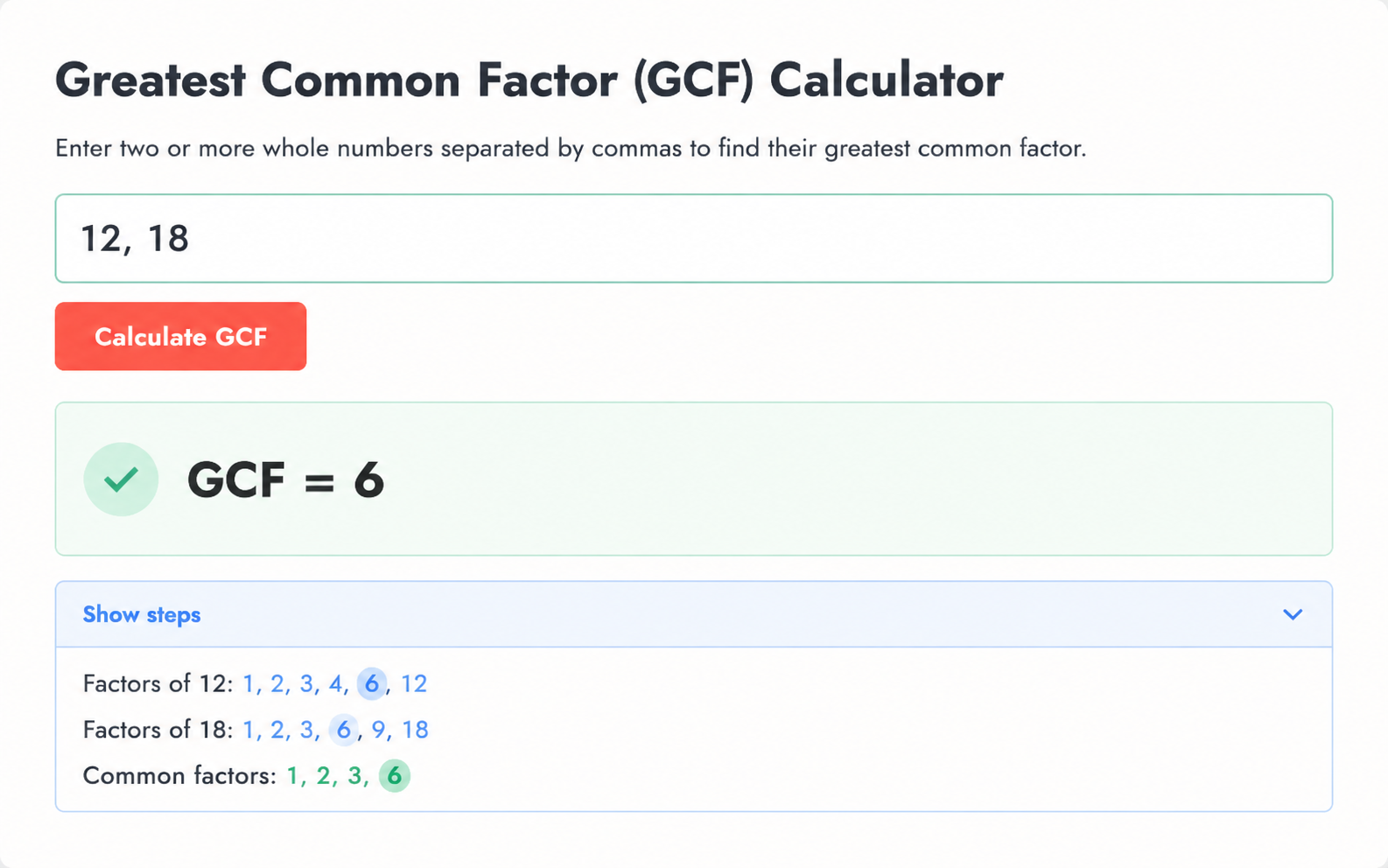
Calculez le PGCD de deux ou plusieurs nombres en utilisant les méthodes de factorisation en nombres premiers et l'algorithme d'Euclide. Obtenez des résultats instantanés avec des explications étape par étape.
If you need to calculate GCF for homework, simplify a fraction, compare GCF and LCM, or check the GCF of 3 numbers, this page gives you both the answer and the method behind it.
Qu'est-ce que le Plus Grand Commun Diviseur (PGCD) ?
Le Plus Grand Commun Diviseur (PGCD), également connu sous le nom de Plus Grand Commun Diviseur (PGCD) ou Plus Grand Facteur Commun (PGFC), est le plus grand entier positif qui divise deux ou plusieurs nombres sans laisser de reste. C'est un concept fondamental en théorie des nombres et a de larges applications en mathématiques, algèbre et informatique.
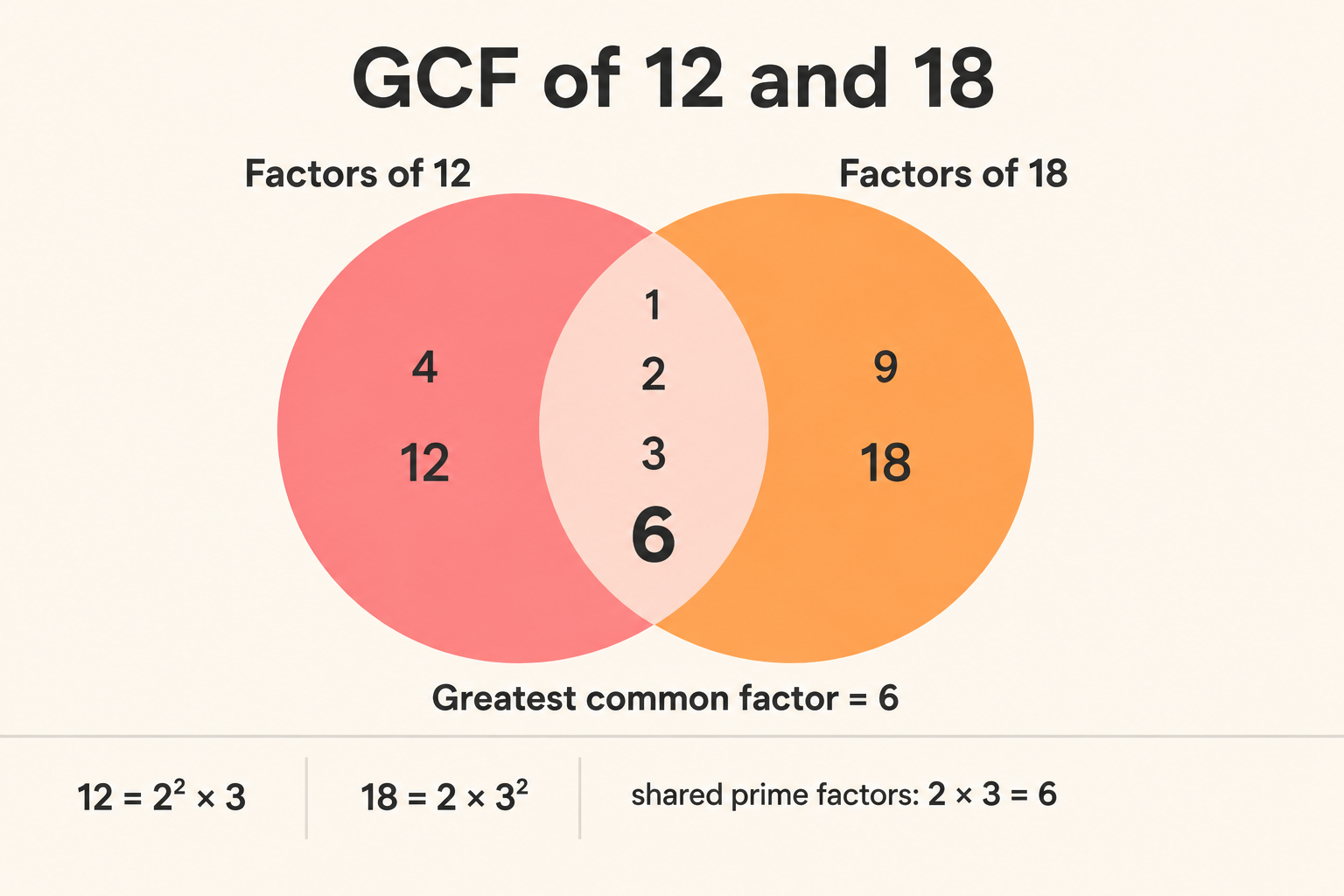
Par exemple, le PGCD de 12 et 18 est 6, car 6 est le plus grand nombre qui divise à la fois 12 et 18 de manière égale. Le PGCD est particulièrement utile lors de la simplification des fractions, de la recherche de dénominateurs communs et de la résolution de problèmes impliquant des ratios et la divisibilité.
GCF vs GCD vs HCF — are they the same?
Yes. GCF, GCD, and HCF usually mean the same thing. GCF means greatest common factor. GCD means greatest common divisor. HCF means highest common factor. Different textbooks and regions may use different names, but all three refer to the largest number that divides the given numbers evenly.
Comment Utiliser le Calculateur de PGCD
Use this section if you are wondering how to find GCF on calculator tools without doing every step by hand.
- Entrez Vos Nombres : Tapez deux ou plusieurs entiers positifs séparés par des virgules dans le champ de saisie (ex. 330, 75, 450, 225).
- Cliquez sur Calculer : Appuyez sur le bouton 'Calculer le PGCD' pour calculer le plus grand commun diviseur.
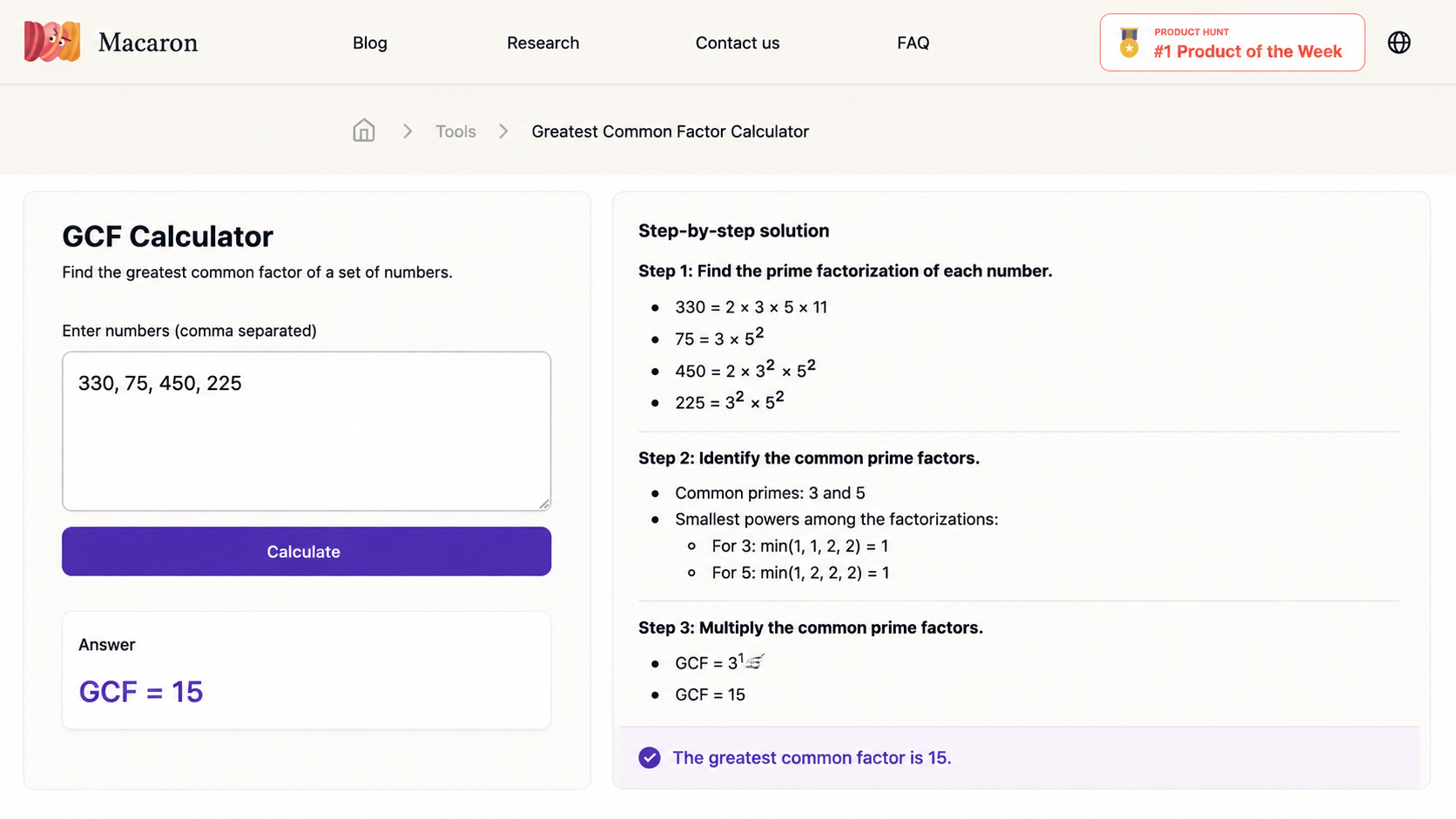
- Voir les Résultats : Le calculateur affiche la valeur du PGCD, la factorisation en nombres premiers de chaque nombre avec les facteurs communs mis en évidence, et les calculs étape par étape utilisant l'algorithme d'Euclide (pour deux nombres).
Perspectives Clés sur le PGCD
- Multiples Méthodes de Calcul : Le PGCD peut être calculé en utilisant diverses méthodes, y compris la liste de tous les facteurs, la factorisation en nombres premiers, ou l'algorithme d'Euclide. Chaque méthode a ses avantages selon la taille et le nombre d'entiers impliqués.
- Essentiel pour la Simplification des Fractions : Le PGCD est crucial pour réduire les fractions à leur forme la plus simple. En divisant à la fois le numérateur et le dénominateur par leur PGCD, vous obtenez la fraction simplifiée.
- Applications en Cryptographie : Le PGCD et les algorithmes connexes jouent un rôle vital dans la cryptographie moderne, en particulier dans le chiffrement RSA et d'autres systèmes de sécurité basés sur la théorie des nombres.
- Toujours un Entier Positif : Le PGCD est toujours un entier positif, et pour tout ensemble de nombres, le PGCD est au moins 1 (puisque 1 divise tous les entiers).
- L'Efficacité Compte : Pour les petits nombres, la factorisation en nombres premiers est intuitive et facile à comprendre. Pour les grands nombres, l'algorithme d'Euclide est plus efficace et plus rapide sur le plan computationnel.
Méthodes pour Calculer le PGCD
There are three common ways to calculate the GCF: listing the factors, using prime factorization, and using the Euclidean algorithm. Each one gives the same answer, so how to calculate the GCF really comes down to which method fits your numbers.
1. Liste de Tous les Facteurs
Cette méthode consiste à lister tous les facteurs de chaque nombre et à identifier le plus grand facteur commun. Bien que simple pour les petits nombres, elle devient impraticable pour les grands entiers.
tools.gcfCalculator.method1Example
This method is simple for small numbers and is a good way to learn what "common factor" means.
2. Factorisation en Nombres Premiers
Décomposez chaque nombre en ses facteurs premiers, puis multipliez les facteurs premiers communs (avec les plus petites puissances) pour trouver le PGCD. Cette méthode est visuelle et aide à comprendre la structure des nombres.
Exemple : 12 = 2² × 3 et 18 = 2 × 3². Facteurs communs : 2¹ × 3¹ = 6, donc PGCD = 6.
Prime factorization is useful when you want to see the structure of each number and understand why the answer works.
3. Algorithme d'Euclide
Cet algorithme ancien et efficace applique à plusieurs reprises le processus de division : divisez le plus grand nombre par le plus petit, remplacez le plus grand par le plus petit, et le plus petit par le reste. Continuez jusqu'à ce que le reste soit 0. Le dernier reste non nul est le PGCD.
Exemple : PGCD(48, 18) : 48 = 18 × 2 + 12, puis 18 = 12 × 1 + 6, puis 12 = 6 × 2 + 0. PGCD = 6.
Factor Out the GCF of Variables, Monomials & Polynomials
A factoring GCF calculator helps with the same core idea: find the largest factor shared by every term, then factor it out. For a numeric expression: 6 + 12 = 6(1 + 2). For an algebraic expression: 6x + 12 = 6(x + 2).
For monomials and polynomials, the GCF may include numbers, variables, or both. Example: 8x² + 12x = 4x(2x + 3). This page's calculator focuses on numeric GCF for positive integers. If you are looking for a factor out GCF calculator for variables, monomials, or polynomials, use the same rule: find the shared numerical factor and the shared variable part with the lowest exponent.
GCF and LCM Calculator – Find Both Together
A GCF and LCM calculator helps you compare two related ideas. GCF is the greatest number that divides the given numbers evenly. LCM is the smallest number that the given numbers divide into evenly.
For two positive integers:
GCF × LCM = product of the two numbers
Example: for 12 and 18: GCF = 6, LCM = 36, 12 × 18 = 216.
The relationship between GCF and LCM
That formula is more than a trick. Because every prime factor of the two numbers ends up in either the GCF (the shared part) or the LCM (the combined part), multiplying them always rebuilds the original product. So if you already know the GCF, you can find the LCM fast:
LCM = (a × b) ÷ GCF
For 12 and 18: (12 × 18) ÷ 6 = 216 ÷ 6 = 36.
Note that this shortcut works cleanly for two numbers. For three or more, calculate the LCM directly instead of dividing the full product by the GCF.
Simplify Fractions Using the GCF
Simplifying fractions using the GCF is one of the most common reasons people reach for a GCF fraction calculator. The idea is simple: divide the numerator and the denominator by their GCF, and the fraction is reduced to lowest terms in one step.
Example: reduce 24/36. The GCF of 24 and 36 is 12. 24 ÷ 12 = 2, 36 ÷ 12 = 3. So 24/36 simplifies to 2/3.
If you divide by a common factor that is not the greatest one, you will still need to simplify again. Using the GCF gets you to lowest terms immediately, which is why it is the cleanest method for reducing any fraction.
Find the GCF of 3 or More Numbers
A GCF of 3 numbers calculator works the same way as it does for two numbers. The GCF of a longer set is the largest integer that divides every number in the set. By hand, the easiest approach is to take the GCF two numbers at a time: find GCF(a, b), then find GCF of that result and c.
Find GCF(a, b), then find GCF of that result and c.
Example: find the GCF of 24, 36, and 60. GCF(24, 36) = 12, then GCF(12, 60) = 12. So the GCF of 24, 36, and 60 is 12.
This pairwise method scales to any number of values, and it is exactly what the calculator does internally when you enter a longer set.
Worked Examples – Common GCF Calculations
These are some of the GCF pairs people look up most often. Each one is worked the short way so you can check your own answer quickly.
| Numbers | Shared factors | GCF |
|---|---|---|
| 12 and 18 | 1, 2, 3, 6 | 6 |
| 8 and 12 | 1, 2, 4 | 4 |
| 16 and 24 | 1, 2, 4, 8 | 8 |
| 18 and 24 | 1, 2, 3, 6 | 6 |
| 15 and 25 | 1, 5 | 5 |
| 24 and 36 | 1, 2, 3, 4, 6, 12 | 12 |
For the most common classroom example, the GCF of 12 and 18 is 6, because 6 is the largest number that divides both 12 and 18 without leaving a remainder.
Coprime numbers — when the GCF is 1
Sometimes two numbers share no common factor other than 1. When that happens, the GCF is 1, and the numbers are called coprime (or relatively prime).
Example: 8 and 15. Factors of 8: 1, 2, 4, 8. Factors of 15: 1, 3, 5, 15. The only shared factor is 1, so the GCF of 8 and 15 is 1. A fraction like 8/15 is already in lowest terms, because there is nothing left to divide out.
Applications Réelles du PGCD
- Simplification des Fractions : Réduisez les fractions à leur plus simple expression en divisant à la fois le numérateur et le dénominateur par leur PGCD.
- Trouver des Dénominateurs Communs : Lorsque l'on additionne ou soustrait des fractions, le PGCD aide à trouver le plus petit commun multiple (PPCM) pour les dénominateurs communs.
- Résolution d'Équations Algébriques : Factorisez le PGCD des expressions polynomiales pour simplifier et résoudre les équations plus facilement.
- Théorie des Nombres et Cryptographie : Le PGCD est fondamental dans les algorithmes utilisés pour le cryptage, les signatures numériques et les communications sécurisées.
- Problèmes d'Optimisation : En informatique, le PGCD est utilisé pour optimiser les algorithmes, réduire la complexité computationnelle, et résoudre des problèmes impliquant la divisibilité et l'arithmétique modulaire.
Questions Fréquemment Posées (FAQ)
Quelle est la différence entre le PGCD et le PPCM ?
Le PGCD (Plus Grand Commun Diviseur) est le plus grand nombre qui divise tous les nombres donnés de manière égale, tandis que le PPCM (Plus Petit Commun Multiple) est le plus petit nombre qui est un multiple de tous les nombres donnés. Ils sont liés : PGCD × PPCM = Produit des deux nombres (pour deux nombres).
Le PGCD peut-il être plus grand que le plus petit nombre ?
Non, le PGCD ne peut pas être plus grand que le plus petit nombre de l'ensemble. Le PGCD est toujours inférieur ou égal au plus petit nombre.
Quel est le PGCD de deux nombres premiers ?
Le PGCD de deux nombres premiers différents est toujours 1, car les nombres premiers n'ont pas de facteurs communs autres que 1.
Comment trouver le PGCD de plus de deux nombres ?
Vous pouvez trouver le PGCD de plusieurs nombres en trouvant d'abord le PGCD de deux nombres, puis en trouvant le PGCD de ce résultat avec le nombre suivant, et ainsi de suite. Alternativement, utilisez la factorisation en nombres premiers pour identifier tous les facteurs premiers communs.
Pourquoi l'algorithme d'Euclide est-il efficace ?
L'algorithme d'Euclide est efficace car il réduit rapidement la taille du problème à chaque étape, le rendant beaucoup plus rapide que de lister tous les facteurs, surtout pour les grands nombres. Sa complexité temporelle est logarithmique.
Quel est le PGCD de 0 et de n'importe quel nombre ?
Le PGCD de 0 et de tout nombre non nul n est n lui-même, car chaque entier divise 0. Cependant, dans les applications pratiques, nous travaillons généralement uniquement avec des entiers positifs.
Need More Than a Calculator? Meet Macaron
A GCF calculator solves one problem well. But homework, study sessions, and everyday questions rarely stop at a single calculation.
Macaron is a personal AI that remembers what you are working on and can build small tools, walkthroughs, and study help around the way you actually learn. If you find yourself reaching for one calculator after another, it is a way to keep all of that in one place that adapts to you.
Create your own tools with MacaronRelated tools and reading
Références et Lectures Complémentaires
Lire et découvrir
Assistant personnel IA
Calculateurs gratuits


