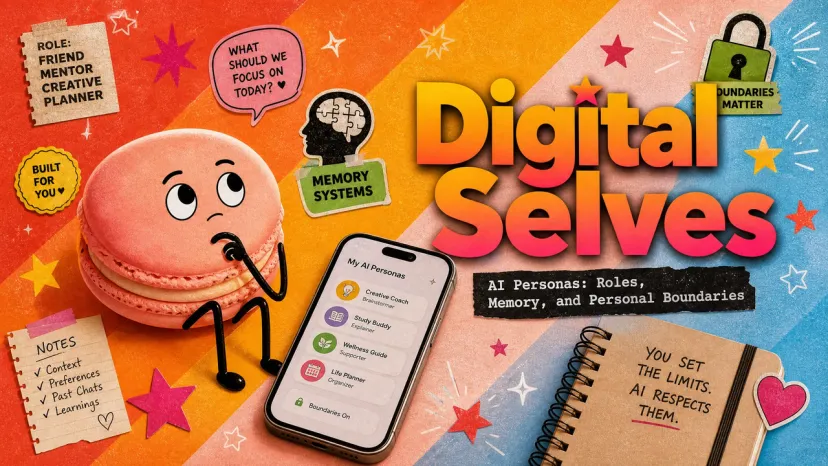
AI Personas: Roles, Memory, and Personal Boundaries
AI Personas: Roles, Memory, and Personal Boundaries
The most useful thing about AI personas isn't the voice or the name you give them. It's that a good one lets you skip the part where you re-explain who you are every single time.
I'm Mary, and I write about the small ways AI changes the way we plan, create, and organize everyday life. I’m less interested in the “magic” side of AI and more curious about what actually holds up after using these tools for a while — what saves time, what creates extra friction, and what quietly changes the way we work.
I didn't get that at first. I spent a weekend last spring building three of them — a blunt editor, a gentle planner, a brainstorm partner — and by Monday I'd forgotten which one knew what. That's the quiet mess nobody warns you about: personas are easy to make and surprisingly easy to lose track of.
So here's what I want to leave you with — where a persona actually earns its place, where it starts to muddy things, and why the memory underneath matters more than the personality sitting on top.
The 30-second version: A persona is a role and a tone — good for coaching, planning, or reflection. It stops being helpful when the role drifts, when you trust it like an expert it isn't, or when it quietly becomes the thing you turn to instead of a person. And a persona is not the same as memory — one is how it talks, the other is what it remembers about you.
What AI Personas Actually Are
A persona is the character an AI takes on — a name, a tone, a way of talking, sometimes a job title like "coach" or "editor." Underneath, it's the same intelligence. The persona is the outfit, not the person wearing it.
We're wired to read personality into anything that talks back. Researchers have spent years documenting how readily people attribute human traits to machines, extending politeness and trust to something we know isn't human — which boosts engagement but also nudges us toward overreliance. That instinct is why an AI with personality can feel easier to talk to than a blank prompt box. It's also why it's worth staying a little awake to what's happening.
An AI persona generator can spin up a "warm mentor voice" or a "no-nonsense drill sergeant" in seconds. That part is genuinely fun, and I've spent more time than I'd admit tweaking voices. But the tone is a costume. The judgment behind it — sharp or shaky — doesn't change because you renamed it, and it's easy to mistake a confident new voice for a smarter one.
When a Persona Helps
AI personas earn their keep when the role gives you a lane instead of the whole open field. The narrower the job, the better they tend to be at it — a persona built for one clear thing beats a vague all-purpose one almost every time I've tested it.
Coaching, planning, creativity, and reflection roles
There's real value in the reflection case especially. A safe, non-judgmental space to think out loud can help you name what you're feeling before you decide anything — the study I keep coming back to found people used it for exactly that, short-term relief and self-reflection, while also flagging that you shouldn't lean on it to dodge the harder human conversations.
Where I've found a persona most useful:
Coaching — a steady voice that asks the next question instead of handing you the answer.
Planning — turning a vague "I have four days off" into an actual order of operations.
Creativity — a partner that says "what if" without judging the bad ideas out loud.
Reflection — a low-stakes place to think, not a verdict on how you're doing.
That's really it. A persona helps when it narrows the room, not when it pretends to be every room at once.
When Personas Become Confusing
Role drift, false authority, and overattachment
Three ways it goes sideways, in the order I usually notice them.
Role drift. You set up an "editor" and three prompts later it's handing out life advice. The role bleeds, and nothing flags that it happened. You just slowly stop getting what you came for.
False authority. A confident tone reads as competence. But a "coach" or "advisor" persona speaks with the same steadiness whether it's right or guessing. The costume lends an authority the judgment hasn't earned. This is where AI life autonomous personas — the kind you let run with less oversight — need more watching, not less.
Maybe I'm overthinking it. But I'd rather name it now: a persona that feels like a friend is doing its job — right up until it becomes the reason you talk to fewer real ones.
Memory Is Different From a Persona
Here's the distinction I wish someone had drawn for me sooner. A persona is how an AI talks. Memory is what it holds onto about you. You can have one without the other, and they carry different weight.
Privacy researchers actually separate the two cleanly: personality is the human-like manner, personalization is what adapts to your history. A drill-sergeant voice with no memory forgets you between chats. A warm presence that genuinely remembers can recall that you prefer mornings for focused work — even if you never picked a "personality" at all.
Persona
Memory
What it is
How it talks — tone, name, role
What it keeps about you over time
You change it by
Editing or resetting the role
Adding, correcting, or clearing what it holds
The boundary to watch
Role drift
How much it knows, and who can see it
This is where an AI friend like Macaron sits a little differently. Its Deep Memory is built to hold the things that actually matter to you — your preferences, the shape of your week, what you're working toward — so the sense of continuity comes from being remembered, not from a costume you had to configure. The persona can stay simple. The remembering does the quieter, heavier lifting.
And that difference matters for boundaries. You can reset an AI persona in a second. Memory is more like a relationship — it accumulates, and it deserves the same care you'd give anything that ends up knowing a lot about you.
If you've ever felt like you were re-introducing yourself to the same assistant for the hundredth time — that gap between how it talks and whether it actually remembers is exactly the thing worth paying attention to.
FAQ
How should persona settings be documented for later reuse?
Keep it almost embarrassingly simple: a note with the persona's name, its one job, and its tone in a single line. Mine live in a plain doc — "Editor — cuts my writing, blunt, skips the praise." Future-me is always grateful. The mistake I made early on was trusting I'd just remember. I didn't.
Can different personas share the same long-term memory?
Sometimes, yes — and that's the part to think about before you assume otherwise. If something is sensitive, do not assume a persona boundary keeps it isolated. Check the product’s memory controls and use a separately verified account, workspace, or memory store when isolation matters.
What if a persona is only needed for a temporary project?
Make it, name it for the project ("Q3 launch helper"), and give it a mental end date. The temporary ones are exactly the personas most likely to linger and pile up. I delete mine the week a project ships — no ceremony, no second-guessing. It keeps the list honest.
How should shared accounts label persona settings?
Put the person's name right in the label — "Sam's planner," not just "planner." On a shared account, an unlabeled persona is a small trap: someone else's tone and context quietly leaking into your chat. A clear name is the cheapest fix for the most annoying kind of confusion.
When should a persona be reset instead of edited?
Edit when the tone is just slightly off. Reset when the role has wandered so far you find yourself arguing with it. A clean reset beats layering patch after patch onto something that's already drifted. If you've fixed the same persona four times, start fresh — it's faster than it feels.
AI personas are worth using. Just hold them lightly — a role and a tone you can pick up and put down, sitting on top of memory that's doing the quieter, more important work of actually knowing you. Keep the roles clear, notice when one drifts, and don't let the warmth talk you out of the people in your life.
Worth trying an AI friend that leads with memory over personality if you're tired of starting from scratch every time. That's the part I'd want back.
Three years in creative consulting, which mostly means I've tried every productivity system out there and abandoned most of them within a week.
I'm not undisciplined. I just figured out early that most tools aren't really built for the way my brain works — and once I accepted that, things got a lot quieter.
I write about what actually helps. Not for everyone. Just maybe for you.