Calcolatore del Massimo Comun Divisore
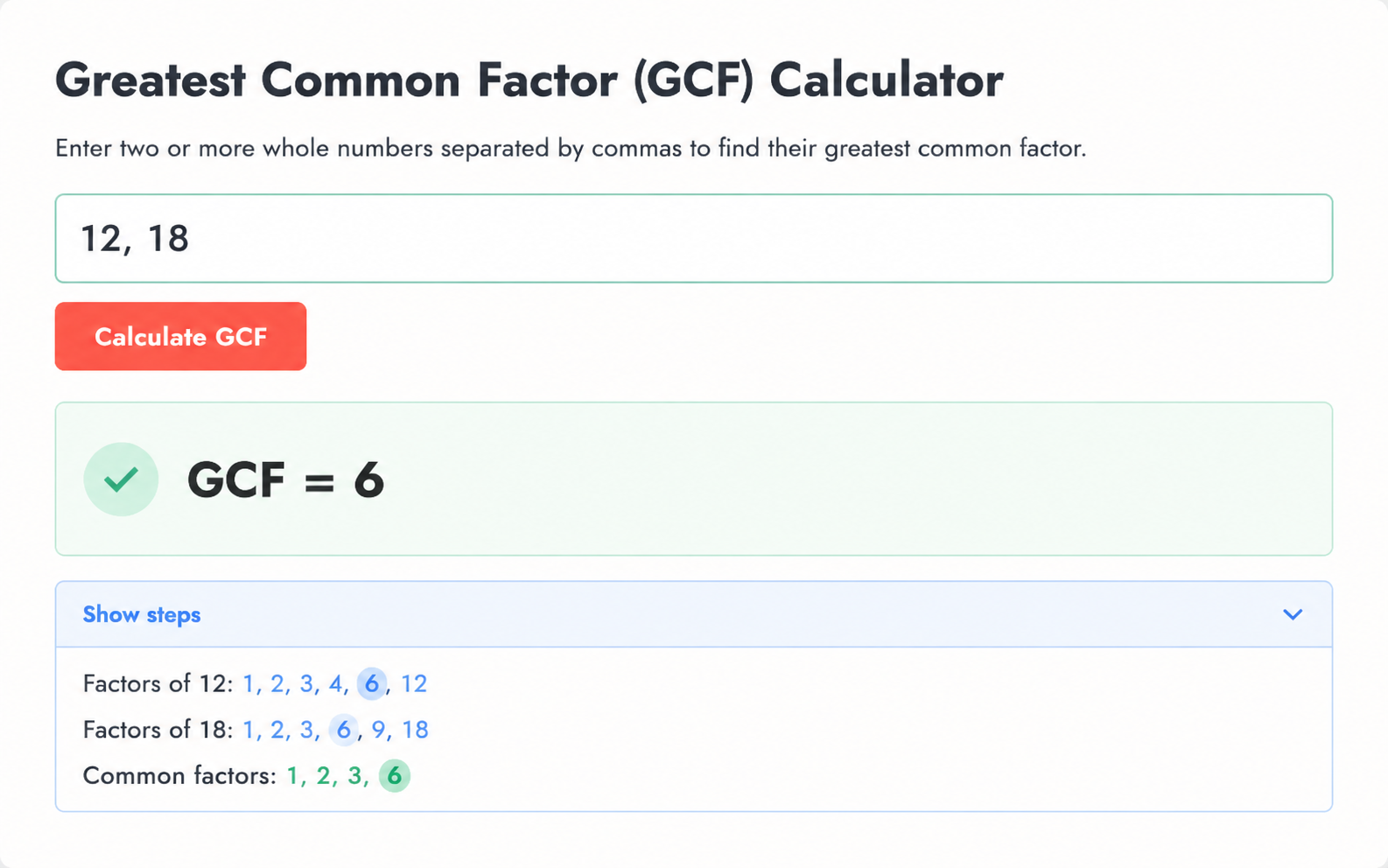
Calcola il MCD di due o più numeri utilizzando i metodi di fattorizzazione prima e l'algoritmo euclideo. Ottieni risultati istantanei con spiegazioni passo per passo.
If you need to calculate GCF for homework, simplify a fraction, compare GCF and LCM, or check the GCF of 3 numbers, this page gives you both the answer and the method behind it.
Che cos'è il Massimo Comune Divisore (MCD)?
Il Massimo Comune Divisore (MCD), noto anche come il Massimo Comune Divisore (GCD) o il Massimo Comun Divisore (HCF), è il più grande numero intero positivo che divide due o più numeri senza lasciare un resto. È un concetto fondamentale nella teoria dei numeri e ha ampie applicazioni in matematica, algebra e informatica.
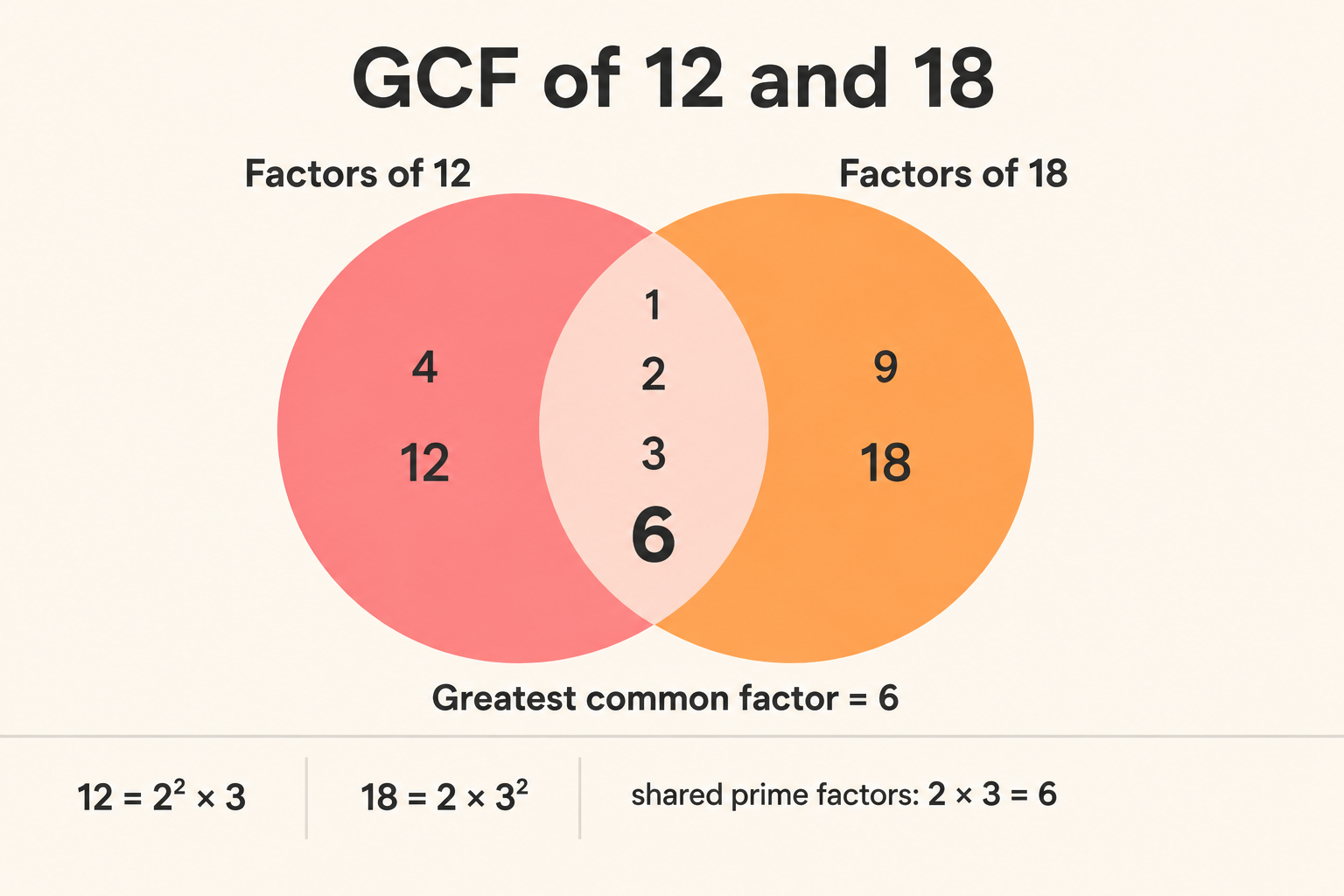
Ad esempio, il MCD di 12 e 18 è 6, perché 6 è il più grande numero che divide sia 12 che 18 esattamente. Il MCD è particolarmente utile quando si semplificano frazioni, si cercano denominatori comuni e si risolvono problemi che coinvolgono rapporti e divisibilità.
GCF vs GCD vs HCF — are they the same?
Yes. GCF, GCD, and HCF usually mean the same thing. GCF means greatest common factor. GCD means greatest common divisor. HCF means highest common factor. Different textbooks and regions may use different names, but all three refer to the largest number that divides the given numbers evenly.
Come Usare il Calcolatore MCD
Use this section if you are wondering how to find GCF on calculator tools without doing every step by hand.
- Inserisci i Tuoi Numeri: Digita due o più numeri interi positivi separati da virgole nel campo di input (es., 330, 75, 450, 225).
- Clicca su Calcola: Premi il pulsante 'Calcola MCD' per calcolare il massimo comune divisore.
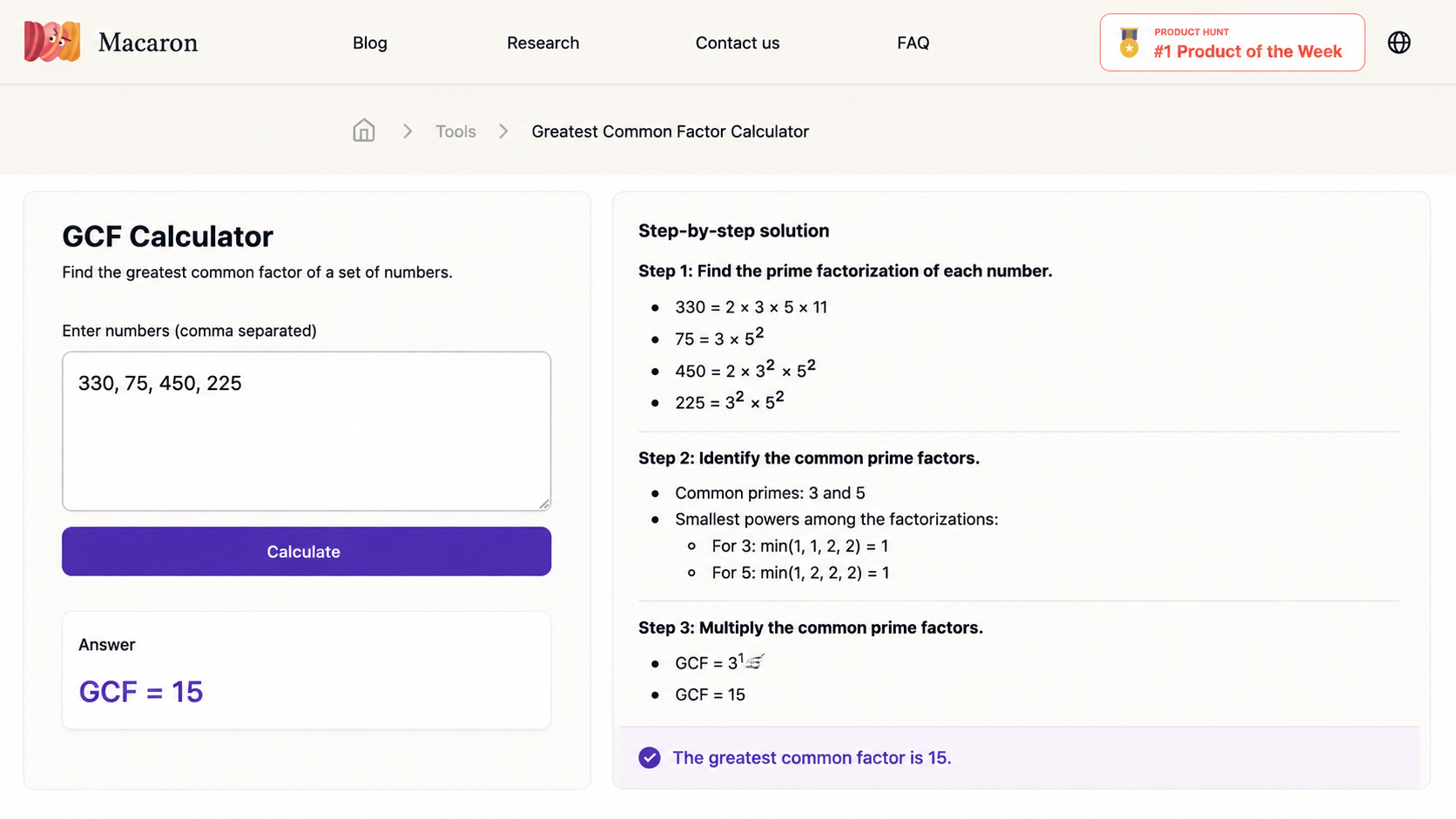
- Visualizza i Risultati: Il calcolatore mostra il valore del MCD, la fattorizzazione prima di ciascun numero con i fattori comuni evidenziati e i calcoli passo per passo utilizzando l'algoritmo euclideo (per due numeri).
Approfondimenti Chiave sul MCD
- Metodi Multipli di Calcolo: Il MCD può essere calcolato utilizzando vari metodi tra cui l'elenco di tutti i fattori, la fattorizzazione prima o l'algoritmo euclideo. Ogni metodo ha i suoi vantaggi a seconda della dimensione e del numero degli interi coinvolti.
- Essenziale per la Semplificazione delle Frazioni: Il MCD è cruciale per ridurre le frazioni alla loro forma più semplice. Dividendo sia il numeratore che il denominatore per il loro MCD si ottiene la frazione semplificata.
- Applicazioni in Crittografia: Il MCD e gli algoritmi correlati svolgono un ruolo vitale nella crittografia moderna, in particolare nella crittografia RSA e in altri sistemi di sicurezza basati sulla teoria dei numeri.
- Sempre un Numero Intero Positivo: Il MCD è sempre un numero intero positivo, e per qualsiasi insieme di numeri, il MCD è almeno 1 (poiché 1 divide tutti i numeri interi).
- L'Efficienza Conta: Per numeri piccoli, la fattorizzazione prima è intuitiva e facile da comprendere. Per numeri più grandi, l'algoritmo euclideo è più efficiente e computazionalmente più veloce.
Metodi per Calcolare il MCD
There are three common ways to calculate the GCF: listing the factors, using prime factorization, and using the Euclidean algorithm. Each one gives the same answer, so how to calculate the GCF really comes down to which method fits your numbers.
1. Elenco di Tutti i Fattori
Questo metodo comporta l'elenco di tutti i fattori di ciascun numero e l'identificazione del fattore comune più grande. Sebbene sia semplice per numeri piccoli, diventa impraticabile per interi più grandi.
tools.gcfCalculator.method1Example
This method is simple for small numbers and is a good way to learn what "common factor" means.
2. Fattorizzazione Prima
Scomponi ciascun numero nei suoi fattori primi, quindi moltiplica i fattori primi comuni (con le potenze più basse) per trovare il MCD. Questo metodo è visivo e aiuta a comprendere la struttura dei numeri.
Esempio: 12 = 2² × 3 e 18 = 2 × 3². Fattori comuni: 2¹ × 3¹ = 6, quindi MCD = 6.
Prime factorization is useful when you want to see the structure of each number and understand why the answer works.
3. Algoritmo Euclideo
Questo antico e efficiente algoritmo applica ripetutamente il processo di divisione: dividi il numero maggiore per il più piccolo, sostituisci il maggiore con il più piccolo e il più piccolo con il resto. Continua fino a quando il resto è 0. L'ultimo resto non zero è il MCD.
Esempio: MCD(48, 18): 48 = 18 × 2 + 12, quindi 18 = 12 × 1 + 6, quindi 12 = 6 × 2 + 0. MCD = 6.
Factor Out the GCF of Variables, Monomials & Polynomials
A factoring GCF calculator helps with the same core idea: find the largest factor shared by every term, then factor it out. For a numeric expression: 6 + 12 = 6(1 + 2). For an algebraic expression: 6x + 12 = 6(x + 2).
For monomials and polynomials, the GCF may include numbers, variables, or both. Example: 8x² + 12x = 4x(2x + 3). This page's calculator focuses on numeric GCF for positive integers. If you are looking for a factor out GCF calculator for variables, monomials, or polynomials, use the same rule: find the shared numerical factor and the shared variable part with the lowest exponent.
GCF and LCM Calculator – Find Both Together
A GCF and LCM calculator helps you compare two related ideas. GCF is the greatest number that divides the given numbers evenly. LCM is the smallest number that the given numbers divide into evenly.
For two positive integers:
GCF × LCM = product of the two numbers
Example: for 12 and 18: GCF = 6, LCM = 36, 12 × 18 = 216.
The relationship between GCF and LCM
That formula is more than a trick. Because every prime factor of the two numbers ends up in either the GCF (the shared part) or the LCM (the combined part), multiplying them always rebuilds the original product. So if you already know the GCF, you can find the LCM fast:
LCM = (a × b) ÷ GCF
For 12 and 18: (12 × 18) ÷ 6 = 216 ÷ 6 = 36.
Note that this shortcut works cleanly for two numbers. For three or more, calculate the LCM directly instead of dividing the full product by the GCF.
Simplify Fractions Using the GCF
Simplifying fractions using the GCF is one of the most common reasons people reach for a GCF fraction calculator. The idea is simple: divide the numerator and the denominator by their GCF, and the fraction is reduced to lowest terms in one step.
Example: reduce 24/36. The GCF of 24 and 36 is 12. 24 ÷ 12 = 2, 36 ÷ 12 = 3. So 24/36 simplifies to 2/3.
If you divide by a common factor that is not the greatest one, you will still need to simplify again. Using the GCF gets you to lowest terms immediately, which is why it is the cleanest method for reducing any fraction.
Find the GCF of 3 or More Numbers
A GCF of 3 numbers calculator works the same way as it does for two numbers. The GCF of a longer set is the largest integer that divides every number in the set. By hand, the easiest approach is to take the GCF two numbers at a time: find GCF(a, b), then find GCF of that result and c.
Find GCF(a, b), then find GCF of that result and c.
Example: find the GCF of 24, 36, and 60. GCF(24, 36) = 12, then GCF(12, 60) = 12. So the GCF of 24, 36, and 60 is 12.
This pairwise method scales to any number of values, and it is exactly what the calculator does internally when you enter a longer set.
Worked Examples – Common GCF Calculations
These are some of the GCF pairs people look up most often. Each one is worked the short way so you can check your own answer quickly.
| Numbers | Shared factors | GCF |
|---|---|---|
| 12 and 18 | 1, 2, 3, 6 | 6 |
| 8 and 12 | 1, 2, 4 | 4 |
| 16 and 24 | 1, 2, 4, 8 | 8 |
| 18 and 24 | 1, 2, 3, 6 | 6 |
| 15 and 25 | 1, 5 | 5 |
| 24 and 36 | 1, 2, 3, 4, 6, 12 | 12 |
For the most common classroom example, the GCF of 12 and 18 is 6, because 6 is the largest number that divides both 12 and 18 without leaving a remainder.
Coprime numbers — when the GCF is 1
Sometimes two numbers share no common factor other than 1. When that happens, the GCF is 1, and the numbers are called coprime (or relatively prime).
Example: 8 and 15. Factors of 8: 1, 2, 4, 8. Factors of 15: 1, 3, 5, 15. The only shared factor is 1, so the GCF of 8 and 15 is 1. A fraction like 8/15 is already in lowest terms, because there is nothing left to divide out.
Applicazioni Reali del MCD
- Semplificazione delle Frazioni: Riduci le frazioni ai loro termini minimi dividendo sia il numeratore che il denominatore per il loro MCD.
- Trovare Denominatori Comuni: Quando si aggiungono o sottraggono frazioni, il MCD aiuta a trovare il minimo comune multiplo (LCM) per i denominatori comuni.
- Risoluzione di Equazioni Algebriche: Fattorizza il MCD dalle espressioni polinomiali per semplificare e risolvere le equazioni più facilmente.
- Teoria dei Numeri e Crittografia: Il MCD è fondamentale negli algoritmi utilizzati per la crittografia, le firme digitali e le comunicazioni sicure.
- Problemi di Ottimizzazione: In informatica, il MCD è usato per ottimizzare gli algoritmi, ridurre la complessità computazionale e risolvere problemi che coinvolgono la divisibilità e l'aritmetica modulare.
Domande Frequenti (FAQ)
Qual è la differenza tra MCD e LCM?
Il MCD (Massimo Comune Divisore) è il numero più grande che divide uniformemente tutti i numeri dati, mentre il LCM (Minimo Comune Multiplo) è il numero più piccolo che è multiplo di tutti i numeri dati. Sono correlati: MCD × LCM = Prodotto dei due numeri (per due numeri).
Il MCD può essere più grande del numero più piccolo?
No, il MCD non può essere più grande del numero più piccolo nel set. Il MCD è sempre minore o uguale al numero più piccolo.
Qual è il MCD di due numeri primi?
Il MCD di due numeri primi diversi è sempre 1, perché i numeri primi non hanno fattori comuni oltre a 1.
Come trovo il MCD di più di due numeri?
Puoi trovare il MCD di più numeri trovando prima il MCD di due numeri, quindi trovando il MCD di quel risultato con il numero successivo, e così via. In alternativa, usa la fattorizzazione prima per identificare tutti i fattori primi comuni.
Perché l'algoritmo euclideo è efficiente?
L'algoritmo euclideo è efficiente perché riduce rapidamente la dimensione del problema con ogni passo, rendendolo molto più veloce rispetto all'elenco di tutti i fattori, specialmente per numeri grandi. La sua complessità temporale è logaritmica.
Qual è il MCD di 0 e qualsiasi numero?
Il MCD di 0 e qualsiasi numero non zero n è n stesso, perché ogni intero divide 0. Tuttavia, nelle applicazioni pratiche, lavoriamo tipicamente solo con numeri interi positivi.
Need More Than a Calculator? Meet Macaron
A GCF calculator solves one problem well. But homework, study sessions, and everyday questions rarely stop at a single calculation.
Macaron is a personal AI that remembers what you are working on and can build small tools, walkthroughs, and study help around the way you actually learn. If you find yourself reaching for one calculator after another, it is a way to keep all of that in one place that adapts to you.
Create your own tools with MacaronRelated tools and reading
Riferimenti e Ulteriori Letture
Leggi e scopri
Assistente personale IA
Calcolatori gratuiti


