Hermes Bot vs Personal AI: Execution or Understanding?
Hermes Bot vs Personal AI: Execution or Understanding?
Quick Verdict
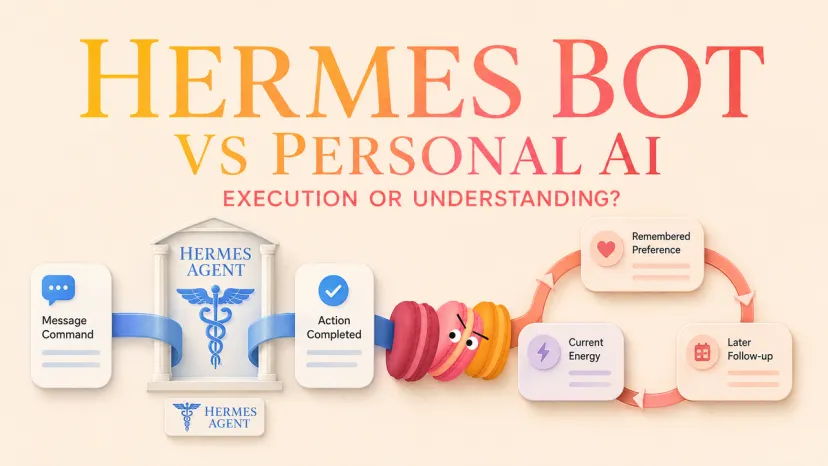
Hermes Bot vs Personal AI is a choice between remote execution and ongoing personal context. Here, “Hermes Bot” means Hermes reached through a Messaging Gateway. Bot Mode is a separate profile experience inside Hermes Desktop, not a standalone Personal AI category.
Choose the Hermes messaging agent when tools and schedules are central. Choose a Personal AI when continuity across repeated decisions matters more. “Understanding” means documented use of supplied context—not consciousness. This is a documentation-based comparison, not a hands-on reliability or memory-retention test.
What “Hermes Bot” Means in This Comparison
Bot Mode Profiles Inside Hermes Desktop
The Bot Mode docs confirm that a Bot is a Hermes profile shown in a Desktop roster. It separates configuration, memory, Skills, credentials, and history; its canonical Bot Chat persists. Bot Mode organizes this state; it is not another Personal AI product.
Messaging Bots Connected Through the Gateway
The Gateway docs describe platform adapter → per-chat session store → agent. It also runs scheduled jobs. This establishes an execution route, not reliable delivery or contextual relevance.
Two Different Product Promises
A Gateway-Connected Hermes Bot for Remote Execution
The promise is remote access to authorized tools. A message may arrive while a required tool, credential, or permission is unavailable. Ask: Can this channel invoke the tool, expose failure, and let me stop the task?
Personal AI for Ongoing Life Context
A personal AI companion aims to reduce repeated setup through personal context. Memory and controls remain product-specific. The Personal AI guide explains the category, not every product.
What Each Type Remembers
Task History, Skills, and Curated Agent Notes
Hermes continuity has distinct layers. Its memory docs describe bounded MEMORY.md notes and a USER.md profile, injected as a frozen session-start snapshot. New writes enter the prompt in a later session; past conversations are searched separately. Curated memory is not searchable history.
Preferences, Routines, and Relationship Context
A Personal AI may retain preferences or recurring-decision context. Verify what was saved, when it was confirmed, and how it is corrected or deleted. “Relationship context” is user-provided history, not human-like knowledge.
How Each Type Helps Day to Day
Commands, Schedules, and Tool-Driven Tasks
Remote-task scenario: you ask an agent to inspect a project folder. Did the request reach the intended session? Was the tool permitted? Which profile, Skill, or history applied? Did work stay in scope? Could you stop it and see failure? Mark answers Confirmed, Unknown, or Product-specific; delivery alone is not success.
Reflection, Planning, and Repeated Personal Decisions
Repeated-decision scenario: you plan meals around preferences and changing commitments. Confirm the context source, freshness, correction path, reminder or quiet-period control, and deletion path. Personal continuity may improve relevance, but it does not decide which tradeoff matters most.
Always-On Access and Proactive Support
Being Reachable Across Messaging Channels
An always-on AI assistant is reachable only while its host, Gateway, credentials, and channel remain available. Receiving a request does not show that the required tool is available, an unattended task will finish, or the system noticed a meaningful need.
Knowing When and Why to Step In
Use this reachability-versus-relevance test:
Dimension
Question to verify
Reachability
Where and when can it receive requests or deliver output?
Execution
Which authorized tools, schedules, and tasks can it actually run?
Continuity
Which history, Skills, notes, preferences, or routines carry forward?
Relevance
Which documented context helps a response fit the current situation?
Initiative control
Who sets triggers, permissions, quiet periods, corrections, and stop conditions?
A scheduled output is proactive in timing, not necessarily relevant. Messaging access does not establish contextual understanding; life context does not establish reliable execution.
Control, Privacy, and Responsibility
Neither category is inherently safer. For Hermes messaging, the documented chain is authorization or pairing, enabled tools, dangerous-command approval, write boundaries, and user review. The security docs call this defense in depth—not a guarantee that every authorized process is isolated.
Profiles separate Hermes state but are not operating-system sandboxes. Life-context products may reuse sensitive or outdated context. For either type, verify credentials, corrections, exports, deletion, and stop controls.
Which Type Fits You?
Choose Hermes messaging if the task needs remote access, an authorized tool, visible failure, and a clear stop condition.
Choose Personal AI if value depends on context that can be inspected, corrected, and kept current across decisions.
Use both if each task has one source of truth and an explicit handoff rule.
Verify first whenever permissions, memory, accessibility, export, deletion, or initiative control is unknown.
FAQ
Can one person use both types without duplicating every reminder?
Yes, but give each reminder one owner. Record its source, check duplicate notifications, and review routing after connection changes. Do not assume native synchronization. Disable the old route before creating its replacement.
Which type is easier to leave or switch away from?
It depends on the product. Check export, credential revocation, subscription cancellation, memory deletion, and account deletion separately. Hermes profile docs confirm profile export with API keys stripped. Export does not prove that original data was deleted.
Does renaming a Bot Mode profile affect its saved conversations?
Hermes confirms that renaming a named profile updates its alias and service. It does not clearly establish, as of the review date, every effect on conversation IDs, Gateway mappings, routines, or file paths. Export first and inspect those references.
How should shared households separate accounts and histories?
Use separate accounts or Hermes profiles where supported, with separate memories, sessions, credentials, channels, and exports. Profile separation isolates Hermes state; it is not a household-account guarantee or device sandbox. Check operating-system access separately.
Which type works better with screen readers and voice input?
There is no category-wide winner. Hermes Desktop docs confirm a command palette, rebindable shortcuts, and zoom; Gateway voice capabilities vary by channel. Screen-reader labels, focus order, and full keyboard-only conformance are not clearly documented as of the review date.
Conclusion
The productivity agent vs personal AI choice is execution vs understanding, with understanding limited to verified contextual continuity. Choose execution when access, tools, failure visibility, and stop controls are confirmed. Choose personal context when memory is inspectable, correctable, and current. Verify unknowns rather than declaring a winner.
Sono Maren, ho 27 anni, strategist di contenuti e sperimentatrice instancabile. Testo strumenti di intelligenza artificiale e micro-abitudini nella vita quotidiana, annotando cosa fallisce, cosa funziona e cosa davvero fa risparmiare tempo. Il mio approccio non riguarda le funzionalità, ma attriti, aggiustamenti e risultati onesti. Condivido intuizioni provenienti da esperimenti che resistono a una settimana reale, aiutando gli altri a vedere cosa funziona senza fronzoli.