Hermes Desktop vs Personal AI Assistants
Hermes Desktop vs Personal AI Assistants

Quick Verdict
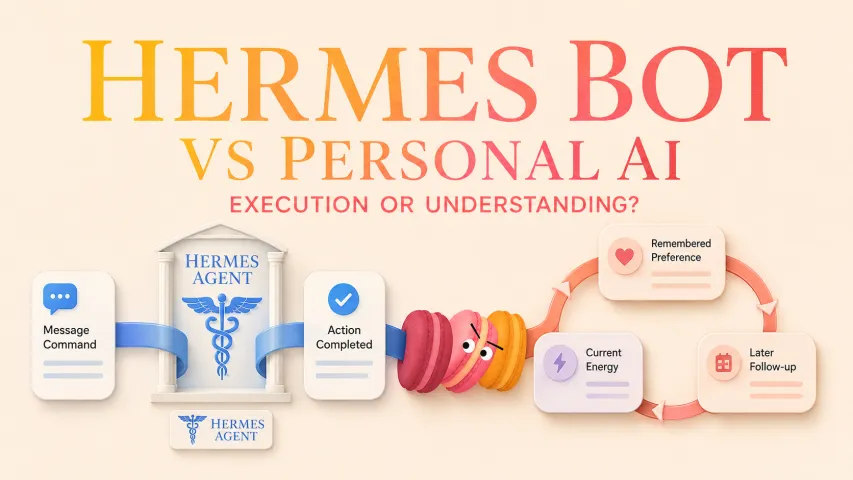
This is an asymmetric comparison. Hermes Desktop is a native interface for configuring and running Hermes Agent work; personal AI assistants are a varied category for ongoing daily support. Choose Hermes Desktop for technical control and defined project execution. Choose a personal AI product for lower setup and routine continuity—subject to its verified controls.
The useful question in a Hermes Desktop vs personal AI choice is who takes responsibility for setup, context, and action. Check where work runs, which state and credentials it uses, and how you review, stop, export, or delete it.
What Each Option Is Designed to Do
Hermes Desktop for Building and Running Agent Work

Nous Research describes Hermes Desktop as the native app for Hermes Agent. Its Desktop documentation says Desktop, CLI, and gateway share the agent core, configuration, sessions, Skills, and memory. The app runs on macOS, Windows, and Linux with a local or user-operated remote backend.
This AI desktop assistant creates an operations surface for work involving project folders, tools, execution steps, and explicit boundaries. A graphical interface may reduce setup friction, but it does not turn Hermes into a prepackaged personal AI companion.
Personal AI Assistants for Ongoing Daily Support
“Personal AI assistant” covers products with different models, memory, and controls. The Personal AI agent guide describes a category focused on individual tasks and context. Some products prepackage routines, planning, or preferences as a personal-context surface. These are not universal features.
Setup and Control

Providers, Tools, Skills, and Permissions
Hermes Desktop exposes providers, models, tools, credentials, and gateways through its UI. These settings feed the same Agent state as other interfaces, so the UI changes how controls are operated—not who owns them. Hermes documents command approvals and file-safety controls in its security documentation.
The Hermes Agent desktop leaves credentials, tool permissions, files, remote access, and execution limits to deliberate choices. These are documented controls, not independent proof that a configuration is safe.
Ready-to-Use Experiences with Less Configuration
Some consumer personal AI products package onboarding and personalization together. That may reduce setup, but it does not guarantee privacy, better memory, or offline operation. A productivity agent vs personal AI comparison should count setup burden and ongoing responsibility.

Memory and Personalization
Curated Agent Memory and Session Continuity
Hermes describes persistent memory as a bounded, curated layer and treats session search as a separate way to recover past conversation details in its memory documentation. This supports project continuity and reusable Skills; it does not prove better personal understanding.
Life Context, Preferences, and Relationship Continuity
Some personal AI products aim to retain preferences, routines, or relationship context. Check the exact product's documentation. “Relationship continuity” is a design goal, not proof of understanding or a substitute for human judgment.
Daily-Life Fit
Project Execution and File-Based Work
Consider this hypothetical decision prompt: “I need an agent to work through a defined project and files.” Hermes Desktop fits when its documented file, tool, Skill, and backend controls match that task. Verify what it can read, where execution occurs, and which actions require review.
Routines, Reflection, Planning, and Small Decisions
Now consider: “I need ongoing support across routines and small daily decisions.” Some personal AI products may reduce repeated setup. Treat this as a hypothetical choice, not a test result, and verify how the exact product stores, corrects, exports, or deletes personal context.

Privacy and Responsibility Trade-Offs
The clearest comparison is a three-part responsibility split:
- User configures: Hermes providers, models, tools, Skills, credentials, files, approvals, and backend boundaries.
- Product prepackages: Some personal AI products may package onboarding, interface, memory behavior, routines, and support surfaces, but these vary by product.
- User still controls: Sensitive inputs, corrections, permissions, connected accounts, exports, deletion requests, and situations where either assistant should not act.
Desktop documentation says gateway tokens use the operating-system keyring, with a plain-text option on Linux systems without one, and offers uninstall scopes that preserve data or remove all local user data. The profile documentation says exports can include Skills, memory, persona, cron jobs, plugins, and settings while stripping credentials. These controls are not a privacy guarantee or universal export.

Desktop documentation says gateway tokens use the operating-system keyring, with a plain-text option on Linux systems without one, and offers uninstall scopes that preserve data or remove all local user data. The profile documentation says exports can include Skills, memory, persona, cron jobs, plugins, and settings while stripping credentials. These controls are not a privacy guarantee or universal export.
Which Type Fits You?
Choose Hermes Desktop if: you want provider and tool control for defined projects and can manage credentials, permissions, and execution boundaries.
Choose a Personal AI product if: its documented controls support ongoing assistance and you prefer prepackaged setup and continuity.
Verify first: execution location; state, memory, and credentials used; approval boundaries; connectivity; export and deletion scope; shared-device behavior; and accessibility.
FAQ
Can Hermes Desktop and a personal AI assistant use the same model?
Possibly. Hermes supports custom OpenAI-compatible endpoints according to its provider documentation, but the exact model, version, credentials, and context requirements still need verification. Shared model access does not make tools, memory, permissions, or interfaces equivalent.
Which option works better with unreliable internet access?
Neither wins by default. A local Hermes backend plus a supported local model can keep model inference local, but hosted providers, remote gateways, web-backed tools, and updates retain separate network dependencies. Personal AI connectivity varies by product; never infer offline support from a desktop app alone.
Can households keep separate personal contexts on one device?
Hermes documents profiles with isolated configuration, Skills, and sessions, but not a household account guarantee. Verify accounts, memory boundaries, permissions, operating-system user separation, and shared-device behavior. Avoid one shared context when private information could cross between people.
What data should users export before switching assistant types?
For Hermes, a profile export documents Skills, memory, persona, cron jobs, plugins, and settings, with credentials removed. Do not assume chats, external-service data, or subscriptions are included unless the installed version says so. Separately inventory files, connected accounts, credentials, and deletion or revocation steps.
Do either type offer keyboard-only accessibility settings?
Hermes Desktop documents a command palette, rebindable shortcuts, and zoom. As of August 24, 2026, its documentation does not clearly establish complete keyboard-only task completion, focus order, screen-reader labels, or accessibility conformance. Verify these behaviors in the installed version and in the exact personal AI product.
Conclusion
Hermes Desktop fits configurable agent work; some personal AI products may fit ongoing life support with less assembly. Apply the same execution, context, and exit checks to both, then choose the documented controls that fit your data, device, and responsibilities.
Previous Posts





Candidatar-se para se tornar Os primeiros amigos de Macaron
Ler e descobrir
Assistente pessoal de IA
Calculadoras gratuitas


