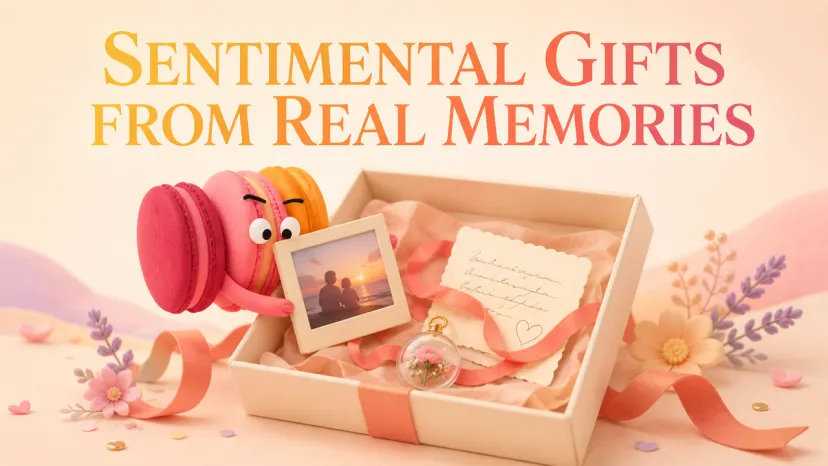
"What did you give my mom last Christmas?" — asked by a friend, in March, about a gift I had picked carefully four months earlier and could not retrieve from memory if my life depended on it. The problem is treating personalization as a feature instead of a connection. A name engraved on a generic mug is still a generic mug. A photo printed on a blanket of someone you see twice a year isn't a memory — it's a logistics decision made in late November.
What follows is a relationship-by-relationship approach, four formats that actually carry meaning, and a way to stop starting from zero every December.
A friend started calling it "Maren's holiday memory problem" after the third year I asked her what I'd given her mother the Christmas before — between client briefs, in the same week I was supposed to be finalizing gifts for nine other people. The problem wasn't the gifts. It was that I had no system for remembering which year held which gift, which preference had shifted, and which idea I'd already used and quietly retired.
The honest version: most sentimental gift ideas fail because they skip the memory and go straight to the object. A keepsake without a story behind it is just an object with extra steps. So I went looking — through old chat threads, photo albums, a notebook where I'd written down things friends said in passing — for what an actual sentimental gift looks like when it starts from the relationship instead of the catalog.
What Makes a Gift Sentimental
Not the price. Not the packaging. Not even the personalization, technically. A gift becomes sentimental when it references something only you and the recipient share — and the recipient recognizes it without explanation.
Shared memory
The single strongest anchor. A specific moment you both remember — a trip, a phrase someone said, a song that played in a kitchen at 2 a.m. The gift doesn't have to reproduce the moment. It has to point at it clearly enough that the recipient feels seen, not flattered.
Personal story
Different from shared memory — this is a story about the recipient that they told you, and the gift quietly acknowledges you remembered. The line between "thoughtful" and "surveillance" is real here, and I'll come back to it. Drawing on Pennebaker writing study and decades of follow-up, written narrative about meaningful events tends to deepen rather than dilute connection — which is why story-based gifts age well.
Meaningful object
An object that already had meaning for the recipient, returned to them in a new form. A pressed flower from a garden they had to leave behind. A framed handwritten recipe from someone no longer here. These are the heaviest format. Use sparingly.
Sentimental Gift Ideas by Situation
The same memory becomes a different gift depending on the relationship. One framework does not fit all four of these.
Friendship
Long friendships accumulate inside jokes, shared playlists, half-finished plans. The best heartfelt presents here lean specific and small. A book with a page bookmarked at the passage that reminded you of them. A photo of a place you were both in, printed for their desk. According to Harvard on relationships, the durability of close friendships correlates with how often small acknowledgments happen — not how grand the gestures are. Friendship gifts that try too hard tend to land worse than ones that show you were paying attention.
Partner or family
Higher stakes, longer history, more shared context. This is where memory-anchored gifts work best — and where generic "personalized" items work worst. An engraved bracelet with a date that means nothing to either of you is a worse gift than a hand-bound book of texts you sent each other in the first six months. The second one took longer. It is also the only one of the two they will keep.
Goodbye or moving away
Different emotional weight. The recipient is leaving, the gift is the last thing they'll associate with the place or stage you shared. Lean toward portable, durable, single-purpose. A small photo album of one specific year. A letter to be opened on the one-month anniversary of their move. Not a houseplant. Not anything fragile. Not anything that needs a charger.
Remembering someone
This category requires the most care. Memorial keepsakes and gifts to remember a loved one can land beautifully or terribly — sometimes with the exact same gift, depending on timing and the recipient's stage of grief. Child Mind grief guidance consistently emphasizes that meaningful objects are most welcome when the recipient signals readiness, not when the giver decides it's time. If you have to convince yourself they're ready, they probably aren't.
In memory presents work best when they're quiet — a small framed photo, a single recipe handwritten on cardstock, a donation in the person's name to something they cared about. Loud memorial gifts (large portraits, multi-photo collages, anything that demands display space) often sit in closets, even when the recipient loved the person deeply.
Memory-Based Gift Formats
Four formats that consistently carry meaning. Most other formats are variations of these.
Photo keepsakes
The most common, the most overdone, the easiest to get wrong. A photo keepsake works when the photo is specific — a real moment with context, not a posed group shot. One photo, well-chosen, framed simply, beats a twelve-photo collage every time. Test: if the recipient has to ask "when was this?", the photo is doing the work. If they have to ask "who is this?", the gift has failed.
Letters or message-based gifts
The format that surprised me most over three years of testing. A handwritten letter — actual paper, actual handwriting — outlasts almost every other sentimental gift I've given or received. Variations work too: a printed compilation of text messages from a specific period, a recorded voice note transcribed and bound. The mechanism behind why this works is well-documented in APA writing research — written narrative creates a different kind of permanence than spoken or photographic memory.
Engraved items
Where most sentimental gift ideas go to die. Engraving works when the text is private — an inside reference, a date that means something specific, a phrase the recipient said. Engraving fails when the text is generic ("Best Mom Ever", a single name, a wedding date with no context). The rule: if a stranger could read the engraving and understand it, the engraving probably isn't sentimental enough.
Custom home objects
Mugs, blankets, candles, frames. The category most flooded by mass "personalization". A custom home object becomes sentimental when the customization references a specific thing only you and the recipient share — not when a name is added to something otherwise generic. A hand-thrown ceramic mug shaped like the one they broke in college works. A mass-produced mug with their first name printed on it does not.
When Sentimental Gifts Can Feel Too Heavy
This is the section most gift guides skip. Per Mayo Clinic on grief and broader research on meaning-making during difficult life stages, the same object that feels healing in year three of a loss can feel like an ambush in year one. The weight of a sentimental gift is decided by the recipient's current state, not the giver's intention.
Too private
A gift that references something the recipient hasn't shared with their partner, family, or current friend group can put them in an awkward position. The closer the inside reference, the higher the risk if the gift gets seen by others. If a gift requires the recipient to explain it, decide whether they'd want to.
Too sad for the moment
Memorial keepsakes during early grief. Photos of an ex during a recent breakup. References to a phase of life the recipient is actively trying to leave behind. The gift can be technically thoughtful and still land wrong. When in doubt, delay. A sentimental gift given six months later is almost always better received than the same gift given six weeks later.
Too hard to display or use
A gift that requires the recipient to find space, dust regularly, or feel guilty about not displaying. Large framed items, custom artwork, anything fragile. If the gift creates a maintenance obligation, it stops being a gift and starts being a small ongoing duty.
How Macaron Can Turn Memories Into Gift Ideas
The actual problem I had — forgetting which year held which gift — turned out to be a problem of memory, not creativity. The ideas were there. The recall wasn't.
Recall stories and details
When I mentioned to Macaron in October that I was starting to think about December, it surfaced things I'd told it over the year — a friend's offhand comment about wanting to learn bookbinding, a sibling's complaint about losing their favorite pen. Not as suggestions. As context I'd forgotten I had. The gift ideas came from me. The remembering didn't have to.
Find the right emotional tone
The harder part of memorial gifts and goodbye gifts isn't choosing the object — it's calibrating the tone. Too light feels dismissive. Too heavy feels intrusive. I asked Macaron to help me think through a remembrance gift for a friend whose mother had passed eight months earlier, and the most useful thing it did was push back gently on my first three ideas as too heavy for the stage she was in.
Save ideas for future moments
The system I didn't have before: when I notice something — a passing comment, a shared moment, an offhand wish — I can note it without needing to know yet who it's for or when. Six months later, when I'm trying to figure out what to give that person, the notes are still there. Starting from zero every December was the actual failure mode. Not the gifts.
FAQ
How do I choose a sentimental gift from one small memory?
Start with the memory itself, not the format. Ask: what specifically about this moment did the recipient and I both notice? The answer points to the format. A shared laugh might become a letter. A shared place might become a framed photo. A shared object might become a recreation. The memory chooses the format — you don't choose the format and retrofit a memory into it.
How do I make a sentimental gift meaningful without feeling too heavy?
Match the gift's emotional weight to the recipient's current state, not your own. If you're more invested in the memory than they are, scale down. A small reference works better than a grand gesture when the relationship is in a quieter phase. Heavy gifts work in heavy moments — anniversaries of meaningful events, big transitions, deep losses years later. Not random Tuesdays.
Are photo keepsakes or memory-based gifts good choices?
Photo keepsakes work when the photo is specific and the format is restrained. One photo, simply framed, beats a twelve-photo collage. Memory-based gifts in general work when the memory is shared, not assumed. If the recipient might not remember the moment the gift references, the gift becomes confusing rather than sentimental.
What should I consider for memorial or remembrance gifts?
Three things: the recipient's stage of grief, the gift's volume (loud memorial gifts often go in closets), and whether the recipient has signaled they want this kind of acknowledgment. When uncertain, ask a sibling or close friend of the recipient before giving. The right memorial keepsake at the wrong time is still the wrong gift.
How can AI help turn real memories into appropriate gift ideas?
The useful role isn't generating ideas from nothing. It's remembering details you've already noticed but can't retrieve under pressure — passing comments, small preferences, things mentioned months earlier. The gift comes from your relationship with the recipient. The recall, calibration of tone, and follow-through across the year is where help actually matters.
I'm still testing whether the system holds for a full year-round cycle — the real proof comes next December, when I'll know whether I needed to ask anyone what I gave them the previous year. Will check back in.
I’m Maren, a 27-year-old content strategist and perpetual self-experimenter. I test AI tools and micro-habits in real daily life, noting what breaks, what sticks, and what actually saves time. My approach isn’t about features—it’s about friction, adjustments, and honest results. I share insights from experiments that survive a real week, helping others see what works without the fluff.