Turn Scattered Travel Ideas Into a Personal Trip Board
FAQ
How to Plan a Trip Without Decision Overload
How to Plan a Trip Without Decision Overload
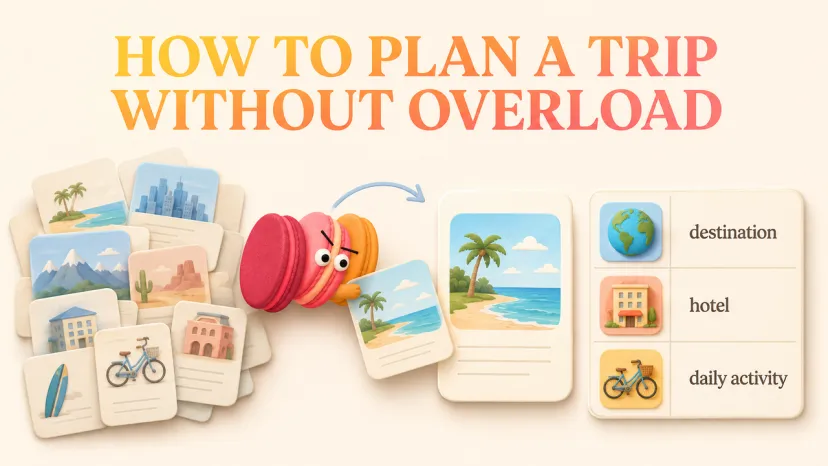
Most trip planning fails at the same point: the moment between "I want to go somewhere" and the first booking decision. The failure isn't a lack of information. It's sequence. People open fifteen tabs comparing destinations before they've decided whether they want to rest or move. That order is backwards, and it's why the planning week turns into a slow grind that ends with nothing booked and everyone slightly annoyed.
The trips that worked for me — the ones I'd repeat — all had the same five-stage order underneath them, even when I wasn't writing it down. The trips that collapsed mid-planning all skipped at least one stage. This isn't about how to plan a trip in fewer steps. It's about doing the right step first.
What follows is the five-stage order, the most common failure point at each stage, and a way to tell which stage is currently failing you.
What gets called "Maren's pre-trip board" in our group chat is really just a running notes file that survives between trips — half-finished thoughts, a few saved links, and the constraints I keep forgetting I have. It's nothing impressive. It just stops me from starting from zero every time.
Start With the Kind of Trip You Actually Want
Before any destination, any date, any spreadsheet — name the trip's purpose. This sounds obvious. It isn't. Most people skip it because it feels too soft to be a planning step.
It's the most expensive step to skip. Research on the cost of decision fatigue consistently shows that when the underlying goal is unclear, the cost of each subsequent small choice goes up. You're not actually comparing two hotels. You're re-litigating the trip's purpose every time you compare anything.
Rest, adventure, culture, food, or connection
Pick one as primary. Maybe one as secondary. Not three. A "rest + adventure + culture + food" trip is four trips fighting each other.
Solo, couple, family, or group travel
Each shape has a different center of gravity. Group travel optimizes for consensus. Solo travel optimizes for momentum. Mixing them mid-planning is where most family trips quietly break.
Energy level and travel pace
Be honest about your real energy, not your aspirational one. I once planned a seven-day Tokyo itinerary that would have required me to function at about 140% of my normal capacity. I knew this on paper. I booked it anyway. Day three was a recovery day I hadn't planned for, which meant day four was also recovery, which meant by day five the itinerary was fiction.
Turn the Idea Into a Realistic Trip Frame
Now — and only now — does the destination come in.
Destination shortlist
Keep it to three. Not seven. Studies on choice overload from PMC are fairly clear that beyond a small set, more options reduce satisfaction, not increase it. Three real candidates, evaluated against the purpose from stage one, will beat seven evaluated against nothing.
Dates and flexibility
Two questions: are the dates fixed, or is a ±3-day window acceptable? If flexible, flight prices alone often resolve the destination shortlist within ten minutes.
Budget range without over-optimizing
Set a ceiling. Not a target. A target budget gets optimized down to misery. A ceiling lets you spend toward the middle of it without guilt.
Build the Core Itinerary Before the Details
The itinerary fails when it's a list of everything you might do. It works when it has structure.
The HBR piece on the power of small wins is about workplaces, but the underlying mechanic applies to trips: visible progress on something meaningful sustains energy. A trip with one anchor experience per day has built-in small wins. A trip with twelve possibilities per day has none.
Anchor days
One thing per day. Not the only thing — the thing that, if everything else falls apart, the day still counts. For a Kyoto trip, that might be one temple. Not seven.
Travel days
These are not bonus days. They're not "we can also fit in lunch in the old town." A travel day is a travel day. Plan it as one.
Open time
Leave 30–40% of the trip unscheduled. This is the part that experienced travelers know and first-time planners refuse to believe. Open time is where the trip actually happens.
Make Planning Easier With a Personal AI Workflow
This is where I'd been stuck for years. The planning notes from one trip never carried over to the next. By trip three, I'd forgotten that I prefer evening flights, hate buffet breakfasts, and need at least one café-with-wifi morning per week of travel. Every trip restarted the same conversation.
What changed wasn't the planning. It was that something started remembering the constraints between trips. NN/g on interface copy notes that the cost of repeat decisions is consistently underestimated — we tend to budget for the choice, not for the cumulative load of choices we shouldn't be making again.
Save preferences
Pace, dietary needs, sleep schedule, the specific kinds of activities that exhaust you. Once. Not retyped every December.
Compare options without starting over
A personal AI that already knows you don't do early flights doesn't need to be told again. It just filters. The comparison happens once, against criteria that didn't have to be re-explained.
Turn scattered notes into a plan
The friction with notes is that they stay notes. Notes only become a plan when something converts them. Macaron's role here, for me, is the conversion step — taking the loose draft of "things I've been saving for this trip" and turning it into a day-by-day frame I can actually read on the plane.
It's not magic. It's just less retyping.
What Most Trip Plans Forget
Three things that don't show up on any itinerary template:
Recovery time
Time-zone shifts, long travel days, and high-stimulation environments all carry a real cost. The CDC NIOSH on fatigue is written for shift workers, but the principle scales: recovery isn't optional, it's just whether you schedule it or whether your body schedules it for you on day three.
Weather and local closures
Many museums close one day a week. Markets run on specific days. National holidays move things around. A 90% itinerary that ignores closures is a 0% itinerary on Tuesday.
Food, transport, and daily energy
Where you eat, how you get around, and how much standing-and-walking the day requires — these compound. A day with three transit transfers and two long museum walks ends differently than a day with one transit ride and a long lunch.
Turn Scattered Travel Ideas Into a Personal Trip Board
This is the part I'd most strongly defend against losing.
Keep decisions in one place
Not five tabs, two screenshots, a Notes app draft, and a saved Instagram post. One file, one board, one conversation thread. The location doesn't matter. The consolidation does.
Save personal travel preferences
The list grows over time. After three trips I knew: middle seats are non-negotiable to avoid, hotels above the seventh floor make me anxious, two transit transfers per day is my ceiling. These aren't preferences worth re-discovering.
Convert notes into a pre-trip checklist
The week before the trip, the board becomes a checklist. The checklist becomes a packing list. The packing list becomes the actual trip. Nothing gets lost in the translation if the steps were small.
FAQ
How early should I start planning a trip?
For a long-haul trip, six to ten weeks is enough — earlier mostly adds anxiety, not quality. For domestic, three to four weeks. The exception is high-season travel where availability forces an earlier hand.
What should I decide before booking anything?
The trip's purpose (rest, adventure, culture, food, connection), travel shape (solo, couple, family, group), and honest energy budget. These three answers eliminate roughly half the destinations on most shortlists, which is the point.
How do I plan a trip when I feel overwhelmed?
Stop comparing. Go back one stage. If you're stuck comparing hotels, the purpose probably isn't clear yet. If you're stuck comparing destinations, the trip shape probably isn't named. Decision overload is almost always a sequence problem, not an information problem.
Should I make a detailed itinerary or keep it flexible?
Both. Anchor days are detailed. Open time is genuinely open. The hybrid is what works — pure flexibility tends to collapse into doing nothing, and full schedules tend to collapse into burnout by day four.
How can AI help with trip planning without taking over?
The useful role is memory and conversion: remembering preferences between trips, converting loose notes into a day-by-day frame, filtering options against criteria you've already stated. Where it stops being useful is when it picks the trip for you. The taste call stays human.
If your last trip planning week ended with three open tabs and one booked flight, the problem probably wasn't the tabs. It was that the purpose stage got skipped, and every comparison after that was running on borrowed clarity. Skip this article if your planning style already runs on five-stage logic — you've already solved this. For everyone else, the first stage is the one to fix.
I’m Maren, a 27-year-old content strategist and perpetual self-experimenter. I test AI tools and micro-habits in real daily life, noting what breaks, what sticks, and what actually saves time. My approach isn’t about features—it’s about friction, adjustments, and honest results. I share insights from experiments that survive a real week, helping others see what works without the fluff.