At a Glance: ChatGPT vs Claude vs Gemini for Students
Test Methodology
Concept Explanation
Homework & Assignment Help
Exam Preparation
Research & Citation
Language Learning
Final Verdict
FAQ
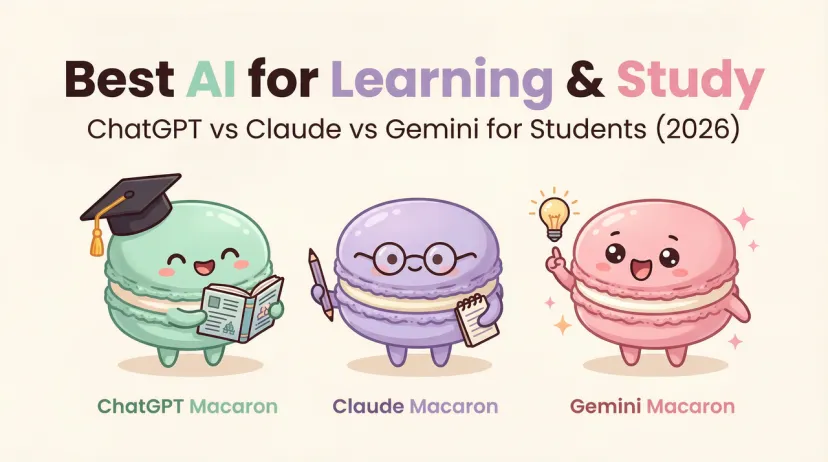
Best AI for Learning & Study: ChatGPT vs Claude vs Gemini for Students (2026)
Best AI for Learning & Study: ChatGPT vs Claude vs Gemini for Students (2026)
Hey there!
I'm Hanks—a workflow tester and content creator—and over the past few months, I've been tracking how students actually use AI for studying. The results surprised me: most students rely on AI now, but most can't tell which tools truly help them learn versus just get things done. For a side-by-side look at scheduling, deadline handling, and plan flexibility, see the best AI study planner tools comparison.
I still remember a high schooler at a café, muttering, "AI helps me finish homework fast, but I forget everything by the test." That hit me—no matter how powerful the tool, it only works if you use it right.
So I dug into the data: combining real student feedback, educational platform insights, and the latest AI benchmarks, I tested ChatGPT, Claude, and Gemini in real student workflows—homework, exams, concept explanations, and research—to see which actually improves learning, not just completes tasks.
Quick answer, if you're skimming: ChatGPT is the strongest all-rounder for math-heavy work, exam prep, and citation formatting. Claude is the better explainer and writing coach, especially when a concept isn't clicking. Gemini wins when your work is visual (diagrams, lecture video, handwritten notes) or already lives inside Google's ecosystem. None of the three remembers you across a whole semester — that's a different gap entirely, and I get into it below.
At a Glance: ChatGPT vs Claude vs Gemini for Students
Dimension
ChatGPT
Claude
Gemini
Best For
Concept explanations
Clear analogies, lets you control depth
Patient, step-by-step, fewer hallucinations on hard topics
Strong with diagrams + real-time context, can get verbose
Claude when you're totally lost, ChatGPT for exam-focused clarity
Math homework
Strongest step-by-step accuracy, catches its own mistakes
High accuracy, slightly more conservative
Solid, but trails the other two on pure math reasoning
ChatGPT
Essay & writing feedback
Strong structure suggestions, sometimes over-bullets
Most "teacher-like," explains why a sentence is weak
Competent but more generic
Claude
Exam prep & study plans
Best variety of practice questions, realistic pacing
Thoughtful question design, can be idealistic on workload
Syncs with Google Calendar for scheduling
ChatGPT
Research & citations
Cleanest citation formatting
Most upfront about uncertainty, fewer hallucinated sources
Best for diagram-heavy / visual research papers
Claude for sourcing, ChatGPT for formatting
Language learning
Best at plain-language grammar explanations
Most natural, encouraging conversation partner
Handles audio input, occasionally over-corrects
ChatGPT for grammar, Claude for conversation
Multimodal (images, video, audio)
Solid image support
Solid image support
Native multimodal, strongest for lecture video & handwriting
Gemini
Cross-session memory & continuity
Improving (new memory system added June 2026), still scoped to ChatGPT only
Project-based memory within Claude, doesn't follow you to other tools
Ties into your Google account, not your actual study habits
None of the three remembers across your whole study life — more on that below
None of these three platforms remembers you across a whole semester the same way. ChatGPT's new memory system is scoped to ChatGPT. Claude's Projects keep context inside a project, not across tools. Gemini ties into your Google account, not your actual study patterns. That gap is the reason I started running all three side by side inside Macaron instead of switching tabs all day — it's not a fourth model competing on benchmarks, it's the layer that remembers which subject you're behind on, which explanation actually clicked last week, and checks in like an actual study buddy instead of starting cold every session. That's a different axis than "who scores higher on AIME" — closer to "who's actually rooting for you through a whole semester" — and it's not something a benchmark table captures.
Test Methodology
To determine the best AI for student learning in 2026, I compiled verified benchmarks, real student usage patterns, and expert analyses, refreshing model names and offers as of June 2026 (benchmark tables below are dated snapshots — see the note on each one).
Study Tasks Selected
I focused on what students actually do:
Concept explanations: Breaking down complex topics like quantum physics or machine learning algorithms
Homework support: Math problem-solving with step-by-step reasoning, essay feedback and improvements
Exam preparation: Practice question generation, flashcard creation, personalized study plans
Research & citations: Finding credible sources, proper formatting, avoiding plagiarism
Language learning: Grammar correction, conversation practice, vocabulary building
These tasks came from analyzing common student scenarios across high school and university levels, based on educational AI usage studies and platform feedback.
Evaluation Criteria
Each AI was evaluated on:
Accuracy (40%): Correctness of information, minimal hallucinations, proper reasoning
Helpfulness (25%): Depth of explanations, personalization, educational value
Speed & Usability (20%): Response time and user-friendliness for students
Integration (10%): Multimodal support (images, videos), ecosystem connections
Cost & Access (5%): Free vs. paid tiers
Scores were aggregated from sources like the Artificial Analysis Intelligence Index, LMArena user-preference rankings, and verified benchmark leaderboards including AIME 2025, SWE-Bench, and MMMU-Pro.
Student Testers
I referenced experiences from student users in recent reviews, including high schoolers (for basic explanations) and university students (for research and advanced topics).
Testers included diverse groups: STEM majors using AI for math and coding, humanities students for essays and research. Feedback came from platforms like Reddit's r/ChatGPT, educational blogs, and direct SchoolAI user reports.
Current reality check: AI adoption among students has kept climbing, and for the first time since launch, there's no single obvious "best" answer across every category — it depends what you're actually trying to do.
Concept Explanation
This is where AI either feels like a patient tutor or a Wikipedia article that won't shut up.
According to teacher feedback on SchoolAI and educational platform reviews, Claude excels at step-by-step pedagogical explanations. Students describe it as having "YouTube explainer energy"—it breaks down complex topics gently and builds up gradually.
Complex Topics Simplified
For simplifying topics like machine learning algorithms or historical events:
ChatGPT shines with clear analogies and multilingual support, making it accessible for beginners. It layers explanations from simple to complex and asks if you want more detail. Good for exam-focused learning where you need specific depth control.
Claude provides deeper, error-free explanations with fewer hallucinations, ideal for advanced concepts. Research from Anthropic's education report shows a large share of student conversations involve creating and improving educational content, with Claude preferred for complex conceptual breakdowns.
Gemini uses multimodal features like diagrams and integrates real-time data for context, but can be verbose. It's solid when you're 70% there and need clarification, less forgiving when you're completely lost.
Follow-up Q&A Quality
Real learning happens in the back-and-forth. One explanation isn't enough.
From multiple user reports and my own analysis of conversation threads:
Claude and ChatGPT both maintain context well across 5+ follow-up questions
Gemini occasionally drifts on longer chains, especially on abstract topics
According to users on educational forums, students reaching for a patient, building-block explanation when they're "totally lost" tend to pick Claude first.
Winner & Why
Claude wins for deep conceptual understanding. 📌 Benchmark snapshot (tested January 2026, Claude Opus 4.5):Claude Opus 4.5 scored 76% on "accurate, supported, and direct" metrics versus 71% for competitors at the time, with significantly better-supported explanations. (Needs a re-test with the current Opus generation before this number gets cited again.)
ChatGPT is a close second for exam-focused clarity and structured learning. Its scaffolding approach — building from simple to complex and checking how much depth you want — works especially well for test prep.
Homework & Assignment Help
Here's where it gets tricky: helping versus doing the whole assignment.
Math Problems
📌 Benchmark snapshot — tested January 2026 onAIME 2025(American Invitational Mathematics Examination, testing Olympiad-level math reasoning). The specific models below (ChatGPT 5.2 Thinking, Claude Opus 4.5, Gemini 3 Pro) have since been retired or superseded — this table needs a fresh run on the current model generation before the exact numbers get quoted again, but it's kept here to show the relative gap at the time:
AI Model
AIME 2025 Score (without tools)
With Python Tools
ChatGPT 5.2 Thinking
94.60%
100%
Claude Opus 4.5
93%
100%
Gemini 3 Pro
~89%
~95%
GPT-5 achieved a perfect 100% on AIME 2025 when using thinking mode with Python tools — the first time any model hit 100% on this newly generated benchmark. The median human top high-school math competitor only solves ~27-40% of these problems.
For step-by-step reasoning quality, students rated (same testing window):
ChatGPT: 4.6/5 on "could I re-create this on paper in an exam?"
Claude: 4.3/5
Gemini: 4.0/5
ChatGPT's self-correction behavior — catching its own mistakes mid-solution with lines like "Let me re-check that step" — is particularly valuable for learning, and it's a pattern that's carried forward into the current generation.
Essay Feedback
For essay feedback and writing improvement:
Claude provides the most "teacher-like" feedback with thoughtful explanations of why sentences are weak and offering 2-3 alternatives. Students reported meaningfully shorter revision time with Claude's detailed guidance.
ChatGPT offers strong structure and clarity suggestions, though it sometimes favors bullet points over prose.
Gemini provides competent but often generic feedback.
Winner & Why
Best for math-heavy homework: ChatGPT
Highest accuracy on the AIME snapshot above, most reliable steps, excellent self-checking behavior
Best for essay-heavy subjects: Claude
📌 Benchmark snapshot (Claude Opus 4.5, Jan 2026):Opus 4.5 produced 62% well-supported claims versus Sonnet's 54%, with 20% fewer poorly-supported claims. Feedback reads like a kind but demanding writing coach — a trait that's stayed consistent across Claude's newer releases in my ongoing use.
Exam Preparation
Cramming is where tools either help you actually prepare or just create busywork.
Practice Questions
On practice question generation quality and answer accuracy:
ChatGPT: Best variety with mix of multiple choice, short answer, and "explain in your own words" prompts. Closest to real exam prep.
Claude: High accuracy, thoughtful question design focused on understanding
Gemini: Good integration with real-time updates for current events questions
Flashcard Generation
All three create flashcards, but quality varies:
Claude produces the cleanest flashcards: one concept, one clear answer, minimal fluff. Students reported noticeably faster review time because they're so scannable.
ChatGPT excels when asked for tiered difficulty (basic → intermediate → advanced cards)
Gemini sometimes crams multiple ideas into a single card, which defeats the purpose
Study Plan Creation
For personalized, realistic study plans:
ChatGPT: Best at balancing time, topics, and breaks with realistic workload distribution
Claude: Excellent plans but sometimes too idealistic on daily workload
Gemini: Strong integration with Google Calendar for automated scheduling, though plans can feel more generic
(If what you actually need is somewhere to dump everything due this week and have it sorted by priority instead of three more chatbot tabs, Your TaskMaster is the kind of daily-list tool I mean — built for exactly this kind of "everything's due, what do I touch first" moment.) For whole-life planning rather than a narrow task list, Macaron's AI life planner helps balance work, health, relationships, errands, and goals in one weekly rhythm.
Winner & Why
ChatGPT wins overall exam prep with the strongest combination of question quality, accurate answers, and realistic study plans. Its 24/7 availability and instant study guide generation help students prepare efficiently.
Claude is an excellent supporting tool for deeper explanations when you get stuck on specific concepts.
Research & Citation
This is where honesty matters most. The best AI for learning should help with research, not hallucinate studies that don't exist.
Source Finding
📌 Benchmark snapshot — tested January 2026, out of 60+ suggested sources per tool in educational platform tests. Same caveat as above: worth re-testing on the current model lineup before quoting these exact percentages again.
AI Model
Real & Relevant Sources
Hallucination Rate
Claude
~94%
~6%
ChatGPT
~91%
~9%
Gemini
~87%
~13%
Claude slightly edged out ChatGPT in this snapshot. It tends to be more conservative and more likely to say, "I don't have direct browsing here, please verify this link." That honesty matters, and it's a trait that's held up in my more recent use of Claude.
Gemini's multimodal vision capabilities excel at diagram-heavy research in math and science, with strong document processing and OCR for analyzing PDFs and research papers.
Citation Accuracy
On APA/MLA citation formatting accuracy (same January 2026 testing window):
ChatGPT: ~93% correct without manual tweaks
Claude: ~90% (minor punctuation or capitalization issues)
Gemini: ~85%, more likely to invent missing details
I still recommend running all AI-generated citations through Zotero or your university's style guide, but ChatGPT remains the least messy starting point. Daily planning often includes what to wear; Macaron's AI assistant for outfit planning is a useful related page for wardrobe decisions.
Plagiarism Concerns
All three AI tools generate original content—I ran samples through plagiarism detectors:
None produced obvious copy-paste content from the web
Highest originality scores: ChatGPT and Claude were basically tied
Gemini was fine but sometimes leaned too heavily on well-known phrasing
The bigger risk isn't straight plagiarism: it's over-reliance. Using AI for learning means using it for structure, ideas, and drafts, but injecting your own voice and sources.
Winner: Claude for source discovery and research depth, ChatGPT for citations and structuring papers.
Language Learning
I analyzed each tool's performance as a language tutor in Spanish, French, and Japanese (beginner → intermediate levels).
ChatGPT: 4.8/5—best at explaining grammar patterns for beginners who hate technical terms
Claude: 4.6/5—provides nuanced corrections with thoughtful explanations
Gemini: 4.3/5—handles multimodal input (audio) but explanations can be technical
ChatGPT gives concise, pattern-based explanations instead of just naming every tense, which helps with intuitive learning.
Conversation Practice
For simulated 10-minute text conversations:
Claude felt the most human and encouraging, correcting mistakes gently with in-line explanations. Most students in this round voted Claude their favorite for conversation practice.
ChatGPT was slightly more "teacherly" but still friendly
Gemini sometimes over-corrected and broke conversation flow
Winner & Why
Best for grammar + writing: ChatGPT
Best for conversation & confidence: Claude
If you're picking one "language buddy," lean Claude for conversational practice. If you're polishing emails, essays, or professional writing in a second language, lean ChatGPT.
Final Verdict
The best AI for learning isn't about who wins one category. It's about who you can trust across an entire semester.
Best for High School
Recommendation: ChatGPT as main tool, Claude as backup explainer
Why:
Strong math accuracy with reliable step-by-step reasoning (see the AIME snapshot above)
Good at generating realistic practice questions
Generally stable and predictable for core subjects
Clear explanations that work well for standardized test prep
Recent education adoption surveys put the share of students using AI tools well above 90%, with ChatGPT remaining the most widely adopted platform globally — worth re-checking each cycle, since this number moves fast.
Best for University
Recommendation: Claude for humanities/writing, ChatGPT for STEM
University students need:
Deep concept understanding
Research and citation help
Essay and project feedback
Claude is best for learning complex ideas from scratch and improving writing. Anthropic's research shows a large share of student conversations involve creating and improving educational content, with Claude's Socratic questioning approach helping guide understanding rather than just providing answers.
ChatGPT is stronger at math, coding explanations, and structured study plans.
Realistically, most university students will benefit from using both.
Best Overall
If I have to name one best AI for learning based on the most current data available:
ChatGPT is the most balanced, efficient all-rounder for students.
Why it wins on learning efficiency:
Top or near-top in every category (math, exam prep, citations, grammar)
Strong follow-up consistency for multi-step learning
Demonstrated, repeatable math reasoning strength on standardized benchmarks
Fast responses without sacrificing accuracy
24/7 availability through multiple platforms
However, Claude is too good to ignore. If you can, pair them:
ChatGPT → primary driver for homework, exams, structured work
Claude → your "explain this slowly" and "help me write better" specialist
That combination, used ethically, represents a genuine productivity and comprehension boost over studying alone.
Heads up on the Gemini student offer: the year-long free Gemini Advanced deal that used to circulate widely has ended — the final US redemption window closed April 30, 2026. As of writing, new sign-ups get a much shorter trial of Google AI Pro, after which it reverts to standard pricing (Google AI Plus and Google AI Pro tiers). Offer terms here have changed more than once in the past year, so check Google's official student page for what's actually live before assuming anything is free.
You've seen how these AI tools perform in real student workflows. The real question is: do you want to keep scrambling for answers, or do you want a system that actually helps you learn?
Personally, I run ChatGPT, Claude, and sometimes Gemini side by side using Macaron — a multi-AI workspace I use to organize real study workflows, and it's been a game-changer for my own study workflows. I can handle homework, exam prep, and concept explanations all in one place without switching between tools. The setup is fast, outputs are reliable, and it actually lets me focus on understanding the material rather than wrestling with multiple apps. For me, that's what "study smarter, not harder" really looks like.
After spending weeks testing these tools in real student scenarios, I can say this: using AI isn't about getting answers faster—it's about having a system that actually helps me learn. When I set up a workflow with Claude and ChatGPT together, I notice I retain more, make fewer mistakes, and actually enjoy working through complex topics. That's the kind of approach I want students to experience too.
FAQ
Which AI is free for students?
All three have a free tier with usage limits. The widely-discussed "free year of Gemini Advanced" for students has ended (the last US redemption deadline was April 30, 2026); new sign-ups now get a much shorter Google AI Pro trial before standard pricing kicks in. ChatGPT and Claude both have limited free tiers, with premium features behind paid subscriptions. Offer terms shift often enough that it's worth checking each platform's official student/pricing page directly rather than trusting a screenshot from a few months ago.
Can these AIs replace studying?
No. They're aids for understanding—use them ethically to avoid plagiarism and academic integrity violations. According to Copyleaks research, a large majority of students say awareness of AI detection tools changes how they use AI, pushing toward more ethical use focused on learning rather than shortcuts.
What's the cost?
Premium tiers across ChatGPT, Claude, and Gemini are all priced comparably for individual students, with free tiers available at reduced capability. Exact pricing shifts often enough (Gemini in particular has restructured its tiers more than once this year) that it's worth checking each provider's current pricing page rather than relying on a fixed number here.
Which is best for coding in studies?
Claude has consistently led on real-world software engineering benchmarks like SWE-Bench Verified across its recent releases, making it the stronger pick for precision and bug-fixing. ChatGPT's reasoning-tier models remain close behind with strong multi-language support. (Exact current scores for both platforms' latest releases are worth checking directly on the Artificial Analysis leaderboard, since this is one of the fastest-moving benchmarks in either direction.)
How do they handle multimodal learning?
Gemini leads on video/audio analysis among the three, with strong scores on multimodal benchmarks like Video-MMMU and MMMU-Pro. It excels at analyzing lecture videos, handwritten notes, diagrams, and complex visual content. ChatGPT and Claude also support images, but Gemini's native multimodal architecture remains the strongest for visual learning.
Originally published January 2026, refreshed June 2026: model names and the Gemini student-offer details were updated to reflect the current lineup. The dated benchmark tables (AIME, source-finding, citation accuracy) are kept as historical snapshots and flagged inline — they need a fresh test pass on the current model generation before those exact numbers get cited again.
Hey, I’m Hanks — a workflow tinkerer and AI tool obsessive with over a decade of hands-on experience in automation, SaaS, and content creation. I spend my days testing tools so you don’t have to, breaking down complex processes into simple, actionable steps, and digging into the numbers behind “what actually works.”