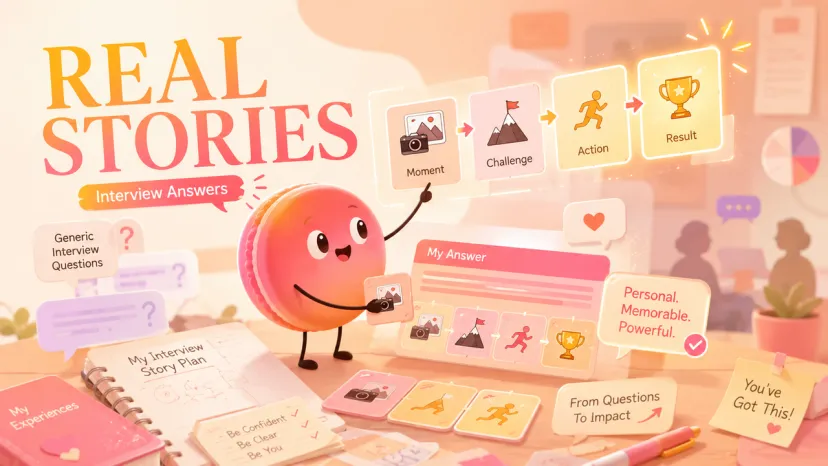
Why Job Interview Questions Feel Harder Than They Look
The Main Types of Interview Questions
How to Build Better Answers From Real Stories
Common Interview Questions to Prepare First
Turn Your Experiences Into an Interview Story Bank
FAQ
Related articles
Job Interview Questions: Build Answers From Real Stories
Job Interview Questions: Build Answers From Real Stories
Hey — I've answered these in real rooms, not just rehearsed them in my head. I've also sat on the other side of the table and watched sharp people give answers that went nowhere. So this isn't a list of clever lines. It's how I stopped treating job interview questions as a memory test and started treating them as "which real story do I pull here." If you've ever walked out knowing you had the experience but couldn't say it right, this one's for you.
Why Job Interview Questions Feel Harder Than They Look
Most common interview questions aren't hard to understand. "Tell me about a time you handled conflict" is a plain sentence. The hard part is retrieving, shaping, and delivering a real example in about ninety seconds, under pressure, in front of someone deciding your next two years. That's a performance problem, not a knowledge problem.
And the room matters more than people admit. Even with 7.6 million job openings on the table as of April 2026, hiring stayed slow that month — employers are taking their time and screening harder. Your answers get more scrutiny, not less.
You are not just answering the question
When someone asks "why this role," they're not collecting trivia. They're checking whether you understand the job, whether you'll stay, and whether your reasons survive a follow-up. I missed this for years. I answered the literal question and ignored the real one underneath it.
Interviewers are listening for evidence
This took me three final-round rejections to accept: interviewers have heard the polished version a hundred times. The standard lines off every "interview questions and answers" roundup get rehearsed by thousands of candidates, so a clean, generic answer signals almost nothing. What cuts through is a specific moment only you could describe. The story is the evidence. The structure just keeps it from rambling.
The Main Types of Interview Questions
Most questions asked in interviews fall into five buckets. Knowing the bucket tells you what they're actually fishing for, which makes the answer obvious.
Question type
What they're really checking
Example you'll hear
Background
Can you walk your path without rambling
"Walk me through your resume"
Experience
Did you do the thing, or just stand near it
"What did you own on that project?"
Behavioral
How you act when things go sideways
"Tell me about a time you missed a deadline"
Motivation
Why this job, why now, will you stick
"Why this role?"
Role-fit
Whether your strengths match the need
"Why are you a fit for this team?"
Background questions
These open most interviews. The trap is treating "tell me about your background" as permission to narrate your whole life. Pick the three or four moves in your history that lead logically to this chair, and stop there.
Experience questions
Here they're separating ownership from proximity. "We launched X" invites the follow-up "what did you do." Answer the second question before they ask it — name your specific piece.
Behavioral questions
These are the "tell me about a time when…" questions, and they run on a story structure that deserves its own walkthrough, including the named frameworks like STAR and CAR. I keep that full build-and-sequence breakdown to its own piece so this page stays a map, not a manual.
Motivation questions
"Why this role" and "why are you leaving" live here. The honest version beats the flattering version. I once gave the polished "I'm passionate about your mission" line and watched the interviewer's face go flat. Specific reasons — the team, the problem, the stage of the company — land better than enthusiasm.
Role-fit questions
This is where they map your strengths against the job description. If you can't name what the role actually needs, you can't show you fit it. Read the posting like it's the question sheet, because mostly it is.
How to Build Better Answers From Real Stories
I stopped trying to invent impressive answers and started mining for true ones. Slower to prep, far easier to deliver, and impossible for someone else to copy.
Pick one concrete moment
Not "I'm good at handling pressure." One specific afternoon when something was on fire and you were holding the hose. A real date, a real stake, a real decision point. Vague competence claims convince no one; a moment with edges does.
Explain the decision you made
The middle of the story is where most people skip. They jump from "there was a problem" to "and it worked out." The interviewer wants the part in between — what you chose, what you ruled out, and why. That's the only part that shows judgment.
Show the result without overclaiming
End with what happened, ideally with a number, because measurable results land harder than adjectives. But don't inflate. If the project half-worked, say it half-worked and what you'd change. "We cut response time by about a third" beats "I revolutionized the workflow," and it survives the follow-up question.
Common Interview Questions to Prepare First
If you only prep five, prep these. They show up in nearly every job interview, in some wording.
Tell me about yourself
This is almost always first, and it's where most answers go sideways into a life story. Give a short professional arc: where you are now, one or two things you've done, and why you're here. Sixty to ninety seconds. I rehearsed this one maybe forty times early on and still bombed it — I just sounded like I was reading. The fix wasn't more reps. It was having a real through-line instead of a memorized paragraph.
Why this role
Tie your reasons to this job, not a generic upgrade. Name something specific about the team, the product, or the problem. Generic "growth opportunity" answers read as "I'll leave when something else grows faster."
Strengths and weaknesses
This one has its own set of traps — the fake weakness, the humble-brag, the strength with no example behind it — so I handle it in depth on its own rather than half-cover it here.
A challenge you handled
A pure behavioral question. Pick a real obstacle where your decision mattered, not one where luck did the work. The closer the challenge is to what this role will throw at you, the more it counts.
Your goals
"Where do you see yourself" is less about a tidy five-year plan and more about whether your direction fits theirs. It carries enough traps of its own that I treat it as a separate topic rather than rush it here.
Turn Your Experiences Into an Interview Story Bank
The reason interviews feel like cramming is that we rebuild our examples from scratch every time. I did this for years — same projects, reinvented the night before, every single time. A story bank kills that. Build it once, reuse it forever.
Save stories by skill
Tag each story by the thing it proves: leadership, conflict, a mistake you owned, a tight deadline, a hard call. Most "tell me about a time" questions map to one of these tags. When the question lands, you reach for the tag, not your panicking memory.
Match stories to job descriptions
Before each interview, line your saved stories against the posting's requirements. If they want "cross-functional collaboration," you already know which story you're telling. I keep my interview stories in one place now, re-sortable by role, so I pull the version that fits this job instead of rebuilding from zero.
Keep backup examples for follow-up questions
Have a second example ready for your top three skills, because good interviewers dig. "Can you give me another time?" has wrecked more candidates than the original question. One story per skill is a single point of failure. Two is a buffer.
If your interview is next week and your palms are already sweating, here's tonight's whole job — no app, no system: open a notes file, write down three work moments you're proud of, and tag each with one word, like "conflict," "deadline," or "a save." Twenty minutes. That's a starter story bank, and you walk in with something to reach for instead of a blank mind. Do that much and the rest of this article has already paid for itself.
A notes file works, and plenty of people stop there. At Macaron, we built a career-and-learning coach for the part a plain list can't do: it remembers your examples and re-sorts them against each job description, so you stop rebuilding your answers before every interview. It can't tell you whether you'll get the offer — and we won't pretend it can. Try Macaron free and see how your own experiences turn into a set of interview stories you can actually reuse.
FAQ
What should you do when you cannot think of a strong example for a common question?
Widen the source. Most people only mine their current job. Pull from past roles, internships, volunteer work, side projects, even a group project that went wrong. A modest story told concretely beats an impressive one you can't actually recall the details of. And if you genuinely have nothing, it's fine to answer a slightly adjacent version — "I haven't faced exactly that, but here's the closest" — rather than inventing one that collapses on the follow-up.
How do most people make their answers sound natural instead of memorized?
They prepare the story, not the script. Know your beats — the situation, your decision, the result — but don't lock the wording. Scripting every word tends to come across as stiff, even a little robotic, to an interviewer. I practice out loud until the shape is automatic, then let the exact sentences come out fresh in the room. Sounds counterintuitive. Works better.
When does preparing too many stories start to hurt more than help?
When you start choosing which story to tell mid-answer. If you've got eight candidates for every question, you'll freeze sorting them. I cap it at five or six core stories, each flexible enough to answer a few different prompts. Past that, prep stops adding confidence and starts adding hesitation.
How should you handle questions that feel too personal during an interview?
Stay calm and redirect to the job. You can answer a narrower, work-relevant version, or politely ask how it relates to the role. Worth knowing: in the U.S., there are pre-employment questions an employer generally should not ask before a job offer — things touching on disability, medical history, and similar protected areas. You're allowed to steer back to your ability to do the work. (This is general information, not legal advice.)
What details from your past are usually better to keep private?
Anything that doesn't help them decide you can do the job and won't be misread. Specific salary history where it's not required, the unfiltered reason a past job ended badly, health details, personal conflicts. You don't have to volunteer the messiest version of your story. Honest and selective aren't opposites — keep it true, keep it relevant, leave the rest out.
Hey, I’m Hanks — a workflow tinkerer and AI tool obsessive with over a decade of hands-on experience in automation, SaaS, and content creation. I spend my days testing tools so you don’t have to, breaking down complex processes into simple, actionable steps, and digging into the numbers behind “what actually works.”