How to Improve Time Management for School and Life
How to Improve Time Management for School and Life

A bad week isn't a willpower problem. It's almost always a planning problem — and one almost nobody actually teaches you to fix.
The evidence tends to show up mid-Wednesday: you're behind on two things, you forgot to eat lunch, and the version of you from Sunday who thought this week was totally manageable feels like a different person. That's not you failing. That's a plan that didn't account for how weeks actually go.
This isn't another list of tips you already know. It's the stuff that actually changes how your days feel — the small shifts that make your time feel like yours again, not just a sequence of things you're behind on.
Why Time Management Feels Hard
Hidden tasks, optimistic planning, and context switching
Here's the thing — most time management advice treats your schedule like a math problem. You have X hours, you have Y tasks, you just need to fit them together. But that's not how real life works.
Hidden tasks are the ones you never write down because they feel too small: responding to that email, finding the document, figuring out what the assignment is actually asking. Individually, they're five minutes. Collectively, they eat an hour without warning.
Optimistic planning is the assumption that everything will go as expected. No one accounts for the fact that they'll feel tired at 4pm, or that an essay will take twice as long to start as to finish. So the plan looks good on paper and falls apart by Tuesday.
Context switching might be the biggest one. Moving from chemistry homework to answering messages to checking notifications and back again — every switch costs you something. It's not just time. It's the mental energy to get back into focus. Psychologists who study cognition have found that task switching reduces productive time by as much as 40% — and that mental overload from switching can result in more errors, not just lost minutes. Do that five times in an afternoon and you've lost an hour without moving from your desk.

The reason time management feels hard isn't that you're bad at it. It's that the version you've been taught to do doesn't account for any of this.
How to Improve Time Management Step by Step
Time audit, weekly planning, daily priorities, and buffers
You don't need a new app or a new system. You need to see what's actually happening — and then make one or two changes at a time.
Step 1: Do a time audit for one week.
Don't plan anything differently. Just track what you actually do — roughly, in 30-minute blocks. Where does the time go? Most people are surprised. The two hours they thought they spent studying was actually 40 minutes of studying and 80 minutes of distraction. According to the American Time Use Survey conducted by the Bureau of Labor Statistics, people's perception of how they spend time consistently diverges from what they actually do — the gap between "I worked all day" and what the data shows is rarely flattering. The audit doesn't judge you — it just shows you reality. That information is worth more than any productivity tip.

Step 2: Plan your week before it starts — but plan honestly.
Look at what's actually coming: classes, commitments, the things you said yes to last week that are due now. Block those in first. Then look at what's left. That's your real working time — not the optimistic version where everything fits, but the actual one.
Social psychologists have studied this gap for decades. The planning fallacy — first identified by Kahneman and Tversky — describes how people consistently underestimate task duration even when they know past tasks took longer than expected. Knowing this, try padding your time estimates by 30%. If you think an essay will take two hours, give it three.
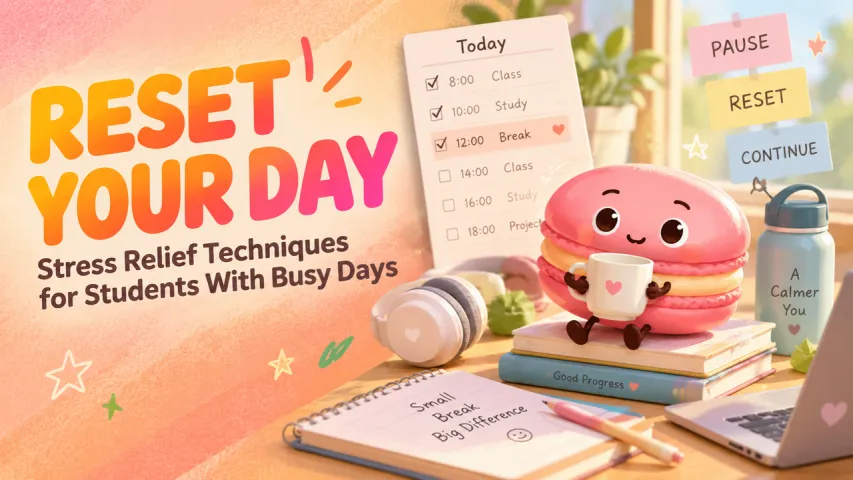
Step 3: Every morning, pick three things that must happen today.
Not ten. Three. If the day goes sideways — and sometimes it will — you've at least done the three things that mattered. Everything else is bonus. This sounds simple because it is. The hard part is believing it's enough.
Step 4: Build buffers on purpose.
A 15-minute buffer between tasks. A free block in the afternoon where nothing is scheduled. Not because you're being lazy, but because things take longer than expected and you need somewhere to put that overflow. Buffer time doesn't mean wasted time — it means the rest of your schedule can actually hold.
One thing I've found genuinely useful here: talking through my week out loud — either with a friend or with something that can actually respond and help me spot where I'm overcommitting. Macaron's Deep Memory means it actually remembers your patterns — that you always underestimate Tuesdays, or that you need an hour to decompress after class before you can focus again. That kind of thing takes time to notice yourself.
Time Management Tools That Help
Planners, assignment trackers, timers, and AI reminders
The tool doesn't matter as much as whether you'll actually use it. That said, here's what tends to work:
Paper planners are still good for people who need to physically write things down. The act of writing helps some people commit. The downside: they don't send reminders, they don't adjust when things change, and a missed day often means a missed week.
Assignment trackers — whether that's a simple spreadsheet, Notion, or an app — are helpful when you have multiple deadlines across multiple subjects. The key is keeping it simple enough that you'll actually update it. A tracker you abandon in week three helps no one.
Timers (the Pomodoro method, for example) work well for people who struggle with getting started. Twenty-five minutes of focus, five-minute break. A peer-reviewed scoping review in PubMed Central found consistent positive associations between structured timed work intervals and improved task focus, reduced cognitive fatigue, and better time management outcomes. The reason it works is simpler than it sounds: your brain commits more easily when the endpoint is visible. It's not committing to the whole evening. Just the next 25 minutes.

AI reminders are where things have shifted in the last couple of years. The difference between a reminder that just pings you at 3pm and one that's actually adapted to how you work — that's a different thing. I've noticed that when Macaron generates a small daily planner based on what I've told it about my week, it remembers that I mentioned a deadline coming up, or that mornings are better for focused work than afternoons. It's a small thing. But it's not a small thing.

Common Time Management Mistakes
Packing every hour and ignoring recovery
Packing every hour is the one I see most. The schedule looks productive — every block has something in it, there's no wasted time. And it works for maybe two days. Then one thing runs long, the whole day falls apart, and you feel like you failed even though you were trying hard.
A full schedule has no room for reality. Something always takes longer, something unexpected always happens. If there's no slack in the system, the system breaks.
Ignoring recovery is sneakier. You can run on fumes for a while. Students especially — there's often a weird pride in being tired, like exhaustion is proof you're working hard. But research on sleep deprivation and cognitive performance shows that insufficient sleep impairs attention, judgment, and decision-making — with executive functions showing particular sensitivity. Tasks that would take 30 minutes fresh take 90 minutes tired. Protecting sleep and rest isn't a luxury. It's what makes the rest of the schedule actually work.

I'm not saying this from a place of having it figured out. I still overcommit sometimes. I still have weeks where I planned too much and feel bad about what didn't happen. The difference now is that I notice it faster, and I adjust — instead of just pushing harder into a system that was already broken.
FAQ
How long does it take to get better at time management?
Genuinely, a few weeks of consistent practice makes a real difference. The first week is just noticing what's actually happening. The second week you start making small adjustments. By week four, some of the new habits start to feel less effortful. That said, it's not a thing you fix once — it shifts as your life shifts.
I've tried planners and they never stick. What should I do?
The planner probably isn't the problem. The question is whether the system fits how you actually think and work, or whether you're trying to fit yourself to someone else's system. Some people do better with digital, some with paper, some with a very minimal list, some with detailed time blocks. Try something for a week, then honestly ask: did this help, or did it add work? Adjust from there.
How do I handle a week when everything goes wrong?
Pick one thing. Just one. The week is already chaotic — you can't fix it entirely. But if you do one meaningful thing each day, you haven't lost the week. Recovery is easier from "I did one thing" than from "I did nothing."
Is it okay to schedule downtime?
Not only is it okay — it's necessary. Unplanned downtime that happens because you're too exhausted to do anything isn't rest. It's collapse. Scheduled downtime that you protect is actual recovery. Your brain needs it. Schedule it like you'd schedule a class.
What if my schedule changes constantly and I can't plan ahead?
Weekly planning still helps even when things are unpredictable. You're not trying to control everything — you're trying to have a starting point. A rough plan that you adjust is infinitely more useful than no plan at all.
If you've felt like time management is something other people are naturally good at and you're just not — I really don't think that's true. The people who seem to have it together mostly just have a system that fits them, and they've stuck with it long enough to trust it.
The first step is always just seeing where your time actually goes. Do that for a week. Then we can talk about what to change.
If you want something that helps you plan without the setup overhead — Macaron can generate a daily planner from a single sentence, and it remembers your patterns over time. Worth trying if you're tired of building systems that don't survive contact with an actual week.
Recommended Reads
Digital Monthly Planner for Real-Life Planning










Apply to become Macaron's first friends
Read & discover
AI Personal Assistant
Free calculators


