Calculadora de Máximo Común Divisor
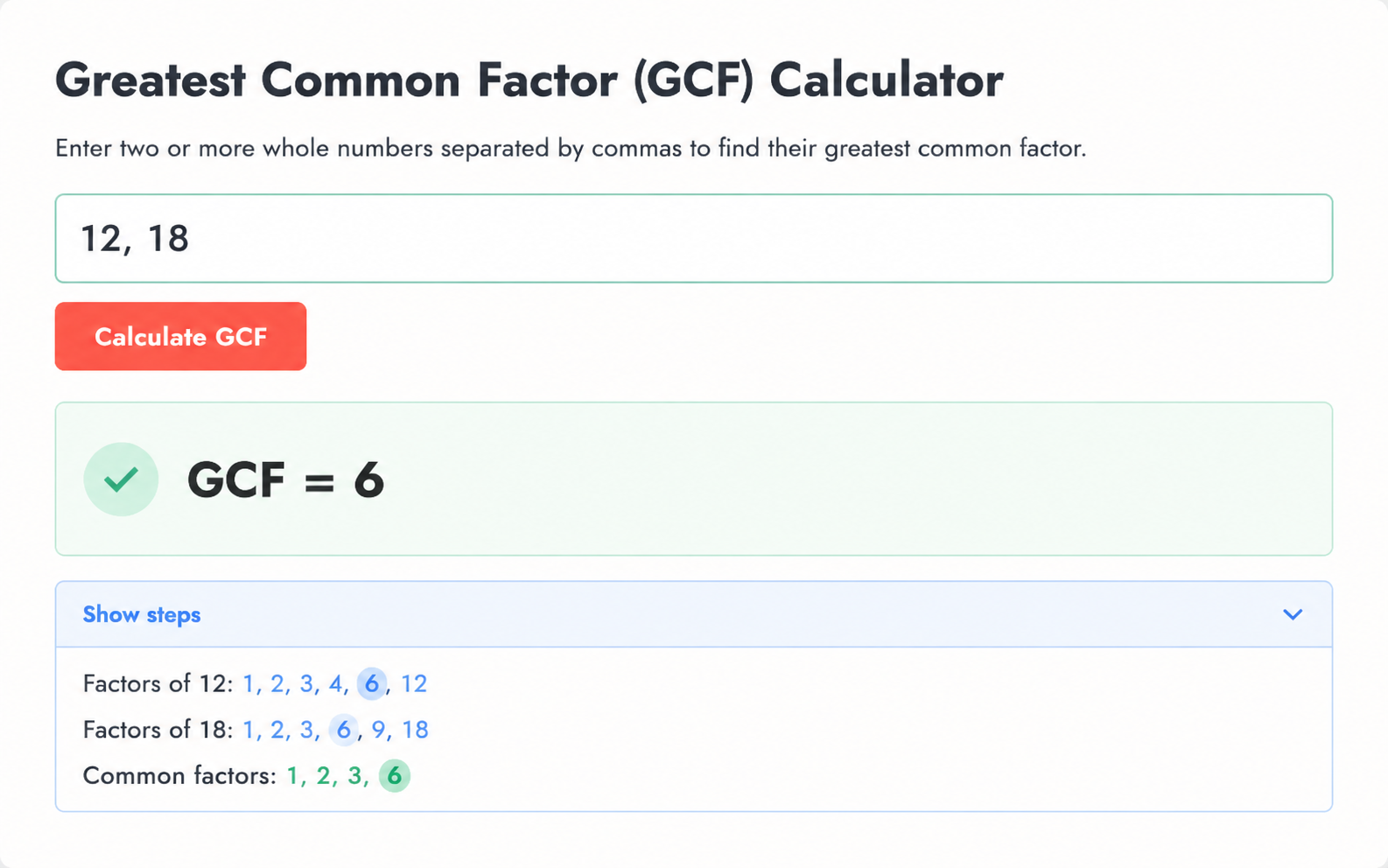
Calcula el MCD de dos o más números usando métodos de factorización prima y el algoritmo de Euclides. Obtén resultados instantáneos con explicaciones paso a paso.
If you need to calculate GCF for homework, simplify a fraction, compare GCF and LCM, or check the GCF of 3 numbers, this page gives you both the answer and the method behind it.
¿Qué es el Máximo Común Divisor (MCD)?
El Máximo Común Divisor (MCD), también conocido como el Máximo Común Divisor (MCD) o el Mayor Divisor Común (MDC), es el mayor número entero positivo que divide dos o más números sin dejar un residuo. Es un concepto fundamental en la teoría de números y tiene amplias aplicaciones en matemáticas, álgebra y ciencias de la computación.
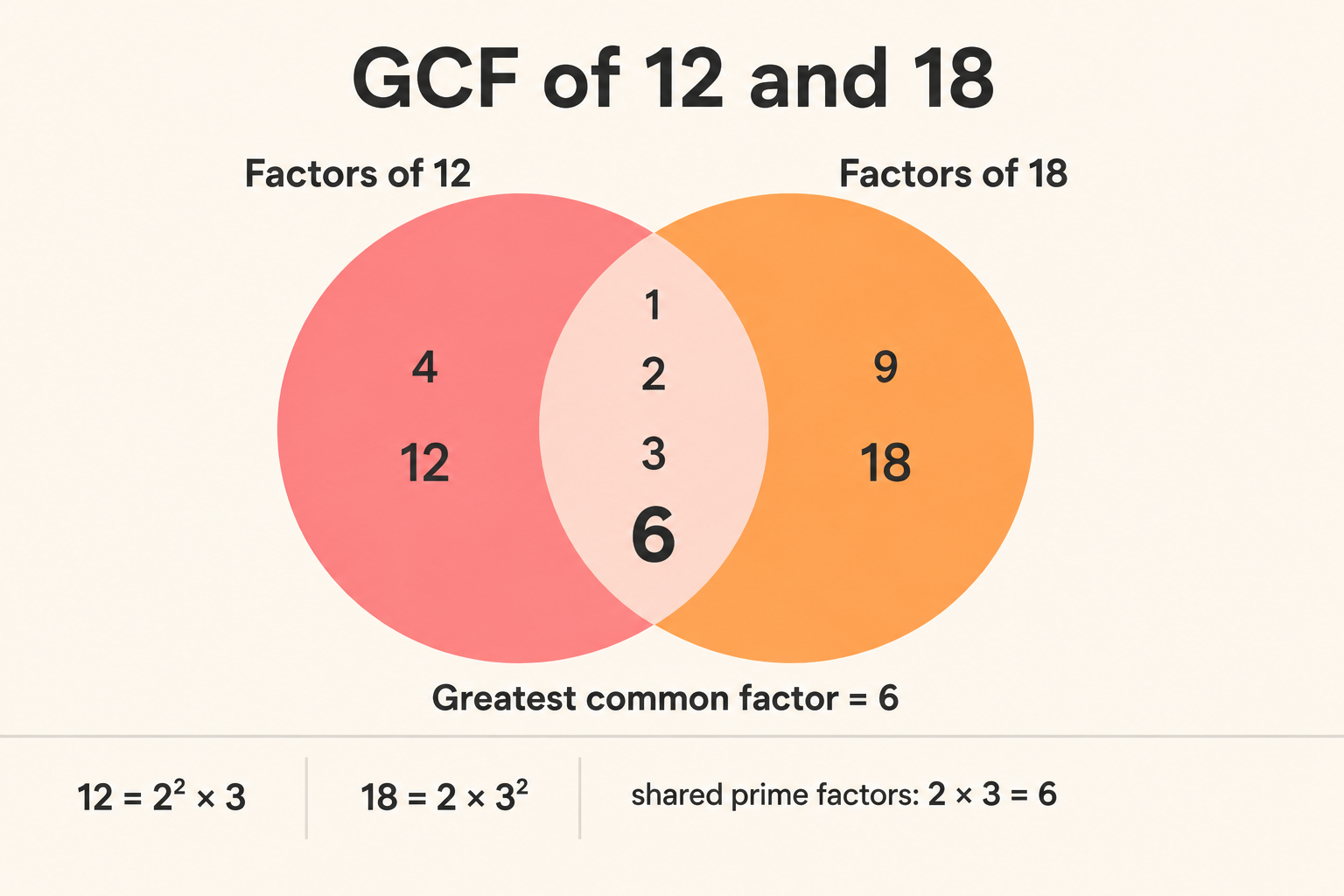
Por ejemplo, el MCD de 12 y 18 es 6, porque 6 es el mayor número que divide ambos 12 y 18 de manera uniforme. El MCD es particularmente útil al simplificar fracciones, encontrar denominadores comunes y resolver problemas que involucran razones y divisibilidad.
GCF vs GCD vs HCF — are they the same?
Yes. GCF, GCD, and HCF usually mean the same thing. GCF means greatest common factor. GCD means greatest common divisor. HCF means highest common factor. Different textbooks and regions may use different names, but all three refer to the largest number that divides the given numbers evenly.
Cómo Usar la Calculadora de MCD
Use this section if you are wondering how to find GCF on calculator tools without doing every step by hand.
- Introduce Tus Números: Escribe dos o más enteros positivos separados por comas en el campo de entrada (ej. 330, 75, 450, 225).
- Haz Clic en Calcular: Presiona el botón 'Calcular MCD' para computar el máximo común divisor.
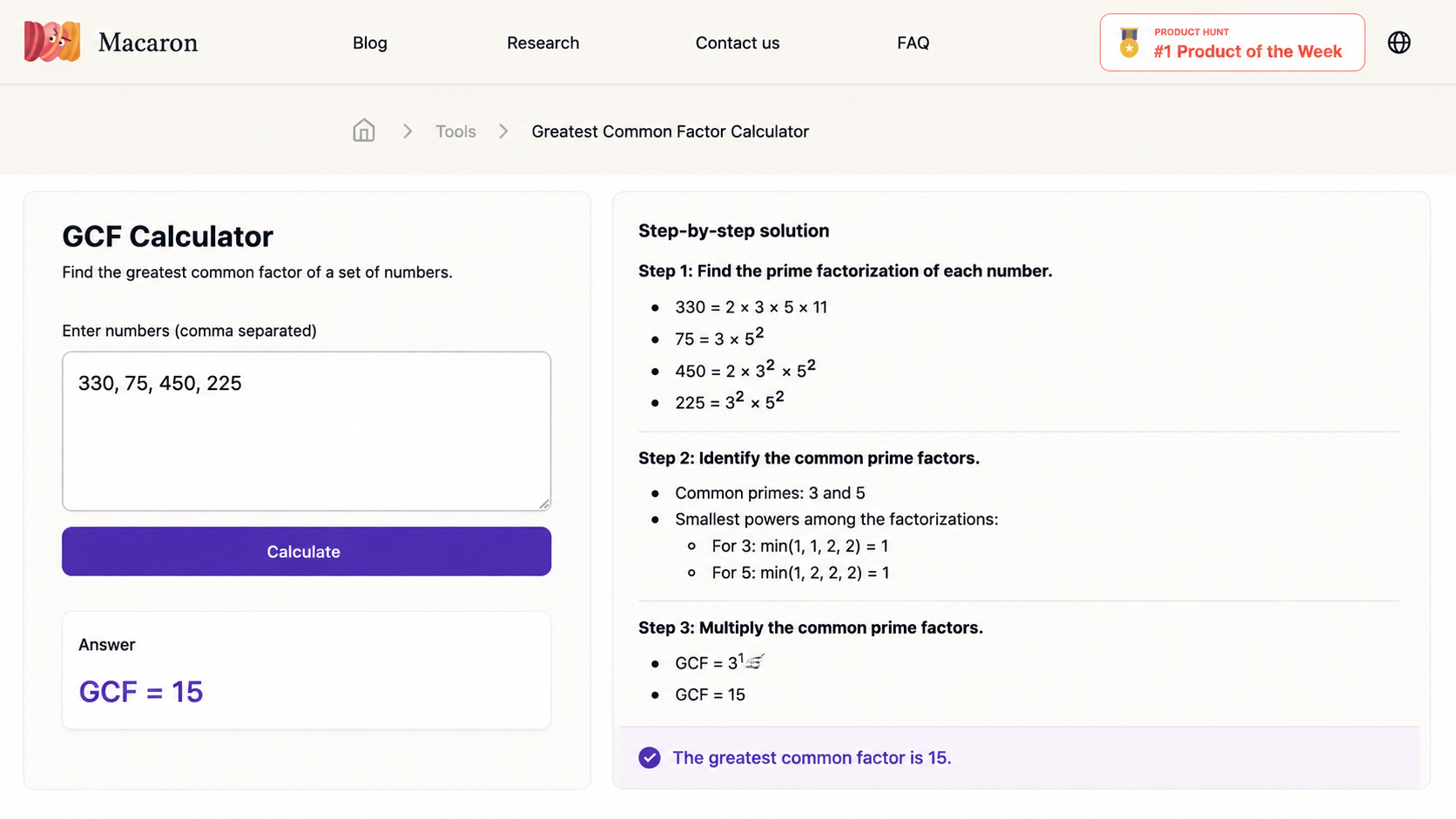
- Ver Resultados: La calculadora muestra el valor del MCD, la factorización prima de cada número con factores comunes resaltados, y cálculos paso a paso usando el algoritmo de Euclides (para dos números).
Información Clave Sobre el MCD
- Múltiples Métodos de Cálculo: El MCD puede calcularse usando varios métodos, incluyendo listar todos los factores, factorización prima, o el algoritmo de Euclides. Cada método tiene sus ventajas dependiendo del tamaño y número de enteros involucrados.
- Esencial para la Simplificación de Fracciones: El MCD es crucial para reducir fracciones a su forma más simple. Al dividir tanto el numerador como el denominador por su MCD, obtienes la fracción simplificada.
- Aplicaciones en Criptografía: El MCD y los algoritmos relacionados juegan un papel vital en la criptografía moderna, particularmente en el cifrado RSA y otros sistemas de seguridad basados en teoría de números.
- Siempre un Entero Positivo: El MCD siempre es un entero positivo, y para cualquier conjunto de números, el MCD es al menos 1 (ya que 1 divide a todos los enteros).
- La Eficiencia Importa: Para números pequeños, la factorización prima es intuitiva y fácil de entender. Para números más grandes, el algoritmo de Euclides es más eficiente y computacionalmente más rápido.
Métodos para Calcular el MCD
There are three common ways to calculate the GCF: listing the factors, using prime factorization, and using the Euclidean algorithm. Each one gives the same answer, so how to calculate the GCF really comes down to which method fits your numbers.
1. Listar Todos los Factores
Este método implica listar todos los factores de cada número e identificar el mayor factor común. Aunque es directo para números pequeños, se vuelve impráctico para enteros más grandes.
tools.gcfCalculator.method1Example
This method is simple for small numbers and is a good way to learn what "common factor" means.
2. Factorización Prima
Descompón cada número en sus factores primos, luego multiplica los factores primos comunes (con las potencias más bajas) para encontrar el MCD. Este método es visual y ayuda a entender la estructura de los números.
Ejemplo: 12 = 2² × 3 y 18 = 2 × 3². Factores comunes: 2¹ × 3¹ = 6, así que MCD = 6.
Prime factorization is useful when you want to see the structure of each number and understand why the answer works.
3. Algoritmo de Euclides
Este antiguo y eficiente algoritmo aplica repetidamente el proceso de división: divide el número mayor por el menor, reemplaza el mayor por el menor, y el menor por el residuo. Continúa hasta que el residuo sea 0. El último residuo no cero es el MCD.
Ejemplo: MCD(48, 18): 48 = 18 × 2 + 12, luego 18 = 12 × 1 + 6, luego 12 = 6 × 2 + 0. MCD = 6.
Factor Out the GCF of Variables, Monomials & Polynomials
A factoring GCF calculator helps with the same core idea: find the largest factor shared by every term, then factor it out. For a numeric expression: 6 + 12 = 6(1 + 2). For an algebraic expression: 6x + 12 = 6(x + 2).
For monomials and polynomials, the GCF may include numbers, variables, or both. Example: 8x² + 12x = 4x(2x + 3). This page's calculator focuses on numeric GCF for positive integers. If you are looking for a factor out GCF calculator for variables, monomials, or polynomials, use the same rule: find the shared numerical factor and the shared variable part with the lowest exponent.
GCF and LCM Calculator – Find Both Together
A GCF and LCM calculator helps you compare two related ideas. GCF is the greatest number that divides the given numbers evenly. LCM is the smallest number that the given numbers divide into evenly.
For two positive integers:
GCF × LCM = product of the two numbers
Example: for 12 and 18: GCF = 6, LCM = 36, 12 × 18 = 216.
The relationship between GCF and LCM
That formula is more than a trick. Because every prime factor of the two numbers ends up in either the GCF (the shared part) or the LCM (the combined part), multiplying them always rebuilds the original product. So if you already know the GCF, you can find the LCM fast:
LCM = (a × b) ÷ GCF
For 12 and 18: (12 × 18) ÷ 6 = 216 ÷ 6 = 36.
Note that this shortcut works cleanly for two numbers. For three or more, calculate the LCM directly instead of dividing the full product by the GCF.
Simplify Fractions Using the GCF
Simplifying fractions using the GCF is one of the most common reasons people reach for a GCF fraction calculator. The idea is simple: divide the numerator and the denominator by their GCF, and the fraction is reduced to lowest terms in one step.
Example: reduce 24/36. The GCF of 24 and 36 is 12. 24 ÷ 12 = 2, 36 ÷ 12 = 3. So 24/36 simplifies to 2/3.
If you divide by a common factor that is not the greatest one, you will still need to simplify again. Using the GCF gets you to lowest terms immediately, which is why it is the cleanest method for reducing any fraction.
Find the GCF of 3 or More Numbers
A GCF of 3 numbers calculator works the same way as it does for two numbers. The GCF of a longer set is the largest integer that divides every number in the set. By hand, the easiest approach is to take the GCF two numbers at a time: find GCF(a, b), then find GCF of that result and c.
Find GCF(a, b), then find GCF of that result and c.
Example: find the GCF of 24, 36, and 60. GCF(24, 36) = 12, then GCF(12, 60) = 12. So the GCF of 24, 36, and 60 is 12.
This pairwise method scales to any number of values, and it is exactly what the calculator does internally when you enter a longer set.
Worked Examples – Common GCF Calculations
These are some of the GCF pairs people look up most often. Each one is worked the short way so you can check your own answer quickly.
| Numbers | Shared factors | GCF |
|---|---|---|
| 12 and 18 | 1, 2, 3, 6 | 6 |
| 8 and 12 | 1, 2, 4 | 4 |
| 16 and 24 | 1, 2, 4, 8 | 8 |
| 18 and 24 | 1, 2, 3, 6 | 6 |
| 15 and 25 | 1, 5 | 5 |
| 24 and 36 | 1, 2, 3, 4, 6, 12 | 12 |
For the most common classroom example, the GCF of 12 and 18 is 6, because 6 is the largest number that divides both 12 and 18 without leaving a remainder.
Coprime numbers — when the GCF is 1
Sometimes two numbers share no common factor other than 1. When that happens, the GCF is 1, and the numbers are called coprime (or relatively prime).
Example: 8 and 15. Factors of 8: 1, 2, 4, 8. Factors of 15: 1, 3, 5, 15. The only shared factor is 1, so the GCF of 8 and 15 is 1. A fraction like 8/15 is already in lowest terms, because there is nothing left to divide out.
Aplicaciones del Mundo Real del MCD
- Simplificación de Fracciones: Reduce las fracciones a su mínima expresión dividiendo tanto el numerador como el denominador por su MCD.
- Encontrar Denominadores Comunes: Al sumar o restar fracciones, el MCD ayuda a encontrar el mínimo común múltiplo (MCM) para denominadores comunes.
- Resolver Ecuaciones Algebraicas: Factoriza el MCD de expresiones polinomiales para simplificar y resolver ecuaciones más fácilmente.
- Teoría de Números y Criptografía: El MCD es fundamental en algoritmos usados para cifrado, firmas digitales y comunicaciones seguras.
- Problemas de Optimización: En ciencias de la computación, el MCD se usa para optimizar algoritmos, reducir la complejidad computacional y resolver problemas que involucran divisibilidad y aritmética modular.
Preguntas Frecuentes (FAQ)
¿Cuál es la diferencia entre MCD y MCM?
El MCD (Máximo Común Divisor) es el mayor número que divide a todos los números dados de manera uniforme, mientras que el MCM (Mínimo Común Múltiplo) es el menor número que es múltiplo de todos los números dados. Están relacionados: MCD × MCM = Producto de los dos números (para dos números).
¿Puede el MCD ser mayor que el número más pequeño?
No, el MCD no puede ser mayor que el número más pequeño del conjunto. El MCD siempre es menor o igual al número más pequeño.
¿Cuál es el MCD de dos números primos?
El MCD de dos números primos diferentes siempre es 1, porque los números primos no tienen factores comunes aparte de 1.
¿Cómo encuentro el MCD de más de dos números?
Puedes encontrar el MCD de múltiples números encontrando primero el MCD de dos números, luego encontrando el MCD de ese resultado con el siguiente número, y así sucesivamente. Alternativamente, usa la factorización prima para identificar todos los factores primos comunes.
¿Por qué es eficiente el algoritmo de Euclides?
El algoritmo de Euclides es eficiente porque reduce el tamaño del problema rápidamente con cada paso, haciéndolo mucho más rápido que listar todos los factores, especialmente para números grandes. Su complejidad temporal es logarítmica.
¿Cuál es el MCD de 0 y cualquier número?
El MCD de 0 y cualquier número no cero n es n mismo, porque todo número entero divide a 0. Sin embargo, en aplicaciones prácticas, típicamente trabajamos solo con enteros positivos.
Need More Than a Calculator? Meet Macaron
A GCF calculator solves one problem well. But homework, study sessions, and everyday questions rarely stop at a single calculation.
Macaron is a personal AI that remembers what you are working on and can build small tools, walkthroughs, and study help around the way you actually learn. If you find yourself reaching for one calculator after another, it is a way to keep all of that in one place that adapts to you.
Create your own tools with MacaronRelated tools and reading
Referencias y Lecturas Adicionales
Leer y descubrir
Asistente personal con IA
Calculadoras gratuitas


