How to Plan a Family Vacation That Fits Real Life
How to Plan a Family Vacation That Fits Real Life

It's a Tuesday night. The kids are finally down, there's a browser tab open that just says "things to do in somewhere," and three group-chat messages from your sister about what she wants this trip to be. Nothing's booked. And you're already tired.
That's usually where family trips fall apart. Not in the booking, but in the part nobody writes guides about: fitting a real trip around real people who nap at different times, get hungry at different times, and define "fun" in ways that barely overlap. I've planned enough of these for my own family — the toddler nephew, the sister who over-books, the dad who fades by mid-afternoon — to know that the clean hour-by-hour itinerary is the first thing to break.
So here's a different way to think about how to plan a family vacation. Less hour-by-hour scheduling, more designing around the actual humans coming with you. You'll walk away with a rough shape you can build on — and a lot less guilt about the gaps.
The short version, if you're skimming:
- Start with who's coming, not where you're going.
- Pick a trip shape before you book anything.
- Plan one real thing per day. Leave the rest open.
- Budget for the friction points — food, transport, the surprise meltdown.
- Keep notes for next time. In the future you will be grateful.
Start With the Family, Not the Destination
Most planning advice tells you to pick a place first. I think that's backwards. The place is the easy part. The hard part is the group you're traveling with — and they should shape everything that comes after.
Ages, energy, and mobility
A toddler, a ten-year-old, and a grandparent do not have the same day in them. That sounds obvious. It stops being obvious the moment you fall in love with an itinerary that involves four miles of walking before lunch.
Before you commit to anywhere, sketch the real range of your group. Who naps. Who fades by 3pm. Who needs flat ground, a bench every so often, or a bathroom that isn't a half-mile away.
If you're looking somewhere outdoors, this is worth real homework. The National Park Service keeps detailed accessibility planning information for parks — paved trails, accessible campsites, shuttle options — and contacting a park ahead of time can save you from arriving somewhere your whole group can't actually enjoy together.

Different ideas of fun
Here's the thing — "a good trip" means something completely different to each person at the table.
One kid wants a pool. The other wants a museum. One adult wants to do nothing. The other already booked a spreadsheet's worth of reservations in their head.
Surface this out loud before booking. Ask everyone for one thing that would make the trip feel worth it to them. Not five things. One. You'll spot the overlaps fast, and the real conflicts even faster — which is exactly when you want to find them.
Non-negotiables and dealbreakers
Every family has a few hard lines. The 1pm nap that cannot move. Food allergy. The medication schedule. The cousin who genuinely cannot do heat.
Write these down first, because they quietly veto a lot of options. A destination that looks perfect on paper can collapse against a single dealbreaker.
If you're heading abroad or somewhere remote, build in health prep early. The CDC's guidance on traveling with children covers what to pack, how illnesses show up differently in kids, and why some prep needs to happen weeks ahead — not the night before.

Choose a Trip Shape Before Booking Details
Once you know your people, pick a shape. This one decision saves more arguments than any other, because it sets expectations before anyone gets attached to a specific plan.
Rest-heavy trip

One base. Minimal moving around. A pool or a beach or a backyard, and not much on the schedule. This is the trip you take when everyone's depleted and the goal is to come home less tired than you left.
Don't apologize for it. A slow trip is still a trip.
Activity-heavy trip
Lots of doing. New places, full days, a packed feeling that some families love and some find exhausting by day two.
If this is your shape, the trick is honesty about pace. Even active families need a soft day in the middle. Plan it now, or your bodies will plan it for you — usually with a tantrum.
Multi-family or extended-family trip
The hardest shape, because you're merging different rhythms, budgets, and bedtimes under one roof.
The fix that's worked for groups I know: agree on a few shared anchors — one big dinner, one shared outing — and leave the rest of each day independent. Forced togetherness for a whole week is how good relatives stop speaking. Built-in space is a feature, not a betrayal.
Build a Family-Friendly Itinerary
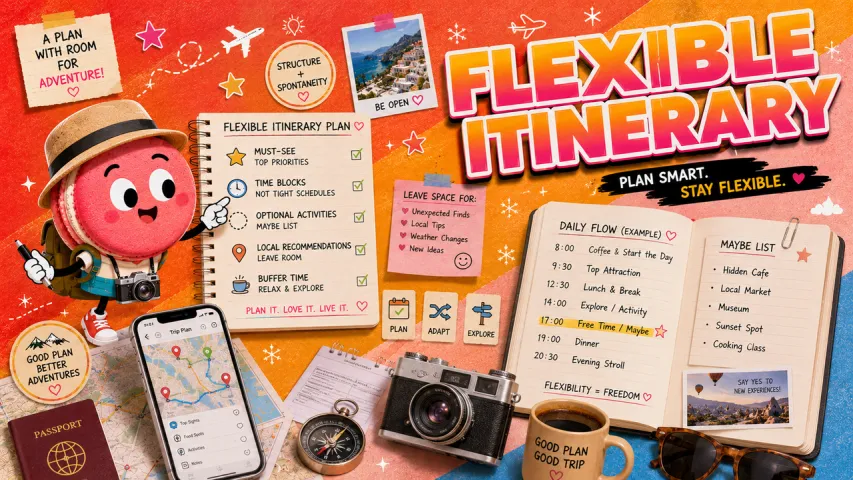
Now the actual days. The mistake I made for years was treating the itinerary like a school timetable — every hour assigned, every gap "wasted." With a family, that's a recipe for falling behind by 10am and feeling like a failure by noon.
The whole point of how to plan a family vacation that actually holds up is to plan less than you think you need. (If you want a deeper approach to laying out the day itself, that's its own thing — see our guide on how to make a travel itinerary.)
One anchor per day
Pick one real thing per day. A single destination, outing, or experience that, if it's the only thing that happens, the day still counts.
Everything else hangs loosely around it. The NPS kids' visit planning page is a nice model here — it nudges families toward one meaningful experience (a ranger program, a single trail) rather than cramming the whole park into one afternoon.

Backup plans
Weather turns. A kid spikes a fever. The "must-see" thing is closed for renovation.
Have a loose plan B for each anchor — usually something indoors, low-stakes, and close by. Not a second itinerary. Just a "if today falls apart, we can do this instead" note. It's the difference between a ruined day and a different day.
Downtime that is actually protected
This is the one people skip, and then wonder why everyone's snapping at each other.
Protected downtime means it's on the plan, not just "we'll rest if we have time." You never have time. Block it. An afternoon back at the room. A morning with nowhere to be. Treat it like a reservation you can't cancel.
Budget for Family Friction Points
Family money doesn't drain on the big stuff. The flights and the hotel, you can see coming. It's the small, constant, unglamorous things that blow the budget — and the mood.
Food
Feeding a family on the road is its own line item, and it's almost always bigger than expected. Snacks alone can rival a meal. Plan for one slightly-too-expensive convenience purchase a day, because it will happen.
One real lever: free entry where you can get it. If you've got a fourth grader, the Every Kid Outdoors pass gets the whole family into national parks and federal lands free for a year — which is real money back in the food budget for a parks-based trip.

Transport
Getting a family from A to B costs more than the ticket price. It costs patience.
If you're flying, the friction is at the airport. TSA's Families on the Fly program now offers dedicated family lanes at many airports, and kids 17 and under can usually join a parent in PreCheck lanes without their own enrollment. Knowing that ahead of time turns the most stressful part of the day into something survivable.
Surprise kid or group needs
Build a small buffer for the unplanned. The forgotten charger. The shoe that falls apart. The pharmacy runs at 9pm.
I'd put a real number on it — even fifty dollars a day set aside for "things I couldn't have predicted." You'll use most of it, and not resent a single dollar. The buffer isn't a budget failure. It's what keeps the rest of the budget intact.
Save Notes for the Next Family Trip
The best thing you can do for your next trip happens at the end of this one, while it's all still fresh.
On the way home — or honestly, the day after — jot down what worked and what didn't. Which anchor was a hit. Which day was too much. What you wish you'd packed. What food saved you. The nap window that turned out to be sacred.
It feels like a small thing. But two trips later, when you're staring at that same Tuesday-night browser tab, those notes are gold. This is also where an AI friend that remembers — like Macaron — quietly earns its place, by holding onto your family's patterns and preferences so you're not rebuilding them from memory every single time.

That's really it. Plan around your people, leave room to breathe, and keep notes for the version of you who has to do this again.
FAQ
What family needs are easiest to forget during planning?
Downtime and food, almost every time. We plan the exciting parts and assume the boring necessities sort themselves out. They don't. The other big miss is mobility — assuming everyone keeps the same pace, then discovering on day one that they can't.
How do families handle differing travel preferences without conflict?
Ask each person for one thing that would make the trip feel worth it to them, then build around the overlaps. The conflict usually isn't that people want different things — it's that nobody said what they wanted until they were already disappointed. Naming it early defuses most of it.
What makes a family itinerary feel too packed or stressful?
More than one anchor per day. The moment you schedule a second "must-do," you've built in a way to fall behind. Packed itineraries don't fail because the activities are bad — they fail because there's no slack, so one delay topples the whole day.
What notes or lessons should you save after a family trip?
Pace, food, and surprises. Was the schedule too full or too empty? What did everyone actually eat, and what did it cost? What caught you off guard? Those three notes will reshape how you plan a family vacation next time more than any destination guide will.

Nobody nails a family trip. I certainly haven't. There's always a meltdown you didn't see coming, a day that goes sideways, a thing you forgot. But there's a real difference between a trip that runs you ragged and one that just — quietly works, most of the time. That's the bar. Not perfect. Just a trip that fits the actual people in it, with a little room left over for the parts you couldn't plan.