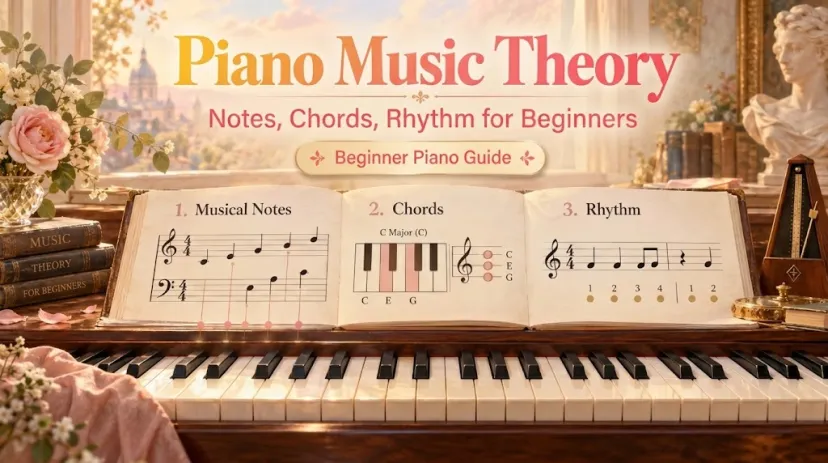
Piano Music Theory for Beginners: Notes, Chords, Rhythm
Piano Music Theory for Beginners: Notes, Chords, Rhythm
A page of piano music can seem to ask you to solve several puzzles at once: which key to press, why those notes sound together, and when to play them.
The pieces of piano music theory become easier to use when you connect them on one small example. We’ll stay in C major, build C and Am chords, then read a short passage beat by beat. That is enough to give each new term a job at the keyboard.
Notes and Intervals on the Keyboard
The white keys repeat the letter names A through G. Find C immediately to the left of a group of two black keys. Moving right from C, the white keys are C, D, E, F, G, A, B, then C again.
An interval is the distance between two notes. It has two parts worth keeping separate. Its number counts letter names, including both ends: C–D is a second; C–E is a third. Its precise size also depends on semitones, the steps between adjacent piano keys. C–E spans four semitones, so it is a major third. A–C also counts as a third, but spans three semitones, making it a minor third. Open Music Theory’s interval explanation distinguishes that letter-name count from interval quality.
The same distinction will explain why our two chords sound different. For now, notice one easy trap: counting white keys alone tells you the interval number, but not always its quality.
How a Scale Defines a Key
Play the white keys from C up to the next C. Here is the C-major relationship in one line; each number between notes is a distance in semitones.
Note:          C --2-- D --2-- E --1-- F --2-- G --2-- A --2-- B --1-- C
Scale degree:  1       2       3       4       5       6       7       1
The first C is degree 1, or the tonic. E is degree 3; G is degree 5. There is no black key between E and F or between B and C, which accounts for the one-semitone gaps. The pattern is whole, whole, half, whole, whole, whole, half. You can check that pattern against Open Music Theory’s major-scale guide.
A scale gives you an ordered collection of notes. A key also concerns which note and harmony feel like home. C major and A minor can use the same seven white-key note names, so the collection alone does not settle what the music emphasizes. In the passage below, returning to a C chord and ending the melody on C helps establish C as home. That is a listening clue, not a rule that every piece must end that way.
Build Major and Minor Triads
A triad has three notes arranged as a root, a third, and a fifth. You can find the letters by taking alternate notes from a scale: start on C, skip D to reach E, then skip F to reach G. The result is C–E–G. Start on A, skip B to C, then skip D to E: A–C–E.
Chord
Notes
Root to third
Root to fifth
C major
C–E–G
Major third: 4 semitones
Perfect fifth: 7 semitones
A minor (Am)
A–C–E
Minor third: 3 semitones
Perfect fifth: 7 semitones
Both chords have a perfect fifth above their root. The third is the difference you can hear and name. In C major, C–E is the wider major third; in Am, A–C is the narrower minor third. This follows the major/minor distinction in Open Music Theory’s triad guide.
“Third” and “fifth” describe positions counted from each chord’s root. They do not mean “the third and fifth keys you happen to press.” Naming the notes first, then checking the semitones, prevents that mix-up without requiring a chart of every chord.
Hear How Chords Work Together
C major and Am share two notes, C and E. Only one chord tone changes: G in C major gives way to A in Am. Play C–E–G together, then A–C–E. Even if you move your hand to make each chord comfortable, listen for the notes that remain familiar while the bass changes from C to A.
That shared material is one reason the shift can sound connected rather than abrupt. But “connected” does not mean the chords are interchangeable. Put A under C–E and you hear an Am harmony; put C under E–G and you hear C major. The bass note gives your ear a strong hint about the root.
Try separating the questions as you listen: Which notes are shared? Which note changed? Where did the bass go? Those observations are more useful at this stage than memorizing a long list of chord sequences.
Count Beats, Note Values, and Rests
Pitch tells you what to play. Rhythm tells you when and for how long. In 4/4, each measure contains four beats, and a quarter note receives one beat. Count steadily: “1, 2, 3, 4.”
Within that measure, a half note lasts two beats and a whole note lasts four. A quarter rest takes one beat of silence in the part where it appears. The count does not stop during a rest. Open Music Theory’s note-and-rest guide shows how sounding durations and rests relate.
At the piano, the hands may have different rhythms at the same time. If the right hand has a rest on beat 3 while the left hand is holding a whole note, the right hand stays quiet; the left-hand sound can continue. A rest in one part is not necessarily silence across the entire instrument.
Follow the Theory Through One Short Passage
Here is an original three-measure example, written as a beat grid rather than a full staff. For clarity, middle C is called C4 in this example. Each left-hand whole note starts on beat 1 and is held through beat 4.
4/4 measure
Left hand
Right hand: beat 1
Beat 2
Beat 3
Beat 4
1 — C
C3, whole note
E4, quarter
G4, quarter
E4, half note begins
Hold E4
2 — Am
A2, whole note
E4, quarter
A4, quarter
Quarter rest
C5, quarter
3 — C
C3, whole note
G4, quarter
E4, quarter
Quarter rest
C4, quarter
First, check the rhythm without playing. Measure 1 has one beat of E4, one of G4, and two of E4: four beats. Measures 2 and 3 each contain three quarter notes and one quarter rest: also four. The left hand holds one four-beat note in every measure.
Now check the pitches against the chords. C3 in measure 1 supports E and G, both members of C major. A2 in measure 2 supports E, A, and C, all members of Am. Measure 3 returns to C harmony and lands on C4. The right hand’s E4 on the first beat of measures 1 and 2 gives you a note to recognize across the chord change.
Play the right-hand line alone while counting aloud. Then play only the three left-hand bass notes, holding each for four counts. Put the parts together slowly enough that beat 3 in measure 2 remains a right-hand rest. If you accidentally play there, pause and count that measure again. Adding speed will not clarify a missed rest.
This tiny passage connects the framework: letter names identify keys; intervals explain the triads; the C-major note collection supplies the melody; bass and chord tones shape the harmony; note values place every sound and silence on a beat. It does not stand in for a complete theory course. It gives you somewhere concrete to point when a term appears in your next piece.
Choose What to Learn Next
The next useful topic depends on where the passage broke down. There is little benefit in studying more chords if finding C still takes all your attention.
If your sticking point was…
Learn next
What it will help you do
Finding E4 or C3
Keyboard note names and staff reading
Locate written pitches in the correct register
Seeing why E–F is a half step
Scale construction
Recognize whole- and half-step patterns
Remembering C–E–G versus A–C–E
Individual chord shapes and inversions
Recognize chord tones in different hand positions
Hearing why the harmony changes
Beginner chord progressions
Follow longer sequences without losing the home chord
Keeping beat 3 silent
Rhythm-reading practice
Count rests while another part continues
Return to the three measures after working on your chosen topic. Piano music theory starts to earn its place when it answers a question you actually met while reading or playing.
FAQ
Why do some sheet-music publishers write H where others write B?
They may use different note-naming conventions. In German notation, H means the pitch called B natural in English; German B means B-flat. Check the score’s language or publisher before treating an H as an extra piano key.
Does middle C have the same octave number in every software program?
No. The physical pitch does not change, but software can label it C3, C4, or C5. For example, Steinberg’s middle-C numbering settings allow those three labels for MIDI note 60. This article uses C4; check your program’s convention before copying octave numbers into it.
What is the difference between movable do and fixed do?
With movable do, “do” names the tonic: C is do in C major, while G is do in G major. With fixed do, “do” names C regardless of the key. Both are naming systems for learning and hearing notes; neither changes which piano key produces a given pitch.
Can a piano play notes between the standard semitones?
An ordinary piano keyboard offers fixed keys at its tuned pitches. Pressing between two keys will not produce a pitch halfway between them. Specially retuned acoustic pianos or appropriately configured digital instruments can make other pitches available, but that requires a different setup from this beginner example.
Why do some scores use B-sharp instead of C?
On a standard equal-tempered piano, B-sharp and C use the same key. Their written names can show different musical roles. In C-sharp major, for instance, the seventh scale degree is written B-sharp so that each scale degree has its own letter name and leads to C-sharp. Play the key the notation indicates, but keep the spelling when you are identifying the scale or chord.