最大公因數計算器
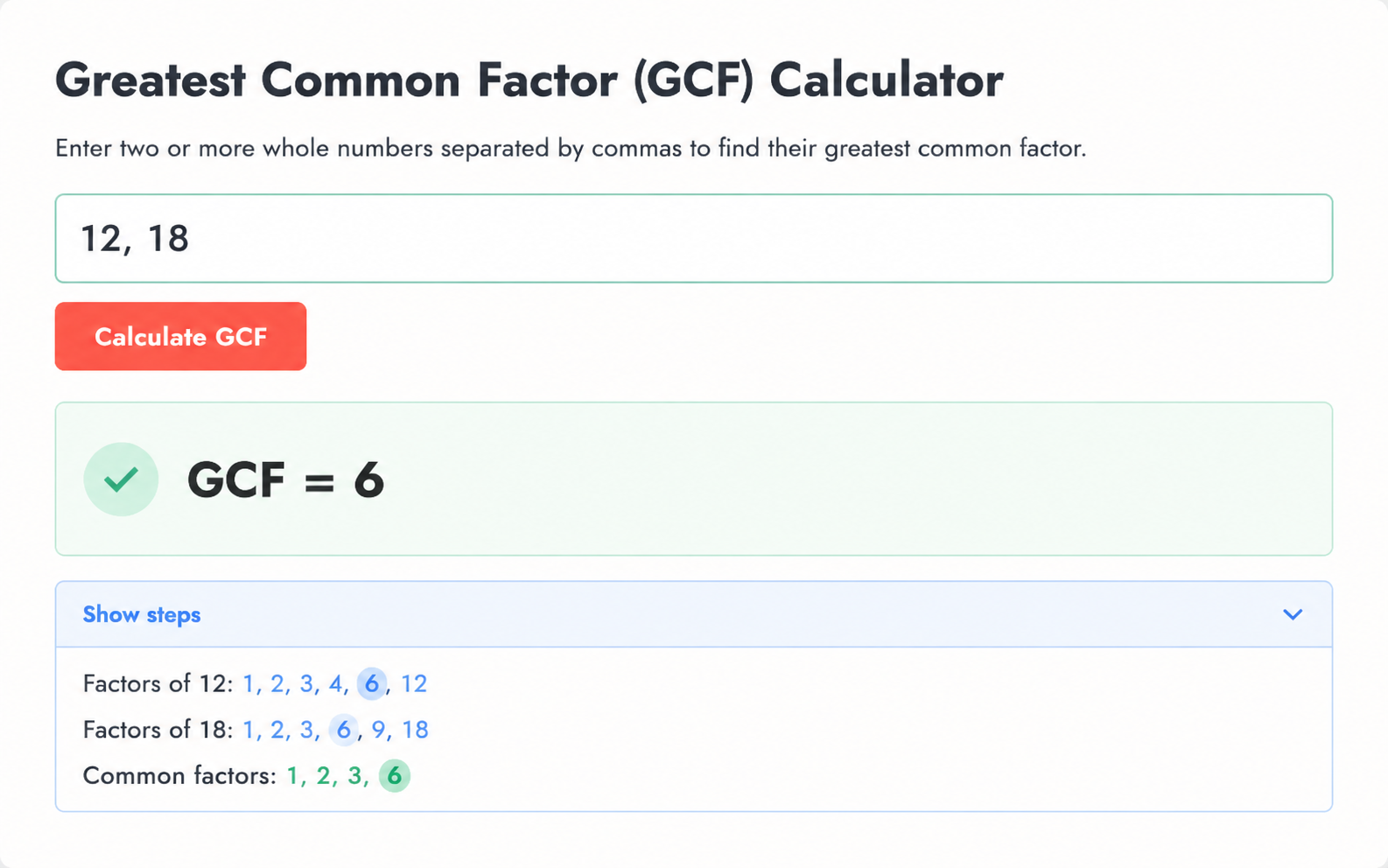
使用質因數分解法和歐幾里得算法計算兩個或更多數字的最大公因數。取得即時結果,並附逐步解說。
If you need to calculate GCF for homework, simplify a fraction, compare GCF and LCM, or check the GCF of 3 numbers, this page gives you both the answer and the method behind it.
什麼是最大公因數 (GCF)?
最大公因數 (GCF),又稱為最大公約數 (GCD) 或最高公因數 (HCF),是能夠整除兩個或多個數字且不留餘數的最大正整數。它是數論中的基本概念,並在數學、代數和計算機科學中有著廣泛的應用。
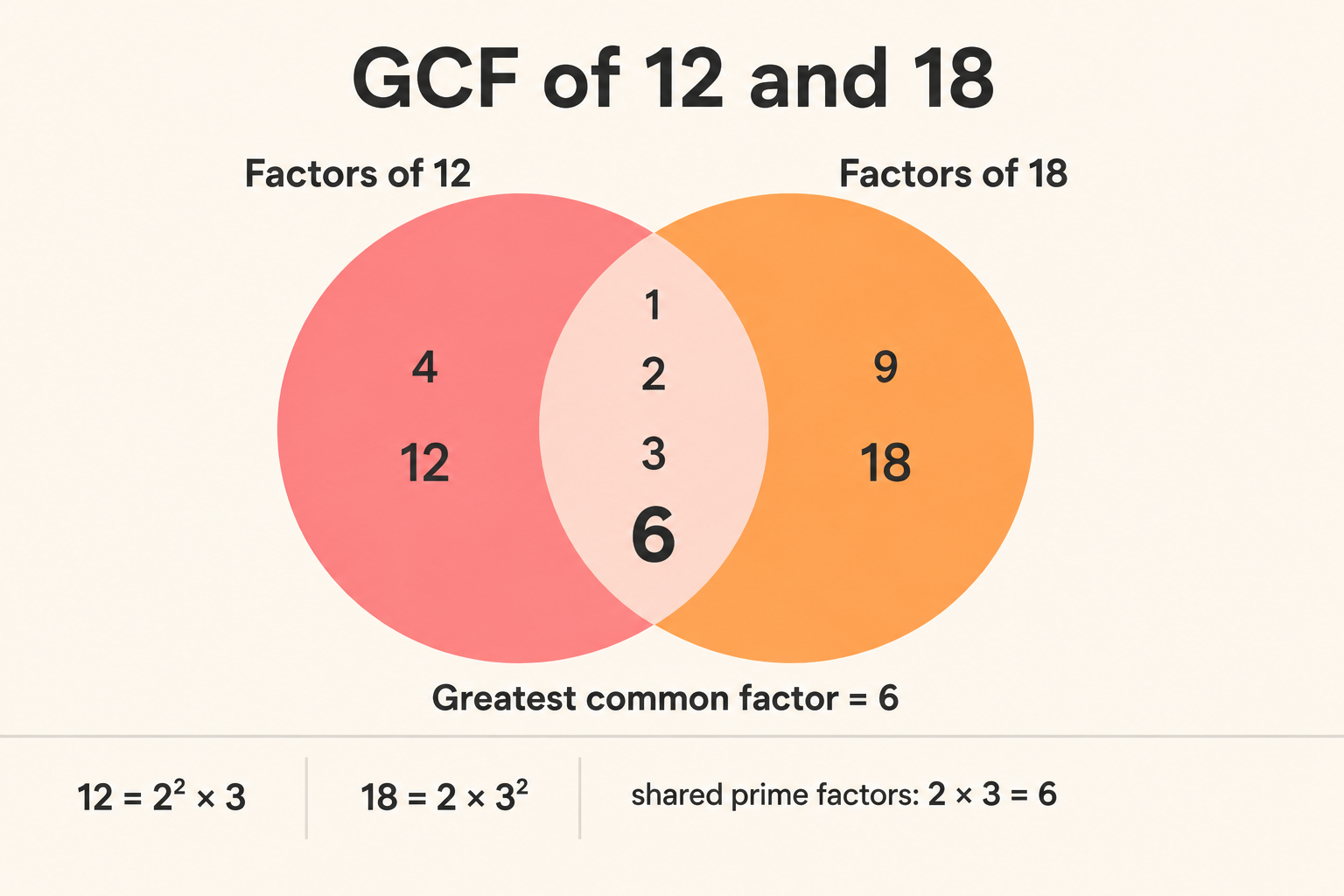
例如,12 和 18 的 GCF 是 6,因為 6 是能夠整除 12 和 18 的最大數字。GCF 尤其在簡化分數、尋找共同分母和解決涉及比率和可整除性的問題時非常有用。
GCF vs GCD vs HCF — are they the same?
Yes. GCF, GCD, and HCF usually mean the same thing. GCF means greatest common factor. GCD means greatest common divisor. HCF means highest common factor. Different textbooks and regions may use different names, but all three refer to the largest number that divides the given numbers evenly.
如何使用 GCF 計算器
Use this section if you are wondering how to find GCF on calculator tools without doing every step by hand.
- 輸入你的數字: 在輸入欄中輸入以逗號分隔的兩個或更多正整數(例如,330, 75, 450, 225)。
- 點擊計算: 按下「計算 GCF」按鈕來計算最大公因數。
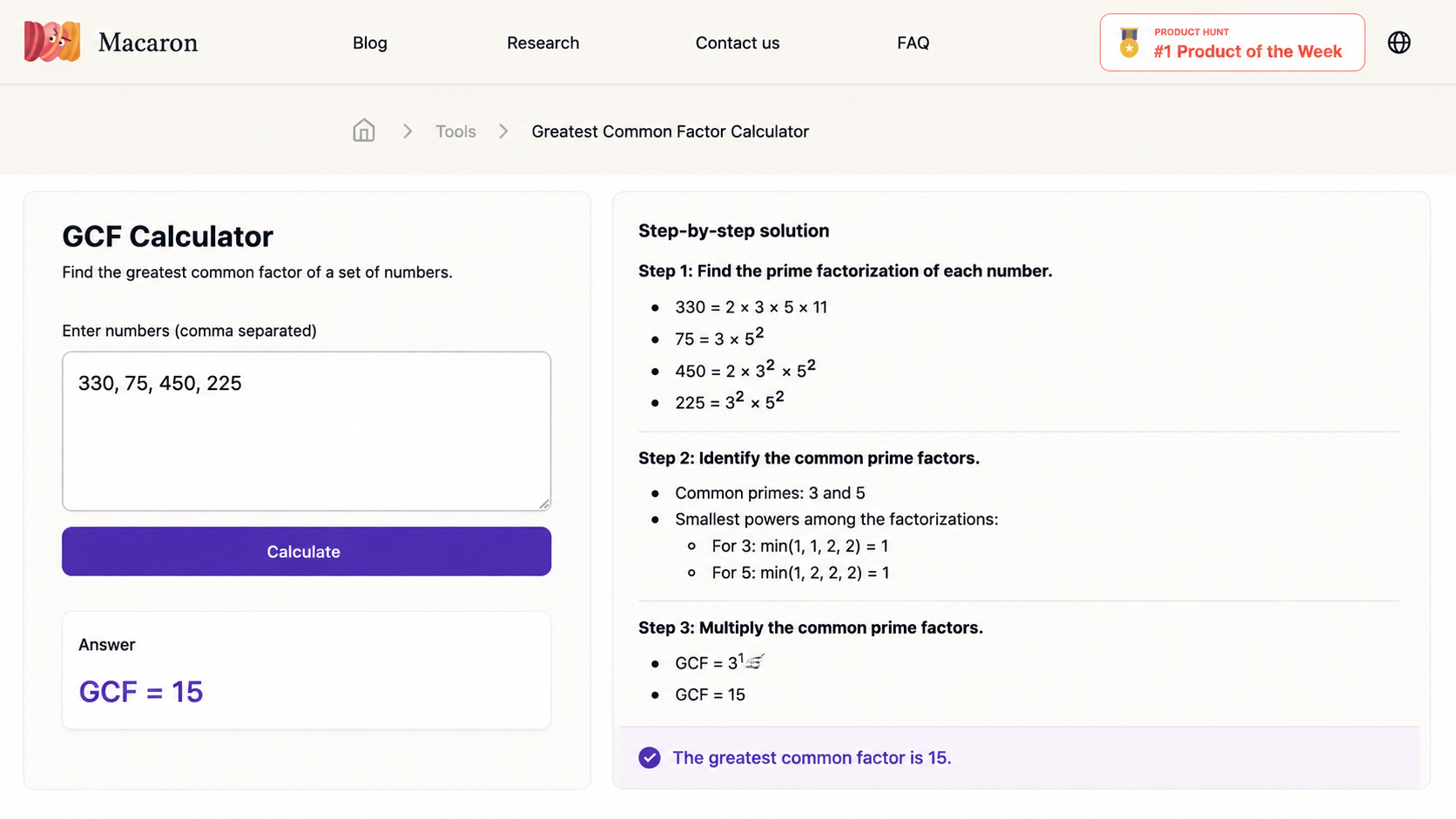
- 查看結果: 計算器會顯示 GCF 值、每個數字的質因數分解並突出顯示共同因數,以及使用歐幾里得算法進行的逐步計算(針對兩個數字)。
關於 GCF 的關鍵見解
- 多種計算方法: 可以通過多種方法計算 GCF,包括列出所有因數、質因數分解或歐幾里得算法。每種方法根據涉及的整數大小和數量而有其優勢。
- 分數簡化的必要性: GCF 對於將分數化簡至最簡形式至關重要。通過用它們的 GCF 分別除以分子和分母,你可以得到簡化的分數。
- 在密碼學中的應用: GCF 和相關算法在現代密碼學中扮演著關鍵角色,尤其是在 RSA 加密和其他基於數論的安全系統中。
- 始終為正整數: GCF 始終為正整數,對於任何一組數字,GCF 至少為 1(因為 1 可以整除所有整數)。
- 效率很重要: 對於小數字,質因數分解直觀且易於理解。對於較大的數字,歐幾里得算法更高效且計算更快。
計算 GCF 的方法
There are three common ways to calculate the GCF: listing the factors, using prime factorization, and using the Euclidean algorithm. Each one gives the same answer, so how to calculate the GCF really comes down to which method fits your numbers.
1. 列出所有因數
此方法涉及列出每個數字的所有因數並識別最大共同因數。對於小數字來說很簡單,但對於較大的整數來說變得不切實際。
tools.gcfCalculator.method1Example
This method is simple for small numbers and is a good way to learn what "common factor" means.
2. 質因數分解
將每個數字分解為其質因數,然後將共同的質因數(具有最低次方)相乘以找到 GCF。此方法具有視覺效果,幫助理解數字的結構。
例子:12 = 2² × 3 和 18 = 2 × 3²。共同因數:2¹ × 3¹ = 6,所以 GCF = 6。
Prime factorization is useful when you want to see the structure of each number and understand why the answer works.
3. 歐幾里得算法
這個古老而高效的算法重複應用除法過程:用較大數除以較小數,用較小數替換較大數,用餘數替換較小數。繼續直到餘數為 0。最後一個非零餘數就是 GCF。
例子:GCF(48, 18):48 = 18 × 2 + 12,然後 18 = 12 × 1 + 6,然後 12 = 6 × 2 + 0。GCF = 6。
Factor Out the GCF of Variables, Monomials & Polynomials
A factoring GCF calculator helps with the same core idea: find the largest factor shared by every term, then factor it out. For a numeric expression: 6 + 12 = 6(1 + 2). For an algebraic expression: 6x + 12 = 6(x + 2).
For monomials and polynomials, the GCF may include numbers, variables, or both. Example: 8x² + 12x = 4x(2x + 3). This page's calculator focuses on numeric GCF for positive integers. If you are looking for a factor out GCF calculator for variables, monomials, or polynomials, use the same rule: find the shared numerical factor and the shared variable part with the lowest exponent.
GCF and LCM Calculator – Find Both Together
A GCF and LCM calculator helps you compare two related ideas. GCF is the greatest number that divides the given numbers evenly. LCM is the smallest number that the given numbers divide into evenly.
For two positive integers:
GCF × LCM = product of the two numbers
Example: for 12 and 18: GCF = 6, LCM = 36, 12 × 18 = 216.
The relationship between GCF and LCM
That formula is more than a trick. Because every prime factor of the two numbers ends up in either the GCF (the shared part) or the LCM (the combined part), multiplying them always rebuilds the original product. So if you already know the GCF, you can find the LCM fast:
LCM = (a × b) ÷ GCF
For 12 and 18: (12 × 18) ÷ 6 = 216 ÷ 6 = 36.
Note that this shortcut works cleanly for two numbers. For three or more, calculate the LCM directly instead of dividing the full product by the GCF.
Simplify Fractions Using the GCF
Simplifying fractions using the GCF is one of the most common reasons people reach for a GCF fraction calculator. The idea is simple: divide the numerator and the denominator by their GCF, and the fraction is reduced to lowest terms in one step.
Example: reduce 24/36. The GCF of 24 and 36 is 12. 24 ÷ 12 = 2, 36 ÷ 12 = 3. So 24/36 simplifies to 2/3.
If you divide by a common factor that is not the greatest one, you will still need to simplify again. Using the GCF gets you to lowest terms immediately, which is why it is the cleanest method for reducing any fraction.
Find the GCF of 3 or More Numbers
A GCF of 3 numbers calculator works the same way as it does for two numbers. The GCF of a longer set is the largest integer that divides every number in the set. By hand, the easiest approach is to take the GCF two numbers at a time: find GCF(a, b), then find GCF of that result and c.
Find GCF(a, b), then find GCF of that result and c.
Example: find the GCF of 24, 36, and 60. GCF(24, 36) = 12, then GCF(12, 60) = 12. So the GCF of 24, 36, and 60 is 12.
This pairwise method scales to any number of values, and it is exactly what the calculator does internally when you enter a longer set.
Worked Examples – Common GCF Calculations
These are some of the GCF pairs people look up most often. Each one is worked the short way so you can check your own answer quickly.
| Numbers | Shared factors | GCF |
|---|---|---|
| 12 and 18 | 1, 2, 3, 6 | 6 |
| 8 and 12 | 1, 2, 4 | 4 |
| 16 and 24 | 1, 2, 4, 8 | 8 |
| 18 and 24 | 1, 2, 3, 6 | 6 |
| 15 and 25 | 1, 5 | 5 |
| 24 and 36 | 1, 2, 3, 4, 6, 12 | 12 |
For the most common classroom example, the GCF of 12 and 18 is 6, because 6 is the largest number that divides both 12 and 18 without leaving a remainder.
Coprime numbers — when the GCF is 1
Sometimes two numbers share no common factor other than 1. When that happens, the GCF is 1, and the numbers are called coprime (or relatively prime).
Example: 8 and 15. Factors of 8: 1, 2, 4, 8. Factors of 15: 1, 3, 5, 15. The only shared factor is 1, so the GCF of 8 and 15 is 1. A fraction like 8/15 is already in lowest terms, because there is nothing left to divide out.
GCF 的實際應用
- 簡化分數: 通過將分子和分母分別除以它們的 GCF,將分數簡化至最低項。
- 尋找共同分母: 在加減分數時,GCF 幫助找到最小公倍數 (LCM) 以便於求共同分母。
- 解代數方程: 從多項式表達式中提取 GCF,以便更輕鬆地簡化和解方程。
- 數論與密碼學: GCF 是用於加密、數字簽名和安全通信的算法的基礎。
- 優化問題: 在計算機科學中,GCF 用於優化算法,減少計算複雜度,並解決涉及可整除性和模運算的問題。
常見問題(FAQ)
GCF 和 LCM 有什麼區別?
GCF(最大公因數)是能夠整除所有給定數字的最大數字,而 LCM(最小公倍數)是所有給定數字的倍數中最小的數字。它們之間的關係是:GCF × LCM = 兩個數字的乘積(針對兩個數字)。
GCF 可以大於最小的數字嗎?
不,GCF 不可能大於集合中最小的數字。GCF 始終小於或等於最小的數字。
兩個質數的 GCF 是多少?
兩個不同質數的 GCF 始終是 1,因為質數沒有除了 1 以外的共同因數。
我如何找到多個數字的 GCF?
你可以通過先找出兩個數字的 GCF,然後用該結果與下一個數字的 GCF,依此類推。或者,使用質因數分解來識別所有共同的質因數。
為什麼歐幾里得算法高效?
歐幾里得算法高效是因為它在每一步中迅速減少問題的規模,使其比列出所有因數更快,尤其是對於大數字。其時間複雜度是對數級的。
0 和任何數字的 GCF 是多少?
0 和任何非零數字 n 的 GCF 是 n 本身,因為每個整數都能整除 0。然而,在實際應用中,我們通常僅使用正整數。
Need More Than a Calculator? Meet Macaron
A GCF calculator solves one problem well. But homework, study sessions, and everyday questions rarely stop at a single calculation.
Macaron is a personal AI that remembers what you are working on and can build small tools, walkthroughs, and study help around the way you actually learn. If you find yourself reaching for one calculator after another, it is a way to keep all of that in one place that adapts to you.
Create your own tools with Macaron


