Business Attire for Men
Business dress attire for male office workers starts with the workplace's actual formality. Use a suit when formal business dress is required; choose tailored separates only where the setting allows them. The dress code decides whether a suit is necessary or tailored separates are enough. Macaron can compare the garments you own against that requirement.
Where Your Office Falls on the Formality Scale
Read the invitation or workplace policy and look at comparable meetings. Formal business dress can call for a matching suit, shirt, and appropriate shoes. Business casual may allow chinos or tailored trousers with a shirt or knit. Ask the host when the distinction is unclear. Turn the available pieces into looks with menswear wardrobe combinations.
Choosing a Suit or Blazer for the Dress Code
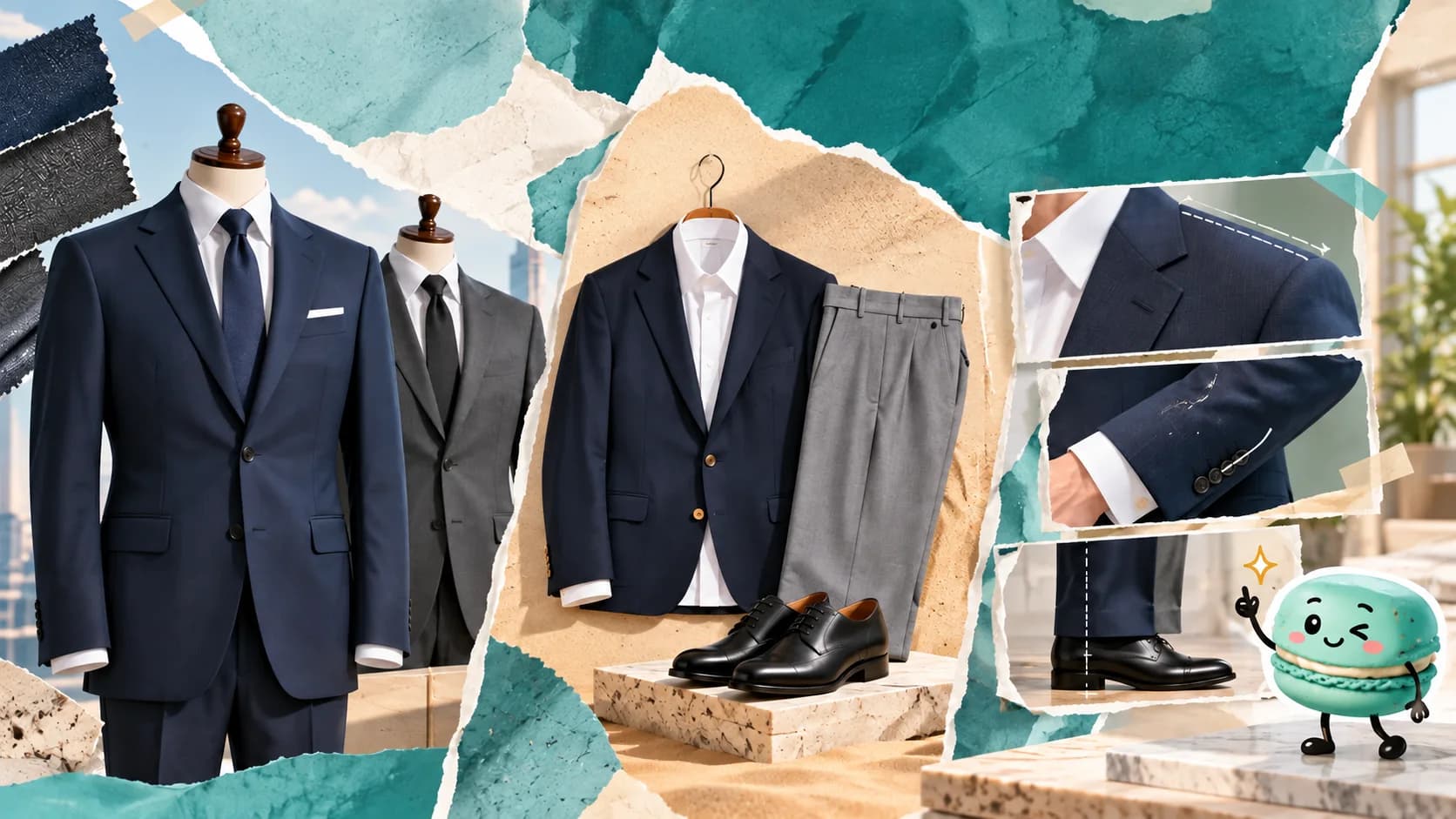
Choose a navy or charcoal suit as an example of a restrained formal base. For separates, try gray trousers with a navy blazer and white shirt. Check shoulders, sleeve movement, and trouser length instead of relying on the label alone.
Check cuts and footwear through office trouser pairings.
Compare a suit with tailored separates
State the office or event dress code, the suit and blazer you own, your shoes, and how long you will be on your feet. Ask Macaron for two options at the right formality.- "Compare my navy suit with gray trousers and a navy blazer for a client meeting. The invitation says business dress."
- "Build three business-casual looks with chinos, plain shirts, loafers, and a cream knit."
- "Create an office outfit checklist covering shoulders, buttons, trouser hem, and shoe condition."
Business Casual Pieces Worth Owning
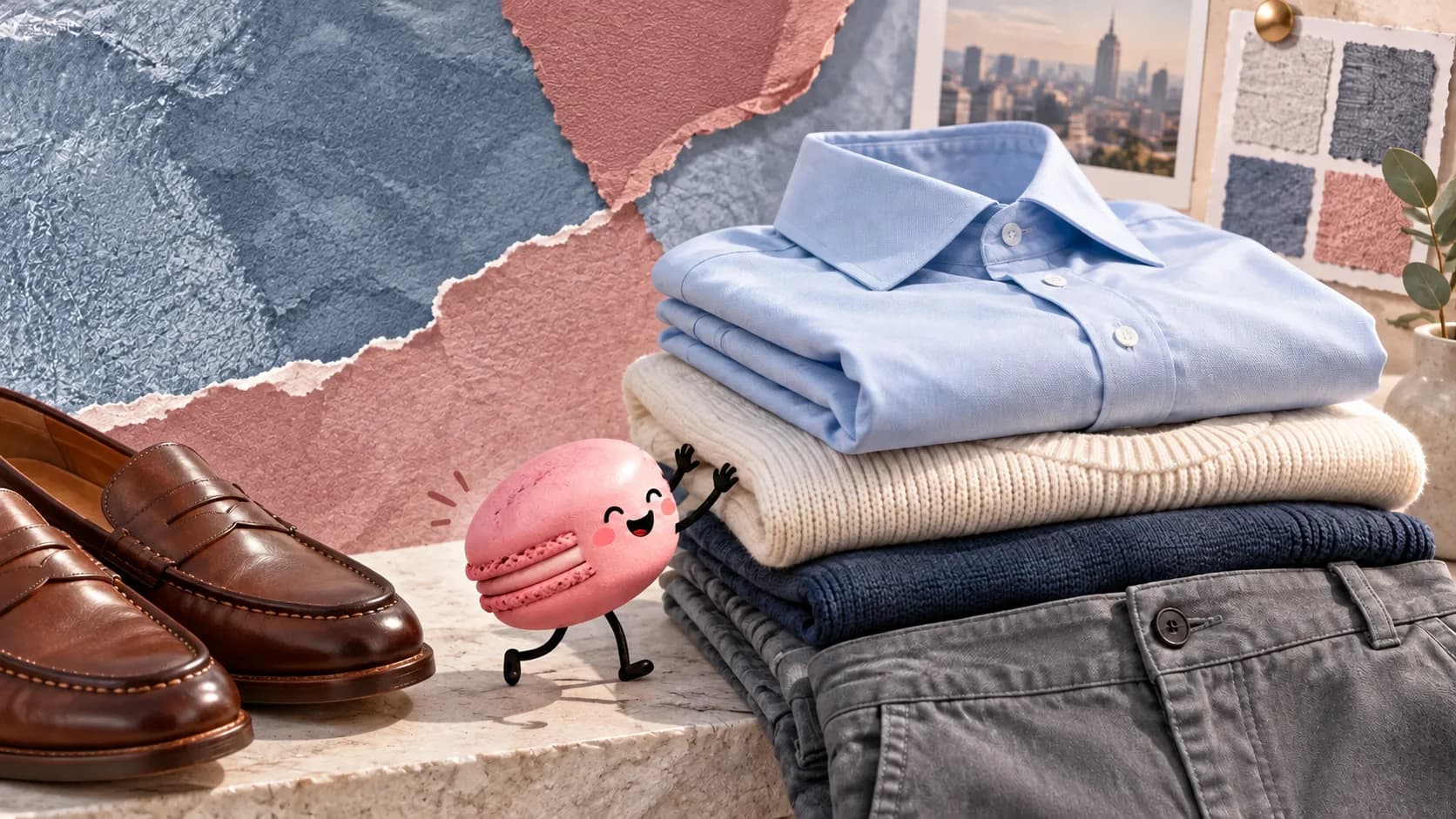
Build a business-casual rotation from two suitable bottoms, plain shirts or polos, a light knit, and shoes accepted at your office. Example: gray chinos, pale-blue shirt, and loafers. Use existing clothes before identifying a genuine gap.
For a companion discussion of workplace formality, compare women's tailored office clothing.
Check the office dress code first
- Confirm the office or event's dress expectation.
- Tell Macaron your suit or separates and available footwear.
- Request combinations at that formality level and a fit checklist.
- Try the full outfit seated and standing before deciding.
Common Mistakes That Undercut a Sharp Look
Check pulling buttons, worn shoe uppers, dragging hems, and accessories that compete with the setting. Sit in the outfit before the commute. A neatly maintained combination usually serves the purpose better than adding more formal items without checking fit.
Set the formality before buying
For a client meeting, compare the host's dress code with the clothes you already own. A matching suit may be appropriate in one office; a blazer and tailored trousers may be enough in another. Choose the least formal combination that still satisfies the actual requirement, then check sleeve, trouser, and shirt fit while standing and seated. A clean shoe and pressed garment usually matter more than adding another accessory.
If the room is more casual or formal
Carry one reversible change if the schedule is uncertain: a tie can go on for a formal meeting and come off afterward, while a blazer can be removed for a casual team lunch. Do not assume that an AI suggestion knows your employer's policy. If safety footwear or uniform rules apply, those requirements take priority over the outfit examples in this guide.
FAQ
Is business casual the same as business dress?
Can I use a blazer instead of a suit?
Do I have to buy a new work wardrobe?
How can I generate combinations from my current clothes?
Sources and editorial note
By Macaron. Content owner: Macaron, operated by MINDAI PTE. LTD.. Contact: contact@macaron.im. Last reviewed: October 16, 2026.
This guide was prepared from an approved editorial brief and checked for heading structure, link integrity, image relevance, and source-to-claim fit. The illustrations on this page were created for this guide and visually reviewed for topic fit. They are illustrative, not evidence of a try-on, salon result, product test, or real-world outcome.
- U.S. Department of Labor: Employment Workshop participant guide — The Department of Labor reference supplies general professional-attire context only. Your employer, conference organizer, industry rules, and safety requirements take precedence.
Macaron can organize outfit options; it cannot verify an employer policy, required protective equipment, accessibility need, or acceptance of a particular look.
Related
Plan Your Next Outfit With Macaron
Share the actual dress code and your available jacket, trousers, and shoes. Ask Macaron for a formal and a permitted less-formal option.
Read & discover
Explore Playbooks
AI Personal Assistant
Free calculators


