Side Bangs for Long Hair
Side bangs with long hair create a directed face frame rather than a centered fringe. Compare the natural sweep, the dry resting point, and how the front joins the long layers before choosing a reference. A side bang is easier to maintain when its length works with your part and tie-back routine. Macaron can help prepare those decisions for your stylist.
Choosing a Side Fringe to Match Your Preferences
Decide whether you want part of the forehead visible and which outline you prefer around the cheeks. Side bangs are not automatically suitable for every face or routine. Use your growth direction, density, and styling tolerance in the comparison. For a centered opening instead, compare wispy curtain fringe alternatives.
Getting the Sweep Direction and Length Right
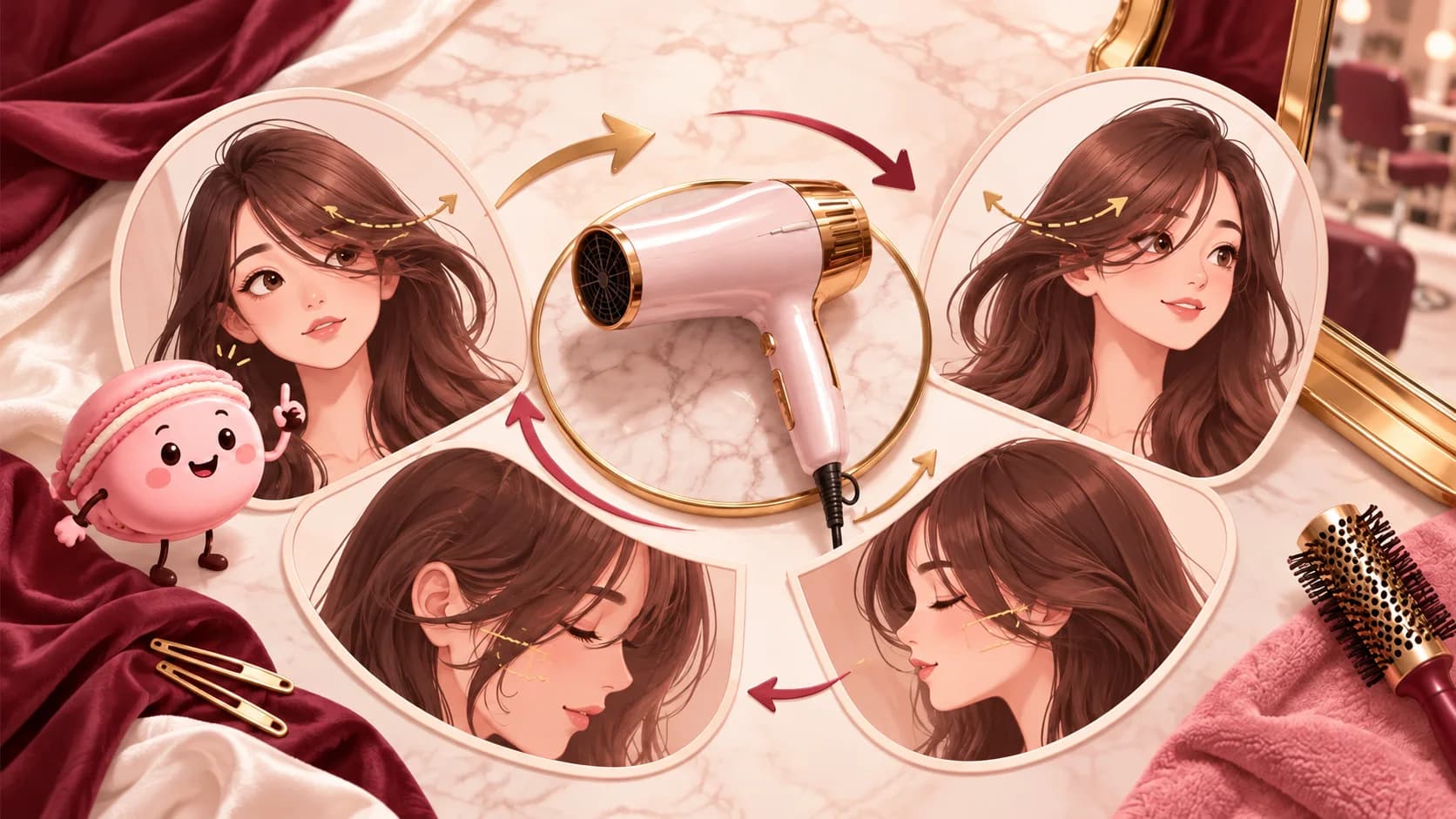
Observe which way the front falls after your usual drying routine. A sweep that opposes it may need more styling. Tell the stylist where you want the shortest piece to rest when dry and check that it remains comfortable near the eyes.
For a proportion-focused discussion, use side fringe choices for a round face.
Set the sweep's dry length
Describe your natural part, where the side bang should end when dry, and whether you tie your hair back. Ask Macaron to compare two front lengths.- "Prepare consultation notes for side bangs with long hair. My front naturally falls right and I prefer forehead space."
- "Compare a cheek-level side fringe and a longer jaw-level frame. Include dry endpoint and eye-comfort questions."
- "Make a side-fringe grow-out decision list without assigning a guaranteed number of weeks."
Styling It With Long Layers Underneath

Discuss whether the side fringe should connect into cheek-level, jaw-level, or longer framing pieces. Keep the longest layers if that is your preference. Ask the stylist to show the transition rather than assuming the fringe and long layers are independent.
Compare another face-frame discussion in side fringe choices for an oval face.
What should you prepare for Styling It With Long Layers Underneath?
- Record natural direction, desired forehead space, and dry endpoint.
- Describe your long layers and styling effort limit to Macaron.
- Request a side-fringe comparison and transition questions.
- Confirm the sweep and layer connection with the stylist.
How It Grows Out Compared to Blunt Bangs
A longer side fringe may be easier to sweep into the surrounding length as it grows, but the process varies. A blunt fringe grows as a different visible edge. Discuss whether to maintain the sweep, pin it back, or blend it gradually at future visits.
Choose a usable side length
A side fringe should connect to your long hair while still making a visible frame. Decide whether the front piece must tuck behind an ear or fit into a ponytail, then tell the stylist before cutting. Pin a section across the forehead to compare a subtle sweep with a stronger angle. Judge it with hair both loose and tied back; the second view often reveals whether the chosen length fits your routine.
If the fringe becomes inconvenient
Change the part or use a clip while the front grows to a tuckable length. If it falls into your eyes, ask for a planned trim rather than repeatedly snipping at home. A little styling from damp hair may guide the direction, but a cut that requires constant correction is not the right low-effort option for you. Discuss a softer grow-out line at the next appointment.
FAQ
Must side bangs sweep away from a particular face shape?
Can I avoid changing the longest layers?
Do side bangs grow out faster than blunt bangs?
Can side bangs work with a tie-back style?
Sources and editorial note
By Macaron. Content owner: Macaron, operated by MINDAI PTE. LTD.. Contact: contact@macaron.im. Last reviewed: October 16, 2026.
This guide was prepared from an approved editorial brief and checked for heading structure, link integrity, image relevance, and source-to-claim fit. The illustrations on this page were created for this guide and visually reviewed for topic fit. They are illustrative, not evidence of a try-on, salon result, product test, or real-world outcome.
- American Academy of Dermatology: Tips for healthy hair — The American Academy of Dermatology reference supports only the general hair-care boundary used here. Haircut shape, fringe placement, and face-framing preferences remain editorial choices to confirm with a qualified stylist.
Macaron can organize consultation options; it does not diagnose hair or scalp conditions, replace a professional consultation, or guarantee a haircut result.
Related
Plan Your Next Haircut With Macaron
Note the side-bang endpoint and your usual hairstyle. Ask Macaron which grow-out questions to discuss with your stylist.
Read & discover
Explore Playbooks
AI Personal Assistant
Free calculators


