Curly Bob with Bangs
For a curly bob with bangs, agree the dry bob outline and fringe length separately. Show your usual curl pattern, explain your drying routine, and ask the stylist to account for the fringe's natural resting position. A curly fringe can end much higher when dry than it appears during a wet cut. Macaron can help you prepare a dry-length brief for your stylist.
Why Curl Pattern Changes How Bangs Are Cut
Different curl behavior at the front and sides can change how the fringe rests. Observe the front after your normal routine and show that result in the consultation. A curl label alone cannot prescribe the amount to cut or guarantee an even edge. For a longer outline, compare a curly lob alternative.
Getting Length Right Despite Shrinkage
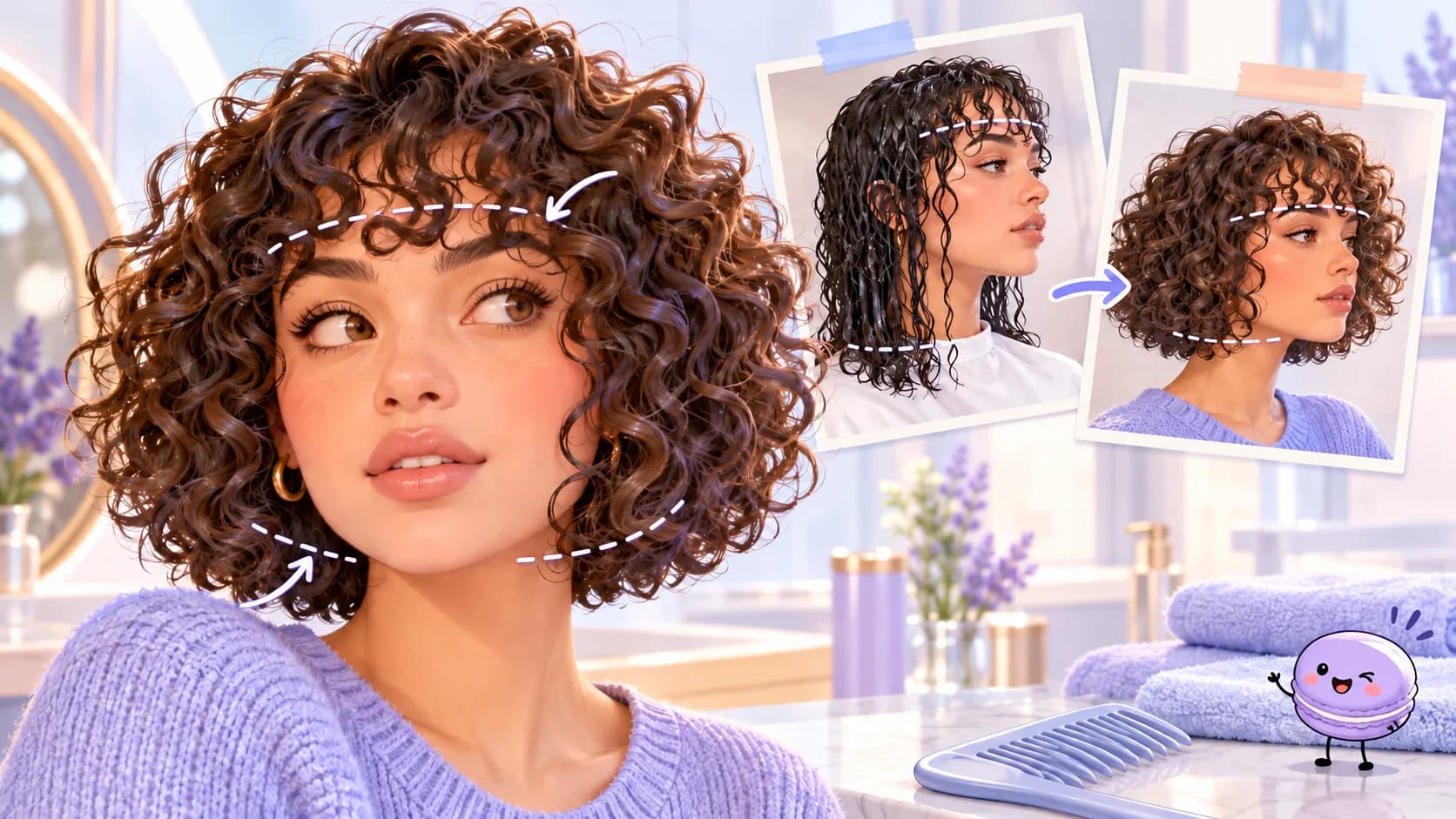
Tell the stylist where you want the fringe and bob perimeter to sit when dry. Wet or stretched hair can appear longer, so ask how the method accounts for your actual change in length. Avoid choosing a fixed shrinkage allowance from an unrelated reference.
For the blunt-versus-soft comparison, review medium bob fringe comparisons.
Describe the fringe at its dry length
Tell Macaron how your front curls rest when dry, how much they shrink, and how you style them. Bring that description to your stylist rather than relying on a wet-length reference.- "Prepare a curly bob consultation with a fringe that stays comfortable near my eyes when dry."
- "Compare a light curly fringe and a denser fringe using my normal curl routine. List unresolved stylist questions."
- "Make a between-trim checklist separating the bob perimeter, fringe comfort, and styling changes."
Reducing Frizz When Styling Curly Bangs

Discuss a familiar routine that limits unnecessary handling while the curls settle. Apply products according to their directions, and compare the finish after drying before changing several steps. Reduced frizz is a preference to work toward, not a guaranteed result from a cut.
To assess daily effort, use fringe upkeep tradeoffs.
What should you prepare for Reducing Frizz When Styling Curly Bangs?
- Observe the dry front and side curl behavior in your normal routine.
- Tell Macaron the desired endpoints and styling constraints.
- Request a two-part decision record and consultation questions.
- Have the stylist assess the curls and confirm the cut and upkeep plan.
Maintaining the Shape Between Trims
Notice eye-level comfort, uneven resting pieces, and the perimeter you want to retain. Arrange an assessment when the outline no longer works for you. Ask whether the fringe needs a separate adjustment; avoid home cutting based on an assumed wet-to-dry difference.
Agree on the dry silhouette
Bring photos of your own curls on an ordinary wash day as well as your desired bob. Point to where you want the bangs and side outline to land after drying. Ask the stylist to discuss shrinkage and uneven curl patterns before cutting a short front piece. A fringe that looks balanced while wet can sit differently when the curls spring up, so the dry target matters more than a ruler measurement alone.
If the front curls behave differently
Treat the fringe and the rest of the bob as separate styling zones. Use the smallest amount of your usual product on the front and let it dry before deciding whether it needs adjustment. If one curl rises higher, changing the part or the drying direction may be enough. Wait for a normal wash-and-dry cycle before asking for a corrective trim; do not keep shortening individual curls.
FAQ
Can wet length determine the final fringe endpoint?
Will curly bangs always stay defined without styling?
Should I trim a dry curl myself if it looks longer?
What if I want a longer bob without a fringe?
Sources and editorial note
By Macaron. Content owner: Macaron, operated by MINDAI PTE. LTD.. Contact: contact@macaron.im. Last reviewed: October 16, 2026.
This guide was prepared from an approved editorial brief and checked for heading structure, link integrity, image relevance, and source-to-claim fit. The illustrations on this page were created for this guide and visually reviewed for topic fit. They are illustrative, not evidence of a try-on, salon result, product test, or real-world outcome.
- American Academy of Dermatology: Tips for healthy hair — The American Academy of Dermatology reference supports only the general hair-care boundary used here. Haircut shape, fringe placement, and face-framing preferences remain editorial choices to confirm with a qualified stylist.
Macaron can organize consultation options; it does not diagnose hair or scalp conditions, replace a professional consultation, or guarantee a haircut result.
Related
Plan Your Next Haircut With Macaron
Describe your dry curl shape and the fringe position you want. Ask Macaron to turn that into questions for your stylist.
Read & discover
Explore Playbooks
AI Personal Assistant
Free calculators


