Blurting Studying Method: How to Use It Properly
Blurting Studying Method: How to Use It Properly

The blurting studying method is a source-closed retrieval-and-check cycle: choose one answerable question, review for understanding, close the source, then write or speak from memory. Compare with a reliable source, correct and classify gaps, choose the next task, and repeat later. Random free writing leaves that cycle unfinished.
A full page is not proof of accuracy. Evidence supports retrieval-practice components, not “blurting” as a separately validated technique or a grade guarantee.
What the Blurting Method Actually Tests
The BCU blurting guide describes study, hide, recall, check, and repeat as practical guidance. You test what you can produce accurately for one question, not intelligence or permanent mastery.
Complete blurting cycle
Objective: finish with a checked answer and a next action for each gap.

A retrieval-practice study found better comprehension and inference performance after retrieval than concept-map studying in science-text experiments. That supports retrieval within those tasks, not every use of blurting. The active recall guide covers the broader method.
Choose a Small Enough Topic
Use the One-Question Fit Test: one clear prompt, one reliable checking source, and an answer you can compare part by part. “Everything about cell division” fails. “How do these processes differ in purpose and outcome?” gives the blurting study method a boundary. Narrow further if checking becomes unwieldy.
Run a Complete Blurting Session
Review the Material With a Clear Question
Read only what you need to understand the question. Aim to explain a relationship, cause, or sequence in your own words. If you cannot explain it with the source open, return to instruction before trying recall. Copying unfamiliar wording does not resolve its meaning.
Use an assigned text, worked solution, or course rubric you can return to. Note its relevant page or section before closing it. If two sources disagree, resolve that disagreement with your instructor before using either as a marking standard.
Close the Source and Write From Memory
Hide notes, tabs, and previous attempts. Use a structured answer, sketch, equation chain, or spoken recording. Stop when you cannot produce more relevant content. If you peek, mark where assistance began; do not count the continued answer as source-free. Page length and fluency are not marks.
Compare, Mark Gaps, and Correct Errors
Check each claim against your chosen source. Separately label correct, partial, missing, wrong, and off-topic content; add corrections in another color or clearly marked annotation. Check missing relationships as well as missing terms. The IES study guidance recommends tests and quizzes to identify content needing further study. Use that principle to choose repairs, rather than treating confidence as the answer key.
An answer can name both stages correctly while reversing their order. Keep the accurate names, but mark the sequence as wrong. If the order is right and its necessary condition is absent, mark that explanation partial. These need different repairs.
Turn Gaps Into the Next Study Task
The Gap-to-Task Ledger is a practical synthesis, not a validated scoring scale. Record the exact statement or omission beside its category. Repair wrong foundational relationships before polishing incomplete details.
Make each task small enough to start directly. “Explain why this step precedes the next” is actionable; “get better at the chapter” is not.
Hypothetical blurting check: Input: “Compare process A and process B by purpose, sequence, and outcome.” Action: the learner recalls both purposes, swaps one sequence, and omits an outcome. Check: classify the sequence as wrong and the outcome as missing. Contrast the correct sequences and identify the misleading cue; separately revisit the outcome section and answer its narrower question. Remaining issue: verify correctness against the real course source; later retrieval is still untested.

Repeat Without Rewriting Everything
Hide the corrected page. Reattempt the original or a narrower prompt on a blank surface; check the repaired relationship specifically. The same wrong relationship recurring is a failure signal. Return to explanations, worked examples, or teacher feedback instead of adding more identical attempts. Correct content need not be recopied during repair.
Know When Blurting Is the Wrong Method
Use worked problems when procedures need step-by-step feedback, deliberate practice for performance skills, and discussion or source evaluation for ambiguous arguments. For high-stakes or changing facts, consult a current reference. The blurting technique can expose gaps, but cannot replace instruction, reliable marking, or checking whether information is still current.
Combine Blurting With Spaced Review
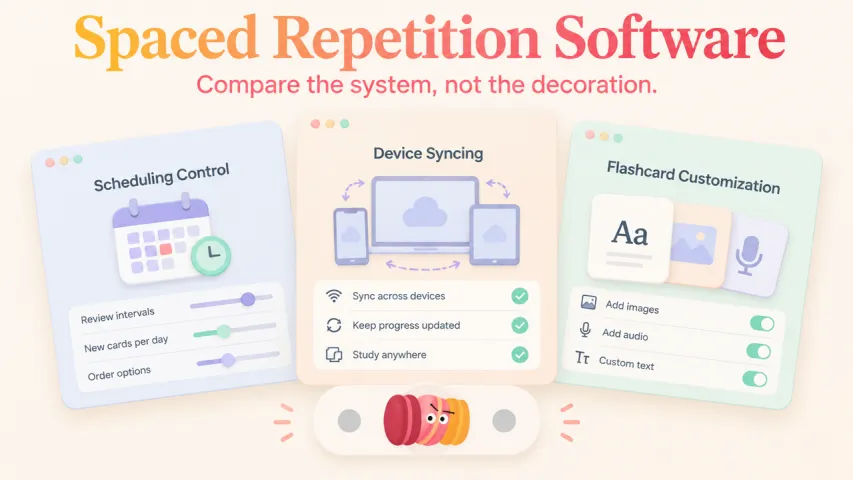
Correct now; test again later. In a spaced-retrieval study, spacing repeated item-recall tests improved later retention compared with no spacing. That item-learning design does not supply a universal timetable. Return after some forgetting is possible; choose a date around difficulty, deadline, and workload. The spaced repetition guide separates timing from what you do when you return.

Let a Personal AI Schedule the Next Attempt
If you use a personal AI such as Macaron, keep its role to details you enter: topic, last attempt, workload, next date, and “sequence still confused.” Verify that saving and scheduling work in your version before relying on them; a paper calendar also works. Keep answers hidden during recall and check them yourself. Do not treat AI output as grading or evidence of mastery. The illustration shows a conceptual planner, not a current Macaron screen.

FAQ
Can group study partners use blurting without sharing identical notes?
Yes. Answer the same question separately before discussing. Agree on an authoritative checking source or rubric; a confident partner is not an answer key.
Does blurting work when answers require diagrams or equations?
Recreate them from memory, then compare symbols, labels, units, and sequence. Use your course rubric or teacher for method-specific marking conventions.
Can students use speech instead of handwriting for blurting?
Yes, for verbal retrieval with a recording or transcript you can check. W3C speech guidance explains speech recognition as an input option. Check transcription errors and school rules before submitting recordings or assistive-technology output.
Should completed blurting sheets be saved or discarded later?
Keep a small error ledger or useful baseline. Check class retention requirements before discarding coursework; confirm deletion and backup behavior for digital files.
Can blurting reveal misconceptions that ordinary flashcards fail to expose?
It can expose wrong relationships that isolated fact cards miss. Explanation or discrimination cards can also test these. Match the prompt to the suspected error.
Conclusion
One blurting studying method session is done when you have attempted the question source-free, checked every material claim, assigned each gap an action, and recorded where to return later. That is session completion, not proof of mastery.
Previous posts








Apply to become Macaron's first friends
Read & discover
AI Personal Assistant
Free calculators


