Cornell Method of Studying: Notes You Can Review
Cornell Method of Studying: Notes You Can Review

The cornell method of studying divides one page into notes, cues, and a summary so captured material can be questioned and reviewed later. Set up the page, capture ideas in the main area, add cues after class, and summarize. Then cover the notes, answer from the cues, compare, and decide what needs repair or another review.
Drawing columns is only setup. Usable questions and checked answers show whether the page is ready to support studying; neatness cannot establish understanding or memory.
What the Cornell Method Is Designed to Do
The Cornell note-taking system separates capturing information from processing it. The Cornell system guide introduces the method developed by Cornell educator Walter Pauk and links to the university's learning-center instruction.
Page-to-Review Map
The objective is a page that lets you attempt an answer, verify it, and locate the next action. The Cue Coverage Check below helps identify which question or explanation needs repair.
Set Up the Page Before Class
Give your Cornell notes template a wide working area, distinct cue area, and bottom summary band. Choose proportions that fit your material; no universal measurements are necessary. Leave cues and summary mostly empty unless your teacher supplies guiding questions.

The Main Notes Area
Keep the explanation here: claims, reasons, examples, steps, and uncertainty. Preserve formulas, diagram labels, source markers, and instructor emphasis when they affect meaning. Leave room to reconnect fragments afterward.
The Cue Column
Use cues to request an answer. Questions, distinctions, sequence prompts, and application cues point back to the main area. Topic labels help navigation but rarely specify what you should retrieve.
The Summary Section
Explain the page's central idea and how its parts connect in a few sentences. Include what remains unclear. Copying the last bullet or listing every detail leaves the page-level question unanswered.
Capture Ideas Without Transcribing Everything
Capture an idea unit: a claim plus its reason, example, condition, or consequence. A definition may need its contrasting case; a procedure needs the reason its steps follow that order.
The failure signal is a fragment you cannot interpret without replaying the entire lecture. After class, add the missing relationship and verify uncertainty against course materials. Mark an unresolved point for clarification instead of guessing. Preserve the connective logic.
Add Questions and Cues After Class
Run this Cue Coverage Check, a practical synthesis for inspecting your page:
- Give each major idea unit one cue job: recall a fact, explain a relationship, distinguish similar ideas, or apply an idea to a case.
- Find orphan note blocks with no cue. Add a prompt for each important block.
- Repair weak prompts: remove answers embedded in the question; narrow broad topic labels; verify or remove questions unsupported by the page.
- Check the summary against the page's main question. Rewrite it if it only repeats the final detail.
Hypothetical page check: Input: economics notes contain an opportunity-cost definition and a class example. Action: replace “Opportunity cost” with “What is opportunity cost, and what was the next-best alternative in the class example?” Check: with notes covered, the learner recalls the definition but lists every rejected option. Remaining issue: verify the example against the actual course source, correct the next-best-alternative distinction, and try the cue again later.
Repair the weak cue or missing explanation; recopying the entire page is unnecessary.

Use the Page for Recall and Review
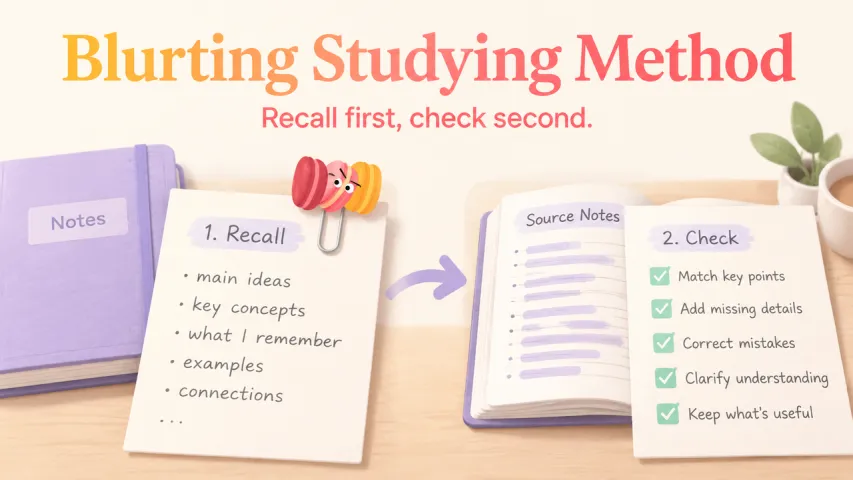
Cover or hide the main notes and summary. Answer a cue aloud or in writing, then reveal the notes and compare. Mark the cue answerable, too broad, misleading, or unsupported. If the cue works but your answer misses the reasoning, revisit the explanation. The active recall guide expands on attempting an answer before looking.

Cornell study strategies describes blank-page retrieval as a way to identify topics needing further practice. In a science-text experiment, a retrieval-practice study found better conceptual learning from retrieval than elaborative concept mapping. It did not test the Cornell layout or establish a result for every class.
One page is ready for later review when major ideas have usable cues, the summary answers the main question, answers attempted without looking have been checked, and every gap has a next action. This does not certify mastery.
Adapt the Method for Digital Notes
A table, template, or tagged blocks can preserve the three functions. Check export and sync behavior in your chosen product. Follow W3C sequence guidance: preserve meaningful reading order when visual positioning disappears. Keep each main idea, detail, and cue relationship understandable in sequence, followed by the summary. A two-column appearance alone cannot establish accessibility.
Decide When Another Note System Fits Better
Use an outline when hierarchy matters most, a concept map for non-linear relationships, sequential worked notes when every procedural step matters, or direct annotation when exact source wording must remain visible. Switch when columns obscure the material's structure. These are fit decisions, not rankings of learning effectiveness.
Let a Personal AI Remember the Next Review Date
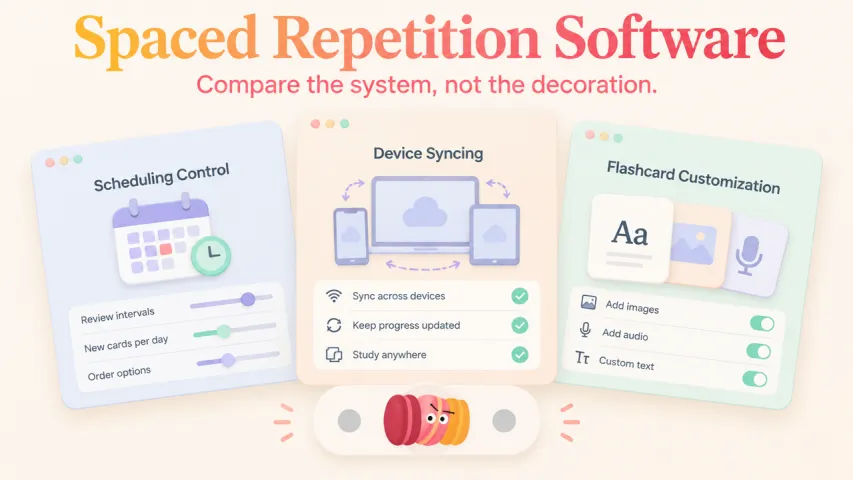
The IES practice guide recommends spaced learning and using tests or quizzes to identify material needing study within educational instruction. For interval decisions, use the spaced repetition guide.
If you use a personal AI such as Macaron, limit its role to learner-entered course, page topic, unresolved cue, last check, next date, and preferred review time. Confirm that the record can be retrieved; verify reminder availability before relying on notifications. Keep answers hidden during recall, and do not delegate note verification, grading, or mastery judgments to it. A paper calendar is a complete alternative. The illustration shows a conceptual planner, not a current product screen.

FAQ
Can Cornell notes be submitted as graded class assignments?
Follow the teacher's rubric, privacy rules, and accessibility accommodations. Ask whether layout, content, citations, and file type are assessed. A useful private study page is not automatically a compliant submission.
Can Cornell notes work for classes without traditional lectures?
Yes, for readings, discussions, labs, or project meetings with ideas worth questioning later. Keep diagrams or procedural steps intact in the main area; switch formats if columns hide relationships.
Can left-handed students reverse the cue and notes columns?
Yes. Reverse the columns or try a top-and-bottom arrangement while keeping cues distinct and answers easy to cover. This changes ergonomics, not the learning method. Assignment templates may still require a fixed layout.
Can Cornell notes preserve mathematical proofs without losing reasoning steps?
Keep every justification and dependency. Use cues for theorem choice, assumptions, or why a step is valid. If compression removes reasoning, retain a sequential proof page and use cues as an index.
Do screen readers navigate multi-column Cornell notes in order?
It depends on document structure and the app. Test heading, cue, note, and summary navigation in the actual exported format. If relationships become unclear, restructure the document using the reading-order principle above.
Conclusion
The cornell method of studying becomes useful when a page supports questions you can answer and check. Capture connected ideas, repair weak cues, and give each unresolved gap a concrete next action before scheduling another review.
Previous posts









Apply to become Macaron's first friends
Read & discover
AI Personal Assistant
Free calculators


