Personalize the Cruise Checklist by Ship and Shore Days
FAQ
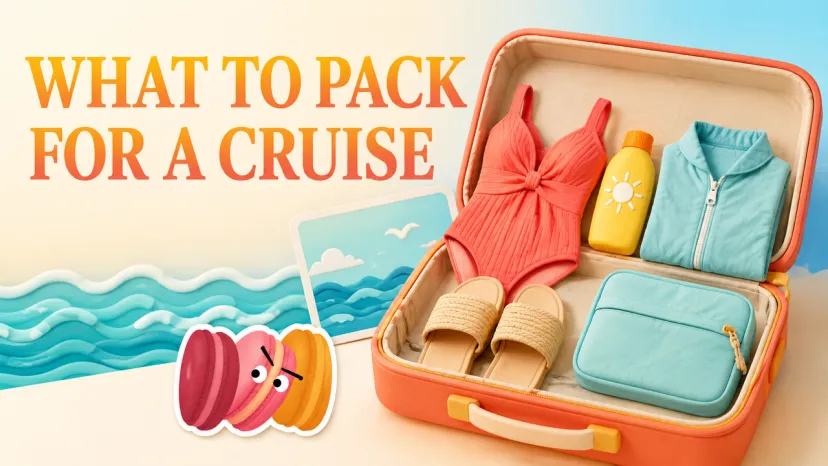
What to Pack for a Cruise
What to Pack for a Cruise
The line moves. Your checked bag is already gone, handed to a porter and rolling toward the ship in a cart you won't see again for hours. And the thing you suddenly want — sunscreen, your boarding pass, a swimsuit — is zipped inside it.
That gap is the whole reason what to pack for a cruise is its own packing problem, not a copy of "what to pack for a trip." A cruise splits your luggage into two bodies with two different jobs: the bag that disappears, and the bag that stays on your shoulder. Get the second one wrong and your first afternoon onboard is spent in jeans, waiting.
"Maren, why are you packing a swimsuit in your purse?" my sister asked at the terminal. Fair question — until 2 p.m. rolled around, the pool deck was open, our checked bags still hadn't arrived at the cabin, and she was the one not swimming. This piece is a list grouped the way a cruise actually unfolds: boarding day, clothes by situation, documents, the shore-day bag, and what to leave home. At the end, a way to adjust all of it to your specific ship.
Pack for Boarding Day First
Most packing guides start with clothes. On a cruise, start with the bag you carry on, because checked luggage can take several hours to reach your stateroom.
Carry-on bag
This is the bag that gets you through the first afternoon. Treat it as a survival kit, not an overflow bag.
Boarding documents and ID (more below)
A change of clothes and your swimsuit
Any medication you take daily
Phone, charger, a small power bank
A light layer for over-air-conditioned lounges
Medication and documents
Prescription medication never goes in checked luggage. If it's delayed or pulled for inspection, you don't want your pills inside it. Keep medication in original labeled containers, and pack a day or two extra in case the return is delayed.
First-day clothes and swimwear
Embarkation afternoon is usually warm and the pools open early. One swimsuit, one casual outfit, and sandals in the carry-on means you're using the ship while everyone else waits for their bags.
Cruise Clothing by Situation
Cruise clothing isn't about quantity — it's about matching the day's situations. Think in scenes, not in piles.
Daytime casual wear
Shorts, tees, sundresses, swimwear, a cover-up. Pack for the number of days, minus a couple, since you'll re-wear and the ship often has laundry.
Dinner and smart-casual outfits
Most evenings on most ships are "smart casual" — a collared shirt, a sundress, nice trousers. Nothing that needs an iron, since irons and steamers are banned in cabins on many lines (more in the next section).
Theme nights or formal nights
Some cruises have one or two dressier nights. Whether you need them, and how formal, depends entirely on your line and ship — don't assume. Pack one flexible dressy outfit only if your line confirms a formal night.
Weather and deck layers
Even on a warm itinerary, top decks get windy and evenings cool down. A light jacket or wrap covers it. For sun-heavy days, the UV protection clothing guidance from the CDC is worth a glance — tightly woven, longer-sleeve layers do more than a thin tee.
Documents, Money, and Cruise Admin
The paperwork is small and easy to underpack. It's also the part that can stop you at the terminal.
ID and confirmations
Bring the ID your cruise line requires (passport or the accepted alternative), your booking confirmation, and your completed online check-in / boarding pass. Keep these in your carry-on, not checked.
Payment setup
Most ships run cashless onboard, linked to a card at check-in. Set this up before you sail, and bring a little cash for porter tips and ashore.
Excursion details
Print or screenshot your excursion confirmations and meeting times. Ship Wi-Fi is unreliable and you don't want to hunt for a PDF as the group leaves.
Shore-Day Bag Essentials
Port days are their own packing job: a small bag you grab on the way off the ship.
Sun protection
You'll be off-ship for hours with no shade and no cabin to retreat to. The CDC sun safety tips for travelers recommend a broad-spectrum SPF of 30 or higher, reapplied every two hours and after swimming. Pair it with the FDA sunscreen advice on applying about a shot-glass amount and 15 minutes before you head out. A hat and sunglasses finish it.
Water and snacks where allowed
Some lines let you bring a limited number of sealed cans or cartons off and back on; others don't. Bring a refillable bottle for shore, and check your line's rule before assuming.
Comfortable walking items
Port days mean uneven cobblestones, long tender lines, and a lot of standing. Broken-in walking shoes beat new sandals every time.
What Not to Pack for a Cruise
Here's where I got it wrong once: I packed a travel steamer for "formal night." It got confiscated at the terminal, and I stood in the inspection line — the so-called naughty room — while everyone else boarded. Lesson learned.
Restricted items
Cruise lines confiscate fire-risk and safety items at security. On Carnival, that commonly includes steamers, clothes irons, surge protectors, extension cords, candles, Bluetooth speakers, and CBD/marijuana products. The Carnival banned items list is the source to check, since rules shift — Carnival recently tightened its language on speakers and wagons.
Things usually provided onboard
Hairdryers are usually in the cabin. Beach towels are typically provided. Soap and basic toiletries too. Leave the duplicates home.
Bulky just-in-case items
The "what if" pile is where overpacking lives. Alcohol is a good example — the Carnival alcohol policy allows one sealed bottle of wine or champagne per adult in carry-on, and bans the rest. Don't pack what gets taken away.
Personalize the Cruise Checklist by Ship and Shore Days
This is the part no generic list can do for you. Two cruises are never the same packing job.
Verify cruise line rules
Carnival, Royal Caribbean, Norwegian, and the rest each have their own banned items, dress codes, and alcohol limits. What's true for one isn't true for another. Check your specific line's official page before you pack, not a forum.
Adjust by itinerary and excursions
A Caribbean beach week and an Alaska glacier cruise need different bags. Let your ports and booked excursions — snorkeling, hiking, a fancy dinner ashore — drive the list.
Save a reusable cruise checklist
Build the list once, then keep it. Adjust the variable parts each trip: line rules, weather, formal nights, shore plans. This is exactly the kind of thing I keep as a small reusable template — same skeleton, swapped details — rather than rebuilding from scratch every time.
Who this works for, and who it doesn't: if you're a first or second-time cruiser who tends to overpack, the boarding-bag-first method saves your first afternoon. If you're a frequent cruiser on one line, you've likely got the rules memorized and just need the shore-day reminders. Either way, the list is a starting skeleton — your ship has the final say.
FAQ
What should I pack in my cruise carry-on?
Pack daily medication in original containers, since security can pull a checked bag for inspection and delay it further. This is the one bag that should never assume your suitcase will arrive on time.
Do I need formal clothes for a cruise?
Whether you need them depends on your ship's cruise dress code tiers, which range from "casual only" on some river and expedition sailings to two gala nights on traditional ocean liners. The detail most lists skip: many lines now rent or sell formalwear onboard, so you can skip the garment bag entirely and decide after boarding. First-time cruisers on a 3-night sailing usually find zero formal nights scheduled.
What should I pack for shore excursions?
A port day daypack works best when it's small enough to clear the gangway scanner without unpacking. Beyond sunscreen and water, bring a printed excursion voucher with the meeting point, because ship Wi-Fi often drops the moment you step ashore and group departures don't wait. Tender ports add a wrinkle: you may stand in a line for a small boat, so closed-toe shoes beat flip-flops there.
What items are usually not allowed on a cruise?
The cruise prohibited items that catch people off guard are rarely the obvious ones — it's heating pads, surge protectors, and CBD gummies, not knives. The reason is fire safety and U.S. federal drug law, which override state laws even if your home state permits cannabis. Frequent flyers get tripped up most, since plenty of these pass airport security fine but get confiscated dockside.
Where should I check my cruise line's latest packing rules?
Go straight to your line's official prohibited items page, then cross-check the brand ambassador updates that many lines post mid-year, since policies on wagons, speakers, and CBD shifted in 2026 without much warning. Anyone booked on a chartered or themed sailing should also check the charter operator's rules, which can add restrictions the cruise line itself doesn't list.
I’m Maren, a 27-year-old content strategist and perpetual self-experimenter. I test AI tools and micro-habits in real daily life, noting what breaks, what sticks, and what actually saves time. My approach isn’t about features—it’s about friction, adjustments, and honest results. I share insights from experiments that survive a real week, helping others see what works without the fluff.