What Everyday Users Actually Need from Personal AI
Why Flexibility Is Not the Same as Personalization
Decide Whether You Need to Build or Simply Use an Agent
Limits to Keep in Mind
FAQ
Conclusion
Previous Posts
What Is DeepSeek Harness—and Do Everyday Users Need It?
What Is DeepSeek Harness—and Do Everyday Users Need It?
The Short Answer for Everyday AI Users
If you are asking what is DeepSeek Harness, the shortest useful answer is this: DeepSeek describes it as an open-source agent harness for developers, not an out-of-the-box life assistant. It supplies pieces for assembling an AI agent while leaving setup and configuration to the builder.
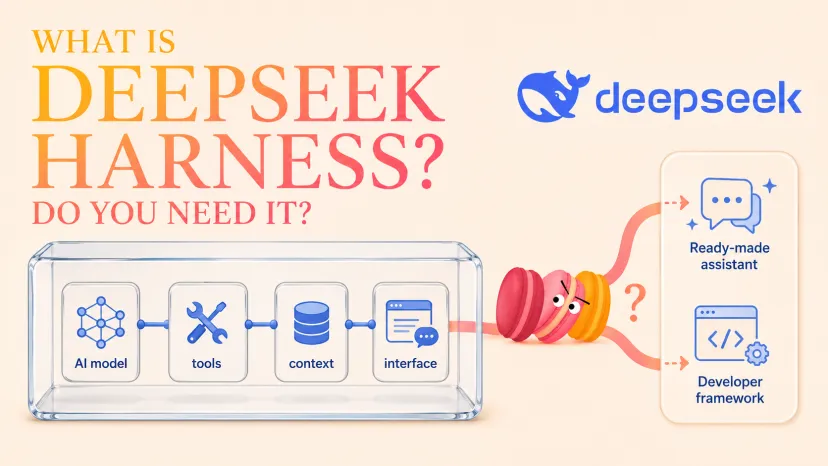
For everyday users, the real decision is “Do I want to build and maintain an agent, or use a ready-made personal AI?” Choose the first when configuration is part of the goal. Choose the second for practical help with plans, routines, and repeated decisions without owning the underlying system.
What DeepSeek Harness Is Without the Jargon
DeepSeek’s official repository calls DeepSeek Harness, or dsh, an open-source agent harness developed by DeepSeek AI. The project is in Developer Preview, and its README warns that rapid iteration will bring compatibility-breaking changes. Its code is covered by an MIT license.
An agent harness is the working environment around an AI model. It connects capabilities such as tools, sessions, storage, permissions, and an interface. DeepSeek’s architecture notes explain that these parts are plugins that builders can replace through configuration.
A Developer Runtime, Not a Ready-Made Life Assistant
DeepSeek’s public term is “agent harness,” not “developer runtime.” Here, runtime is shorthand for the environment that makes an agent operate. The official materials address people composing agent capabilities; they do not position Harness as a consumer assistant for households, routines, or personal goals.
Confirmed: official ownership, open-source status, MIT licensing, Developer Preview status, and plugin-based configurability.
Not confirmed: a hosted consumer app, a no-code path, consumer pricing, regional availability, or production readiness for ordinary users.
Why the Difference Matters to Ordinary Users
Building an Agent Requires Setup and Technical Choices
Flexibility transfers responsibility. A builder decides what the agent can access, how failures are handled, and when a human must approve an action. The builder also owns updates. DeepSeek’s quick start begins with installing software and running a command—a different experience from opening a finished assistant.
This does not mean a non-coder could never use DeepSeek Harness. It means the official project does not currently remove the setup question for them.
Using a Personal Agent Starts with a Life Problem
An everyday user starts with “Help me plan tomorrow,” “Remember my food constraints,” or “Help me compare these options next month.” The Personal AI agent guide covers the broader category. Here, the point is simpler: the user wants support, not a system-building project.
What Everyday Users Actually Need from Personal AI
Help with Plans, Routines, and Repeated Decisions
Daily usefulness often comes from repeatable jobs: ordering a scattered morning, keeping a routine visible, or remembering constraints behind a familiar choice. These tasks need low friction, clear outputs, and an easy way to correct the assistant—not maximum configurability.
Personal Context That Improves Support Over Time
Repeated support improves when relevant preferences, limits, and previous choices carry forward. But more data is not automatically better. A narrow set of user-provided details may be enough; connecting every app is not required for personalization.
Why Flexibility Is Not the Same as Personalization
Configurable Capabilities Change What an Agent Can Do
A harness lets a builder swap or add capabilities, changing the agent’s tools and behavior. It does not automatically teach the agent which details matter to one person or how to retain them.
Deep Memory Changes How Support Fits the Person
Memory is a separate design choice: what is stored, retrieved, corrected, and deleted. Macaron’s current personal AI assistant page describes Deep Memory as retaining user-provided preferences, experiences, and context for more relevant suggestions. That is life-first product positioning, not evidence that Macaron uses or integrates DeepSeek Harness.
In short, capability answers “What can this agent do?” Personal context answers “How should this support fit me?” A flexible runtime may support both, but flexibility alone does not create the second.
Decide Whether You Need to Build or Simply Use an Agent
Use this Build it / Use it path:
Decision point
Build it with a harness
Use a ready-made Personal AI
Problem
You want to assemble an agent system
You want help with a daily-life need
Responsibility
You own setup, permissions, updates, and failures
The product handles more of the operating layer
Customization
You want to configure or replace capabilities
You want useful defaults and simple preferences
Personal context
You design how context is stored and used
You evaluate the product’s memory controls
Smallest start
Test a narrow, reversible configuration
Try one bounded routine or repeated decision
Choose a Harness When You Want to Assemble the Runtime
DeepSeek Harness fits when assembling the operating environment is part of the goal. Be prepared to manage permissions, maintain the setup, and respond to preview-stage compatibility breaks. Its value is control over composition, not freedom from technical responsibility.
Choose a Ready-Made Personal AI When You Want Daily Support
A ready-made Personal AI fits when your priority is using support rather than engineering it. Check whether memory can be viewed or corrected, which actions need confirmation, and what happens to context if you leave. Lower setup burden does not prove better privacy, safety, or quality.
Limits to Keep in Mind
Developer Preview Changes and Setup Responsibility
Developer Preview means rapid change; the README explicitly warns about breaking compatibility. Treat that as an operating cost. Expect maintenance, and test permissions and failure handling before giving an agent meaningful access.
A Ready-Made Assistant Still Needs Clear Data Controls
A finished interface does not remove user responsibility. Check current documentation for retention, deletion, corrections, permissions, confirmations, and account separation. “Personal” does not mean private by default, and “ready-made” does not mean risk-free.
FAQ
Can families use a personal AI without sharing one profile?
Look for separate profiles, permissions, and data boundaries. Shared access can mix preferences, private notes, and histories. Do not assume a family mode exists unless current product documentation confirms it.
Does a ready-made personal AI require a local computer?
There is no category-wide answer. Some products use mobile or hosted services; others need desktop or local components. DeepSeek Harness’s quick start is software a developer runs, but that says nothing about every ready-made assistant. Check supported platforms.
Can an everyday user switch AI providers later?
Possibly, but provider switching and data portability differ. Check whether you can export context, conversations, tool definitions, and routines in usable formats. Confirm how integrations disconnect and retained data is deleted.
What should users check before trusting an AI with routines?
Review requested permissions, confirmation rules, visible history, correction controls, retention, and failure handling. Start with a low-stakes, reversible routine before granting broader access.
Can a personal AI remain useful without connecting every app?
Yes. A narrow routine can use details entered manually, such as a weekly schedule or food preferences. This may require more input but reduces unnecessary access. Add connections only when a specific benefit justifies them.
Conclusion
DeepSeek Harness is an open-source, Developer Preview agent harness for people who want to compose an agent environment. It is not officially presented as a ready-made life assistant. Everyday users need to choose between owning the build and owning only the life problem.
If setup, permissions, updates, and failures are part of your project, a harness fits. If the goal is help with plans, routines, and repeated decisions, a ready-made Personal AI is more direct—provided its memory and data controls meet your needs.
I’m Maren, a 27-year-old content strategist and perpetual self-experimenter. I test AI tools and micro-habits in real daily life, noting what breaks, what sticks, and what actually saves time. My approach isn’t about features—it’s about friction, adjustments, and honest results. I share insights from experiments that survive a real week, helping others see what works without the fluff.