Hiring Manager Interview Questions
Hiring manager interview questions usually move closer to the work than an initial recruiter screen. Practice how you make decisions, collaborate, learn, and reduce friction for the team. Give Macaron Generic answer bank beside Company predictions. Add the role or stage under Role-and-story practice; Deep Memory can keep that verified story context with Role-and-story practice for the next practice round. You can create a manager interview project from your own evidence.
What Hiring Managers Ask That Recruiters Don't
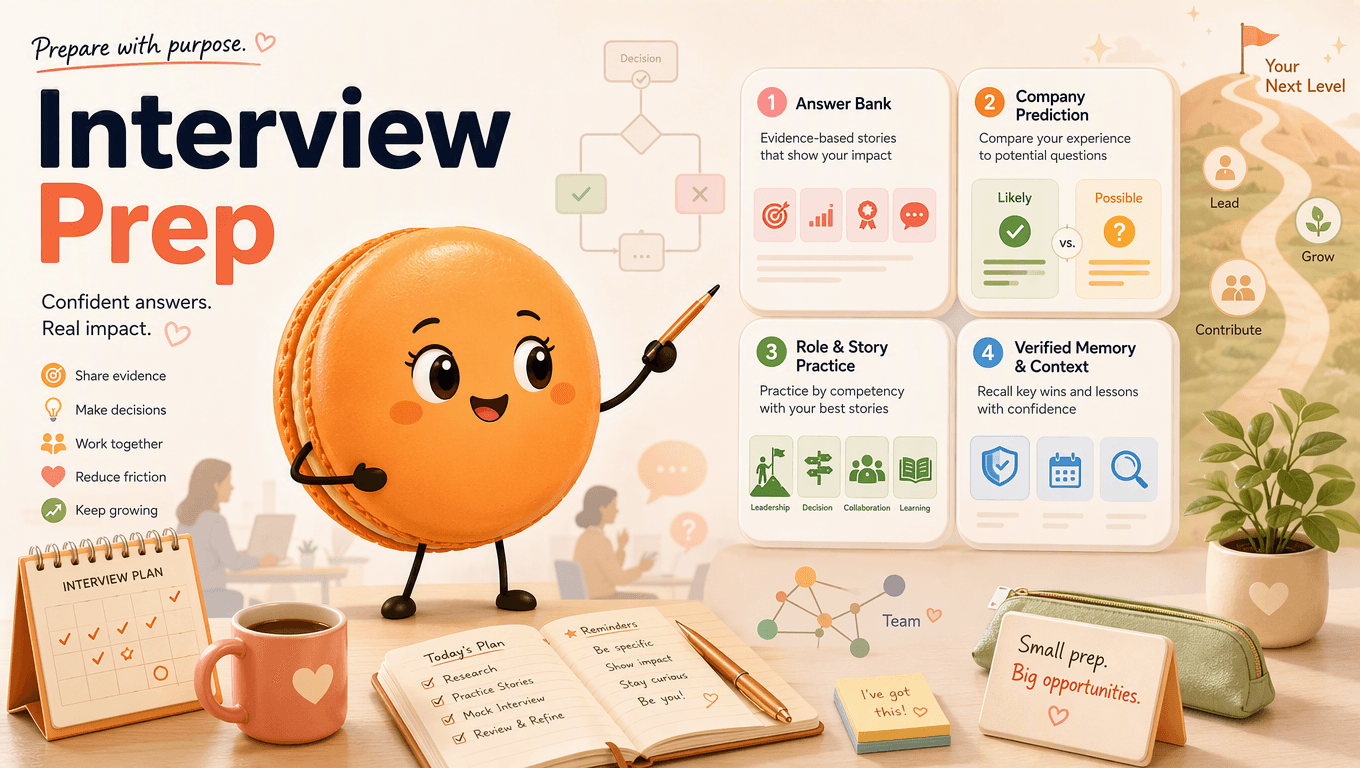
What Hiring Managers Ask That Recruiters Don't
A recruiter often checks broad fit and logistics. A hiring manager is more likely to probe the problems you would own, the standard for good work, and how you operate with their team. CareerOneStop interview guidance helps frame Generic answer bank for interview practice. Your own evidence still belongs under Role-and-story practice.
Macaron Preps You for the Decision-Maker's Questions
Enter the role, level, and experiences you can discuss. The worksheet builds decision-maker questions and prompts you to map each story to action and result. Begin with the situation and constraints: Key points:
- "Generate five manager-level questions for this role and level."
- "Map these projects to decisions, collaboration, and measurable outcomes."
Turn Generic answer bank into a practice prompt: Name the role under Generic answer bank and place one truthful experience beside Company predictions. Let Deep Memory retain only the context needed for Role-and-story practice. The component does not know a private hiring rubric. Review Generic answer bank before rehearsing, connect Company predictions to a real decision, and never treat Role-and-story practice as an outcome prediction.

Showing You'd Make Their Team's Life Easier
Strong answers show how your work changes a teammate's day: clearer decisions, fewer handoffs, faster learning, safer delivery, or better customer outcomes. Name your part without erasing collaborators. Key comparisons:
- Evidence or practice: Generic answer bank; Role relevance: Broad coverage; Next check: Easy to sound rehearsed
- Evidence or practice: Company predictions; Role relevance: Feels specific; Next check: Often based on weak evidence
- Evidence or practice: Role-and-story practice; Role relevance: Grounded in true work; Next check: Requires reflection
How to use the table: Ground Generic answer bank in a real experience, connect Company predictions to the role, and use Role-and-story practice as the next practice check.
The Questions That Tell a Manager You'll Actually Fit
Questions from the candidate reveal how they think about the role. Ask what distinguishes solid from excellent performance, which problem needs attention first, and how the manager gives feedback. Example: A candidate uses one launch story for prioritization and another for conflict. Each answer names the decision, personal action, result, and what they would change. A later update starts from Company predictions rather than rebuilding Role-and-story practice from memory.
Related next steps
structure behavioral examples, prepare the first phone screen, draft a post-interview note.
Frequently Asked Questions
No, Macaron cannot know exactly what a hiring manager will ask in a live interview. Use the role description, company context, and your own evidence to generate plausible manager-style prompts, then practice answering across decision-making, collaboration, learning, and team-fit scenarios.
Prepare a small, varied story bank rather than relying on one example for every question. Choose examples that show different strengths, such as handling ambiguity, influencing others, learning quickly, improving a process, or resolving friction, and refresh the context when your target role or interview stage changes.
No, manager interview answers should not sound like memorized scripts. Build each response around a clear situation, action, result, and reflection, then practice saying it in your own words so you can adapt when the question is phrased differently.
Ask the manager about team priorities, success measures, collaboration patterns, decision-making, and feedback expectations. Pick questions that help you understand the actual work and whether you can succeed in the environment, not just questions that sound impressive.
Read & discover
Explore Playbooks
AI Personal Assistant
Free calculators


